Arrangements (Permutations) (Leaving Cert Mathematics): Revision Notes
📚Revision Notes
Arrangements (Permutations)
What are arrangements (permutations)?
An arrangement or permutation refers to the different ways we can order or sequence a collection of distinct objects. When we change the order of objects, we create a new arrangement.
For example, if we have three letters A, B, and C, we can arrange them in these different ways:
Note
All possible arrangements of A, B, C:
- ABC, ACB, BAC, BCA, CAB, CBA
This gives us six different arrangements in total.
The box method
A helpful way to think about arrangements is using the box method. Imagine we have empty boxes representing positions, and we need to fill them with our objects.
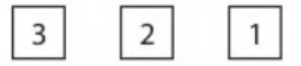
For three objects, we think about how many choices we have for each position:
Important
Box Method Logic:
- First box: 3 choices (any of the three objects)
- Second box: 2 choices (any of the remaining two objects)
- Third box: 1 choice (the last remaining object)
Therefore: different arrangements.
The factorial formula
Definition of factorial
We use factorial notation to represent these calculations. The symbol (read as "n factorial") means:
Example
Factorial Examples:
General rule for permutations
Important
Fundamental Permutation Rule:
The number of arrangements (permutations) of n different objects is
Worked example 1: Basic permutation
Example
Worked Example: Six-Digit Numbers
Question: How many different six-digit numbers can be formed from the digits 1, 2, 3, 4, 5, 6 using all the digits in each number?
Solution: The six digits can be arranged in ways.
Answer: 720 different numbers can be formed.
Permutations with restrictions
When we have restrictions (conditions that limit where certain objects can be placed), we use a modified approach:
Important
Key Strategy: Fill restriction boxes first
- Identify the restriction and fill those positions first
- Count the remaining objects and positions
- Fill the remaining boxes using the box method
Worked example 2: Single restriction
Example
Worked Example: TUESDAY Arrangements
Question: The letters of the word TUESDAY are arranged in a line. (i) How many different arrangements are possible? (ii) How many arrangements begin with T and end with a vowel?
Solution:
(i) There are 7 different letters in TUESDAY.
(ii) Using the box method for the restrictions:
- First box: 1 choice (must be T)
- Last box: 3 choices (vowels U, E, A)
- Remaining 5 boxes: Can be filled in ways
Worked example 3: Objects staying together
Example
Worked Example: Letters Staying Together
Question: In how many ways can the letters of the word NUMBERS be arranged if the letters M and B are always together?
Solution: When objects must stay together, we treat them as one unit.
(i) Total arrangements of NUMBERS =
(ii) If M and B must be together, treat MB as one unit:
- We now have 6 units to arrange: N, U, E, R, S, (MB)
- These 6 units can be arranged in ways
- Within the (MB) unit, M and B can be arranged in ways
Common exam tips
Note
Strategic Approaches for Success:
- Always identify restrictions first - deal with these before calculating remaining arrangements
- Use the box method - it provides a clear visual approach
- When objects must stay together, treat them as a single unit
- Don't forget internal arrangements - if grouped objects can be rearranged within their group
- Check your factorial calculations - these numbers grow very quickly
Remember!
Summary
Key Points to Remember:
- Permutations are arrangements where order matters
- n distinct objects can be arranged in n! different ways
- Use the box method - count choices for each position from left to right
- Handle restrictions first - fill restricted positions before calculating remaining arrangements
- Objects staying together should be treated as one unit, but don't forget internal arrangements within that unit