Estimating Probabilities from Experiments (Leaving Cert Mathematics): Revision Notes
📚Revision Notes
Estimating Probabilities from Experiments
Introduction to experimental probability
When we calculated probabilities earlier, we assumed all outcomes were equally likely to happen. However, in real-life situations, events are not always equally likely and we need another method to estimate the probability of an event occurring.
In such cases, we carry out an experiment or survey to estimate the probability of an event happening. This is called experimental probability.
Note
Experimental probability is particularly useful when dealing with real-world situations where we cannot assume equal likelihood of outcomes, such as weather patterns, consumer preferences, or manufacturing defects.
Understanding relative frequency
When we conduct experiments to estimate probability, we use a concept called relative frequency.
Relative frequency is the number of times an event occurs divided by the total number of trials. It gives us an estimate of the probability that the event will happen.
The relative frequency formula
Important
Essential Formula
This value provides an estimate of the probability that an event will occur by carrying out a survey or experiment.
The law of large numbers
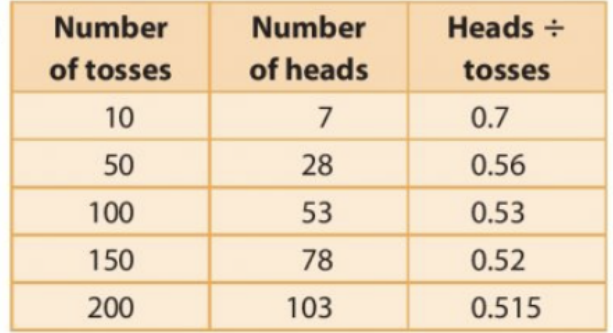
An important principle in probability is that as the number of trials or experiments increases, the value of the relative frequency gets closer to the true or theoretical probability.
Note
This table shows how a coin toss experiment demonstrates this principle. Notice how the ratio of heads approaches 0.5 (the theoretical probability) as more tosses are made. This convergence illustrates why larger sample sizes are always preferable in probability experiments.
Worked example 1: Car colour survey
Let's examine a practical example of experimental probability.
Derek collects data on the colours of cars passing the school gate. His results are shown below:
Example
Worked Example: Analysing Car Colour Data
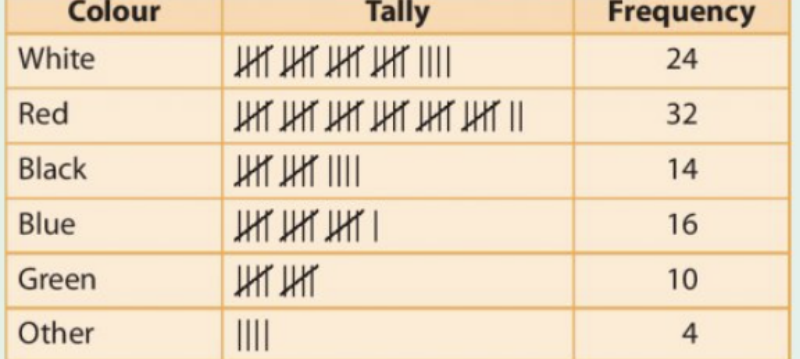
(i) Total cars surveyed = 24 + 32 + 14 + 16 + 10 + 4 = 100 cars
(ii) Relative frequency of blue cars =
(iii) Relative frequency of red cars =
(iv) Probability that next car will be green = relative frequency of green cars =
(v) The estimate for the probability of green cars can be made more reliable by increasing the sample size. Observing 500 cars would give a more accurate estimate of the true probability.
Expected frequency
Sometimes we need to predict how many times an event will occur in a given number of trials. This is called expected frequency.
Important
Expected Frequency Formula
Expected frequency = probability × number of trials
Example calculation
If the probability of getting a blue disc from a bag is , then in 50 draws, the expected number of blue discs is:
Worked example 2: Biassed dice
Example
Worked Example: Biassed Dice Probability
A biassed dice has the following probability distribution:
| Number | 1 | 2 | 3 | 4 | 5 | 6 |
|---|---|---|---|---|---|---|
| Probability | 0.1 | 0.1 | 0.2 | a | 0.2 | 0.3 |
Part (i): Finding the missing probability
Since the dice must land on one of the numbers 1 to 6, the sum of all probabilities equals 1:
Part (ii): Expected number of sixes
If the dice is thrown 300 times: Expected number of sixes = P(6) × number of trials = 0.3 × 300 = 90
Worked example 3: Spinner experiment results
Four friends test a spinner with different numbers of spins:
Example
Worked Example: Comparing Reliability of Results
| Name | Number of spins | Results | ||
|---|---|---|---|---|
| 0 | 1 | 2 | ||
| Alan | 30 | 12 | 12 | 6 |
| Keith | 100 | 31 | 49 | 20 |
| Bill | 300 | 99 | 133 | 68 |
| Ann | 150 | 45 | 73 | 32 |
Which results are most reliable?
Bill's results are most likely to give the best estimate because he conducted the most trials (300). According to the law of large numbers, more trials produce more reliable probability estimates.

Note
The spinner diagram shows a simple probability tool commonly used in experiments. When testing such devices, remember that the reliability of your probability estimates depends heavily on your sample size.
Key tips for exam success
Important
Critical Exam Points
- Always check that probabilities in a distribution add up to 1
- Larger sample sizes give more reliable estimates
- Relative frequency gives an estimate, not the exact probability
- Show all working when calculating expected frequencies
- Compare experimental and theoretical probabilities to identify bias
Common exam scenarios
Understanding these typical question types will help you prepare effectively:
- Identifying bias: Compare experimental results to expected theoretical outcomes
- Missing probabilities: Use the fact that probabilities sum to 1
- Expected frequency: Multiply probability by number of trials
- Sample size: Larger samples give more reliable estimates
Note
Practice identifying which type of question you're dealing with first. This will help you choose the correct approach and formula to apply.
Summary
Key Points to Remember:
- Relative frequency = Number of successful outcomes ÷ Total number of trials
- Expected frequency = Probability × Number of trials
- The sum of all probabilities in a complete distribution equals 1
- Larger sample sizes produce more reliable probability estimates
- Experimental probability approaches theoretical probability as trials increase