Expected Value (Leaving Cert Mathematics): Revision Notes
📚Revision Notes
Expected Value
What is expected value?
Expected value is a fundamental concept in probability that tells us the average outcome we can expect from a random experiment if it were repeated many times. It's like finding the long-run average of all possible results.
When you spin a wheel or roll a dice repeatedly, the expected value represents the average result you would get over a large number of attempts. This concept is crucial for understanding fairness in games and making informed decisions involving probability.
Note
Expected value is one of the most practical applications of probability theory. It helps us make sense of uncertain situations by providing a single number that summarises what we can expect on average. This makes it invaluable for decision-making in everything from games to business investments.
The formula for expected value
The expected value of an experiment is calculated using the formula:
Where:
- represents the expected value
- represents each possible outcome
- represents the probability of each outcome
- means "the sum of"
In simple terms: multiply each outcome by its probability, then add all the results together.
Step-by-step calculation method
Important
Essential Process for Calculating Expected Value:
To find the expected value:
- List all possible outcomes and their probabilities
- Multiply each outcome by its probability
- Add all these products together
- The sum is your expected value
This process is best shown using a probability table with three columns: Outcome, Probability, and Outcome × Probability.
Worked example 1: Basic spinner
Example
Worked Example: Basic Spinner Calculation
Consider a spinner divided into 3 sectors with values 10, 6, and 4.
| Outcome (x) | Probability P(x) | x × P(x) |
|---|---|---|
| 10 | 1/2 | 5 |
| 6 | 1/4 | 1.5 |
| 4 | 1/4 | 1 |
Step-by-step calculation:
Expected value =
Worked example 2: Casino game analysis
Example
Worked Example: Casino Game Profit Analysis
A spinning wheel game costs €8 to play. You win the amount shown where the arrow stops.
| Outcome (x) | Probability P(x) | x × P(x) |
|---|---|---|
| €10 | 1/2 | €5.00 |
| €5 | 1/4 | €1.25 |
| €4 | 1/4 | €1.00 |
Expected payout = €5.00 + €1.25 + €1.00 = €7.25
Since it costs €8 to play but the expected payout is only €7.25: Expected profit = €7.25 - €8.00 = -€0.75
This means you can expect to lose €0.75 on average for each game you play.
Worked example 3: Six-sector wheel
Example
Worked Example: Six-Sector Wheel Analysis
A wheel is divided into 6 equal sectors. You pay €8 to spin and win the amount shown.
| Payout (x) | Probability P(x) | Payout × Probability |
|---|---|---|
| €0 | 2/6 | €0 |
| €6 | 2/6 | €2 |
| €12 | 1/6 | €2 |
| €15 | 1/6 | €2.50 |
Expected payout = €0 + €2 + €2 + €2.50 = €6.50
Since you pay €8 to play: Expected result = €6.50 - €8.00 = -€1.50
You can expect to lose €1.50 per game on average.
Fair games and expected value
Understanding whether a game is fair is one of the most practical applications of expected value. The concept of fairness in probability is mathematically precise and helps us make informed decisions about participating in games or investments.
Important
Game Fairness Based on Expected Value:
A game is considered fair based on its expected value:
- Fair game: Expected payout = 0 (you break even)
- Favourable game: Expected payout > 0 (you win in the long run)
- Unfavourable game: Expected payout < 0 (you lose in the long run)
Most casino games are designed to be unfavourable to players, ensuring the house makes a profit over time.
Important properties of expected value
The law of large numbers
Note
The Law of Large Numbers
When an experiment is repeated many times, the actual average outcome approaches the expected value. This is called the law of large numbers.
This principle explains why casinos are profitable despite individual players sometimes winning big - over thousands of games, the results will approach the expected value, which favours the house.
Expected value doesn't have to be possible
The expected value doesn't need to be one of the actual outcomes. This is a common source of confusion for students, but it's perfectly normal in probability theory.
Note
Expected Value Example: Fair Dice
For example, if you roll a fair six-sided dice:
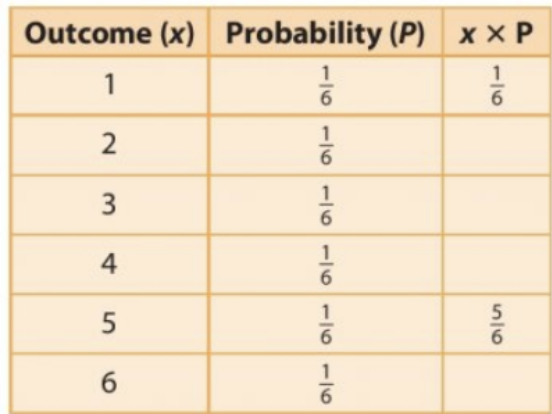
The expected value is 3.5, even though you can never actually roll 3.5 on a dice. This represents the average of all possible outcomes when weighted by their probabilities.
Applications in real life
Expected value is widely used in:
- Insurance industry - calculating premiums and payouts
- Casino operations - ensuring games are profitable
- Investment decisions - comparing potential returns
- Quality control - predicting defect rates
Summary
Key Points to Remember:
- Expected value = multiply each outcome by its probability, then add all results
- Formula:
- Fair games have an expected value of zero
- The expected value doesn't have to be a possible outcome
- The law of large numbers means actual results approach expected value over many trials
Summary
Exam Tips:
- Always set up a clear table with three columns: Outcome, Probability, and Outcome × Probability
- Check that all probabilities add up to 1
- Show your working clearly for each multiplication
- Remember to subtract the cost of playing when calculating expected profit/loss
- Use the expected value to determine if a game is fair or not