Two Events – Use of Sample Spaces (Leaving Cert Mathematics): Revision Notes
📚Revision Notes
Two Events – Use of Sample Spaces
What is a sample space?
When we conduct probability experiments involving two events, we need to organise all the possible outcomes systematically. A sample space is the complete collection of all possible outcomes that can occur in an experiment.
For example, when we toss two coins, each coin can show either heads (H) or tails (T). The sample space contains every possible combination:
Sample space = {HH, HT, TH, TT}

This gives us four equally likely outcomes, which forms the foundation for calculating probabilities involving two events.
Note
The key insight is that by listing ALL possible outcomes first, we ensure we don't miss any when calculating probabilities. This systematic approach is what makes sample spaces so powerful.
Using sample spaces to calculate probabilities
Once we have identified our sample space, calculating probabilities becomes straightforward. We count the favourable outcomes and divide by the total number of outcomes.
From our two-coin example:
- P(two heads) = P(HH) =
- P(one head and one tail) = P(HT or TH) =
The sample space ensures we consider every possibility and avoid missing any outcomes.
Sample space tables for complex experiments
When experiments involve multiple events with many outcomes, we use sample space tables to organise the information systematically. This table method prevents us from accidentally missing outcomes.

Consider tossing a coin and rolling a die simultaneously. The coin has 2 outcomes (H, T) and the die has 6 outcomes (1, 2, 3, 4, 5, 6).
Our sample space table shows all 12 possible combinations: (H,1), (H,2), (H,3), (H,4), (H,5), (H,6), (T,1), (T,2), (T,3), (T,4), (T,5), (T,6).
Note
For two independent events, the total number of outcomes equals the product of individual outcomes. So coin (2 outcomes) × die (6 outcomes) = 12 total outcomes.
Worked example: Two dice
Example
Worked Example: Finding Probabilities with Two Dice
When we throw two dice and add their scores, we need to create a systematic sample space to find probabilities accurately.
Setting up the sample space:
| Die 1 \ Die 2 | 1 | 2 | 3 | 4 | 5 | 6 |
|---|---|---|---|---|---|---|
| 1 | 2 | 3 | 4 | 5 | 6 | 7 |
| 2 | 3 | 4 | 5 | 6 | 7 | 8 |
| 3 | 4 | 5 | 6 | 7 | 8 | 9 |
| 4 | 5 | 6 | 7 | 8 | 9 | 10 |
| 5 | 6 | 7 | 8 | 9 | 10 | 11 |
| 6 | 7 | 8 | 9 | 10 | 11 | 12 |
Total outcomes: 36 (since 6 × 6 = 36)
Calculating specific probabilities:
-
P(total = 7): Count the 7s in the table
- There are 6 ways to get 7: (1,6), (2,5), (3,4), (4,3), (5,2), (6,1)
- P(7) =
-
P(total ≤ 4): Count totals of 4 or less
- Outcomes: 2, 3, 3, 4, 4, 4 (6 outcomes)
- P(4 or less) =
-
P(total ≥ 11): Count totals of 11 or more
- Outcomes: 11, 11, 12 (3 outcomes)
- P(11 or more) =
Worked example: Contingency tables
Example
Worked Example: Using Contingency Tables
Sometimes we use contingency tables to represent sample spaces with categorised data.
| Red | Blue | Total | |
|---|---|---|---|
| 1 | 12 | 8 | 20 |
| 2 | 8 | 22 | 30 |
| Total | 20 | 30 | 50 |
From this table with 50 total outcomes:
- P(Red) =
- P(Blue and 1) =
- P(1) =
Common exam scenarios
Understanding how sample spaces apply to different probability scenarios will help you tackle various exam questions confidently.
Spinning wheels and chance devices:

When dealing with spinners divided into equal sections, each section has equal probability.
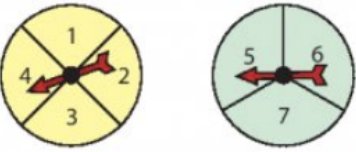
For two spinners used together, multiply the number of sections to find the total outcomes in the sample space.
Drawing from containers:

When drawing objects from bags or containers, list all possible combinations systematically using the sample space approach.
Note
Whether dealing with spinners, dice, cards, or drawing from containers, the fundamental principle remains the same: create a complete sample space first, then count favourable outcomes.
Important
Common Mistakes to Avoid:
- Don't rush into calculations without first establishing the complete sample space
- Watch out for experiments that aren't equally likely - make sure you understand whether all outcomes have the same probability
- Always double-check that your sample space includes ALL possible outcomes
- Be careful when counting - it's easy to miss outcomes or count some twice
Exam tips
Important
Essential Exam Strategies:
- Always write out the complete sample space - this prevents errors and shows your method clearly
- Use tables for complex experiments - they help organise information and reduce mistakes
- Count carefully - double-check your counting of favourable outcomes
- Check your total - ensure your sample space includes all possible outcomes
- Simplify fractions - always express probability in its simplest form
Summary
Key Points to Remember:
- A sample space contains every possible outcome of an experiment
- For two independent events, the total number of outcomes equals the product of individual outcomes
- Sample space tables help organise complex experiments systematically
- Probability =
- Always list outcomes systematically to avoid missing any possibilities
The sample space method is your foundation for solving two-event probability problems - master this systematic approach and you'll handle even complex probability questions with confidence.