Set Theory and Probability (Leaving Cert Mathematics): Revision Notes
📚Revision Notes
Set Theory and Probability
Overview
Set theory and probability are foundational concepts in statistics that help analyse collections of items and their likelihood of occurrence in different situations.
Set Theory Basics
A set is a collection of distinct objects, which could be numbers, people, or events.
Key terms in set theory include:
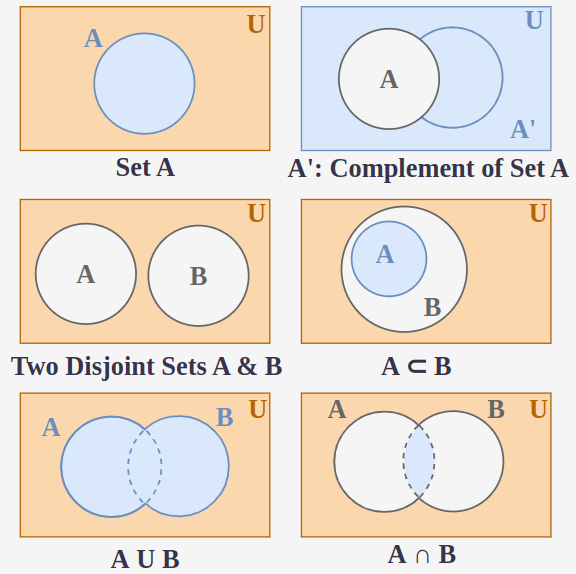
- Universal Set (): The set of all possible elements in a context.
- Subset (): A set is a subset of if all elements of are also in
- Union (): Combines all elements from sets and .
- Intersection (): Includes elements common to both and
- Complement (): The set of all elements in not in
- Disjoint Sets: Sets with no elements in common ()
Set Theory Diagram
Probability Basics
Probability measures the likelihood of an event occurring. It is represented on a scale from 0 (impossible) to 1 (certain).
- Sample Space (): The set of all possible outcomes.
- Event: A subset of the sample space.
- Probability Formula: For equally likely outcomes, the probability of an event is:
Rules of Probability
Addition Rule:
For events and :
If and are disjoint:
Multiplication Rule:
For independent events and :
Worked Examples
Note
Example 1: Rolling a Die
Problem: What is the probability of rolling a 4 or a 6 with a fair six-sided die?
Solution:
Step 1: Define : rolling a 4, and : rolling a 6.
Step 2: Sample space .
Step 3: Using the addition rule for disjoint events:
Answer: The probability is
Note
Example 2: Tossing Two Coins
Problem: What is the probability of getting at least one head when tossing two coins?
Solution:
Step 1: Define : at least one head.
Step 2: Sample space () .
Step 3: Complement of .
Step 4: Calculate :
Step 5: Use the complement rule:
Answer: The probability is .
Summary
- Set Theory Terms: Union (), Intersection (), Complement (), and Disjoint Sets.
- Probability Rules:
- Addition Rule:
- Multiplication Rule: (for independent events).
- Key Formula: