Psychological Preparation (Leaving Cert Physical Education): Revision Notes
📚Revision Notes
Psychological Preparation
Sports Psychology
Note
Sports psychology: the study of how psychology influences sport, athletic performance, exercise and physical activity.
Note
Psychological Preparation: The mental preparation of an athlete before, during, and after competition in order to achieve optimum performance.

Factors that psychological preparation include:
- Confidence
- Self-efficacy
- Motivation
- Concentration
- Feedback
1. Confidence
Note
Confidence: an athlete's belief in their own ability to carry out a specific task to achieve an intended outcome.
Strategies to Improve Confidence:
- Think confidently: Confidence is a belief-coaches and athletes should focus on generating confident thoughts. e.g. an athlete repeating the mantra "I am prepared and capable" before a competition to reinforce positive thinking.
- Identify sources of confidence: Understand the factors that contribute to an athlete's confidence and develop strategies to enhance these areas e.g. A coach helping an athlete reflect on past successful performances to boost their confidence before a major event.
2. Self-efficacy
Note
Self-efficacy: an individuals self-belief that enables them to perform better.
When confidence is specific to a particular situation, it is referred to as state confidence or self-efficacy.
Bandura's model of self-efficacy
- Albert Bandura modelled the factors that affect self-efficacy (self-confidence) in sports performers.
- People with high levels of self-efficacy are more likely to pursue challenging goals, cope with pain and keep trying despite setbacks.
- Bandura's model implies that techniques used by coaches and performers to improve performance work because they affect self-efficacy. Self-efficacy can be improved by:
- Enactive mastery (performance outcomes): Gaining relevant experience by practising and performing a skill, task, etc.
- Vicarious experience (role-modelling): Learn and increase confidence by watching someone else successfully perform the task.
- Verbal persuasion (encouragement): Motivation through verbal encouragement-internal and external feedback.
- Physiological arousal (emotional state): Getting 'psyched up' or emotionally aroused to complete the task/skill. It can have negative impact on performance if emotions run too high.
3. Motivation
Note
Motivation is the level of enthusiasm or desire to train or compete at something.
Intrinsic motivation is motivation from within an individual e.g. personal satisfaction when completing a race.
Extrinsic motivation comes from a source outside the performer e.g. financial gain, trophies, praise, recognition.
Strategies to Enhance Motivation:
- Create a positive training environment.
- Effectively communicate with athletes.
- Focus on enjoyment levels.
- Be positive and supportive.
- Use goal setting to improve mental preparedness.
4. Concentration
Note
Concentration is the ability to focus on the task at hand, excluding irrelevant stimuli.
Strategies to Enhance Concentration:
- Focus attention: Identify key factors to focus on.
- A basketball player focusing on the sound of the ball bouncing and their breathing to stay present during a free throw.
- Thought stopping and centring: Develop skills to handle negative thoughts and maintain focus.
- A tennis player using a specific phrase to interrupt negative thoughts and then taking a deep breath to re-centre before serving.
5. Feedback
- Intrinsic feedback: Immediate feedback received through kinaesthetic feel and sensory perceptions.
- A weightlifter adjusting their grip to improve their lift.
- Extrinsic feedback: Feedback provided by coaches, often after evaluating an athlete's performance.
- Praising a runner for their effort while also suggesting improvements in technique. Guidelines for providing feedback:
- Provide feedback as soon as possible.
- Combine motivational and instructional feedback.
- Offer specific and precise information for improvement.
Anxiety
Note
Anxiety is a state of nervousness, worry or unease. It can can affect an athlete's performance.

Anxiety can develop in different circumstances:
- State anxiety is a temporary emotional state that occurs only in certain situations e.g. pre-game nerves fade with the start of the match.
- Trait anxiety is part of a person's personality, so exists in all parts of their life - social, work, school, and personal. A performer can experience anxiety in two different forms:
- Cognitive anxiety is the mental state of the performer. It involves their thoughts, expectations, worries and concerns about themself or their performance e.g. an athlete doubting their abilities and fearing failure before a match.
- Somatic anxiety affects the body physically. It involves physical symptoms such as increased heart rate and muscle tension e.g. an athlete experiencing a racing heart and sweaty palms before a race.
Note
Catastrophe theory: explains how performance can decline dramatically when cognitive anxiety and physiological arousal are both high. This theory highlights the importance of managing anxiety and arousal to avoid sudden drops in performance
Symptoms of Anxiety
- Physical: sweating, dry mouth, and muscle tension.
- Mental: confusion, negative thoughts, and difficulty concentrating. These symptoms can disrupt an athlete's focus and decision-making during competition.
- Behavioural: can manifest as nail-biting, lethargy, and restlessness. These are often outward signs of internal stress and can affect an athlete's preparation and performance.
Strategies to Manage Anxiety
- Cognitive restructuring
- Relaxation techniques
- Pre-performance routines
- Visualisation
1. Cognitive restructuring
Cognitive restructuring: Replace negative thoughts with positive ones. This technique helps athletes challenge and change unhelpful thoughts that can lead to anxiety.
Example: A tennis player who often thinks, "I'm going to miss this shot," can restructure this thought to, "I have practised this shot many times and can execute it well."
2. Relaxation techniques
Practising deep breathing and progressive muscle relaxation helps to reduce physical symptoms of anxiety and promote a state of calm.
Example: A swimmer practising deep breathing exercises before a race to slow their heart rate and calm their nerves. They may also use progressive muscle relaxation to release tension from their muscles.
Note
Progressive muscle relaxation: This involves the deliberate contraction of muscles followed by a greater relaxation.
Note
Breathing control helps performers to breathe slowly and steadily, and deeper, from the diaphragm. This deep breathing reduces anxiety, controls arousal and aids concentration. 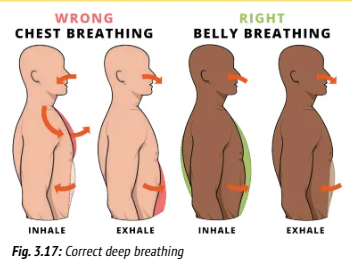
3. Pre-performance routines
Establish consistent routines to enhance focus and control. Pre-performance routines create a sense of familiarity and predictability, which can help reduce anxiety.
Example: A basketball player following a specific warm-up routine before every game, including stretches, shooting drills, and listening to a particular playlist to get into the right mindset.
Note
A pre-performance ritual is any type of routine or habit a performer, athlete or professional does to enhance their performance. It helps them to get into the right mindset and to combat anxiety.
4. Visualisation
Note
Visualisation, or imagery, is a technique in which the performer imagines or visualises themselves being successful in their performance using all five senses.
Athletes can use imagery to mentally rehearse and prepare for competition.
Example: A gymnast visualising their entire routine, seeing themselves executing each move flawlessly and sticking the landing, which helps build confidence and reduce performance anxiety.
Arousal
Note
Arousal is a state of physical and mental readiness.
Note
Arousal is a state of alertness and readiness, which can affect performance. The relationship between arousal and performance is often described by the Inverted-U Theory, which suggests there is an optimal level of arousal for peak performance.
Arousal moves from low state to high state on a continuum:

Arousal can
- Increase muscle tension
- Affect a performer's attention
- Affect a performer's coordination
Note
The inverted-U theory proposes that performers need to be in a zone of optimal arousal to perform at their best. It suggests that sporting performance improves as arousal levels increase, but that there is a threshold point. Any increase in arousal beyond the threshold point will worsen performance. 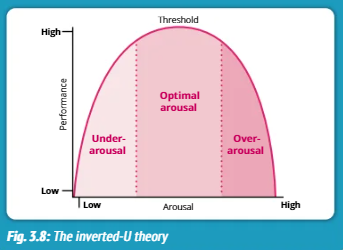
Optimal arousal: Understanding and maintaining an optimal level of arousal to maximise performance involves finding the right balance between being too relaxed and too anxious. At medium arousal levels, sporting performance peaks.
Strategies to Enhance Psychological Factors
Understanding and implementing strategies to enhance psychological factors is crucial for athletes to maintain peak performance levels, manage stress, and improve overall mental resilience in sports.
- Positive self-talk
- Visualisation
- Simulation Training
- Mental rehearsal
- Pre-performance routine
- Goal setting
1. Positive self-talk
Note
Positive self-talk applies positive encouragement (I can, I will) followed by positive reinforcement.
A performer should:
- Use positive self-talk to maintain self-confidence
- Use self-talk to regulate thoughts, feelings and behaviours during competition.
2. Visualisation
Note
Visualisation, or imagery, is a technique in which the performer imagines or visualises themselves being successful in their performance using all five senses.
3. Simulation training
Note
Simulation training: replicating competitive conditions in training to build confidence and reduce anxiety. By practising under similar conditions to the actual competitions, athletes can become more accustomed to the pressures they will face.
Example*:* A swimmer practising with simulated crowd noise to get used to the environment they will face during a competition. This can improve focus during the actual event.
4. Mental rehearsal
Note
Mental rehearsal is a technique in which the performer imagines or visualises themselves being successful in their performance.
Mental rehearsal allows performers to:
- Prepare for competition by imagining themselves performing well in competition.
- Reinforce muscle memory.
- Mentally rehearse during competition to prepare for action and recover from errors.
- Create and use mental images that are detailed, specific, and realistic using each of the five senses.
5. Pre-performance routine
Note
A pre-performance routine is any type of routine or habit a performer, athlete or professional does to enhance their performance. It helps them to get into the right mindset and to combat anxiety.
Going through a series of familiar actions that do not require thought can help to quiet the mind and enhance focus.
Pre-performance rituals can:
- Improve concentration by focusing thought on task-based cues.
- Help performers to overcome a natural tendency to dwell on negatives
6. Goal setting
Setting SMART goals to maintain motivation and focus. Goal setting provides clear objectives and a roadmap for achieving them, which helps keep athletes motivated.
Note
SMART goals:
Specific
Measurable
Achievable
Relevant
Time-bound
Designing a Personal Action Plan for Psychological Readiness
Creating a personal action plan for psychological readiness is essential for athletes to systematically address and strengthen mental preparedness, ensuring they are mentally equipped to handle the demands of competition and training.
The following steps are used to design a personal action plan:
- Identify psychological factors: assess key psychological factors impacting the athlete's performance, such as confidence, motivation, and anxiety.
- Set smart goals: establish specific, measurable, achievable, relevant, and time-bound goals to address identified factors.
- Develop strategies: implement strategies such as visualisation, simulation training, and pre-performance routines tailored to the athlete's needs.
- Monitor and adjust: continuously evaluate the effectiveness of the action plan and make necessary adjustments to optimise psychological readiness.