Basic Units, Derived Units, and Scientific Notation (Leaving Cert Physics): Revision Notes
📚Revision Notes
Basic Units, Derived Units, and Scientific Notation
Basic (fundamental) units
In physics, we need a standardised system to measure different quantities accurately and consistently. The International System of Units (SI) provides us with seven basic units, also called fundamental units, that serve as the foundation for all other measurements.
These basic units were carefully chosen because they can be precisely defined and measured independently of each other. Each basic unit measures a fundamental physical quantity that cannot be expressed in terms of other quantities.
Note
The SI system was established to ensure that scientists worldwide could communicate measurements accurately and consistently. These seven base units form the foundation because they represent the most fundamental properties we can measure in nature.
The five most commonly used basic units in Leaving Certificate Physics are:
- Length: measured in metres (m)
- Time: measured in seconds (s)
- Mass: measured in kilogrammes (kg)
- Electric current: measured in amperes (A)
- Temperature: measured in kelvin (K)
Understanding these basic units is crucial because all other physical quantities can be expressed using combinations of these fundamental measurements.
Derived units
A derived unit is formed when we combine two or more basic units through multiplication or division. These units measure quantities that depend on the basic physical properties.
The beauty of derived units is that they can be expressed as mathematical relationships between basic units. For example, speed depends on both distance and time, so its unit (metres per second) combines the basic units of length and time.
Finding derived units through calculation
When solving physics problems, you often need to determine what unit a derived quantity should have. Here's the process:
Example
Worked Example: Finding the Unit of Volume
Step 1: Identify the formula or relationship Volume = length × breadth × height
Step 2: Substitute the basic units into the formula Units: m × m × m
Step 3: Perform the mathematical operations on the units m × m × m = m³
Step 4: Simplify to find the final derived unit Therefore, volume is measured in cubic metres (m³)
Common derived units with special names
Many derived units are used so frequently that they have been given special names to honour famous scientists. These make calculations easier and help us recognise important physical quantities quickly.
Some key examples include:
- Force: measured in newtons (N), where 1 N = 1 kg⋅m⋅s⁻²
- Energy: measured in joules (J), where 1 J = 1 kg⋅m²⋅s⁻²
- Power: measured in watts (W), where 1 W = 1 kg⋅m²⋅s⁻³
- Pressure: measured in pascals (Pa), where 1 Pa = 1 kg⋅m⁻¹⋅s⁻²
Multiples and fractions of standard units
In physics, we often encounter quantities that are either extremely large or extremely small. Rather than writing out many zeros, we use metric prefixes to express these values more conveniently.
Understanding metric prefixes
Each prefix represents a specific power of 10, making conversions straightforward:
Large quantities (positive powers of 10):
- Kilo (k) = = 1,000
- Mega (M) = = 1,000,000
- Giga (G) = = 1,000,000,000
- Tera (T) = = 1,000,000,000,000
Small quantities (negative powers of 10):
- Centi (c) = = 0.01
- Milli (m) = = 0.001
- Micro (μ) = = 0.000001
- Nano (n) = = 0.000000001
- Pico (p) = = 0.000000000001
Converting between units
Important
When converting between different metric units, remember:
- Moving to a larger unit means dividing by the conversion factor
- Moving to a smaller unit means multiplying by the conversion factor
This is a common source of errors in physics calculations, so always double-check your conversions!
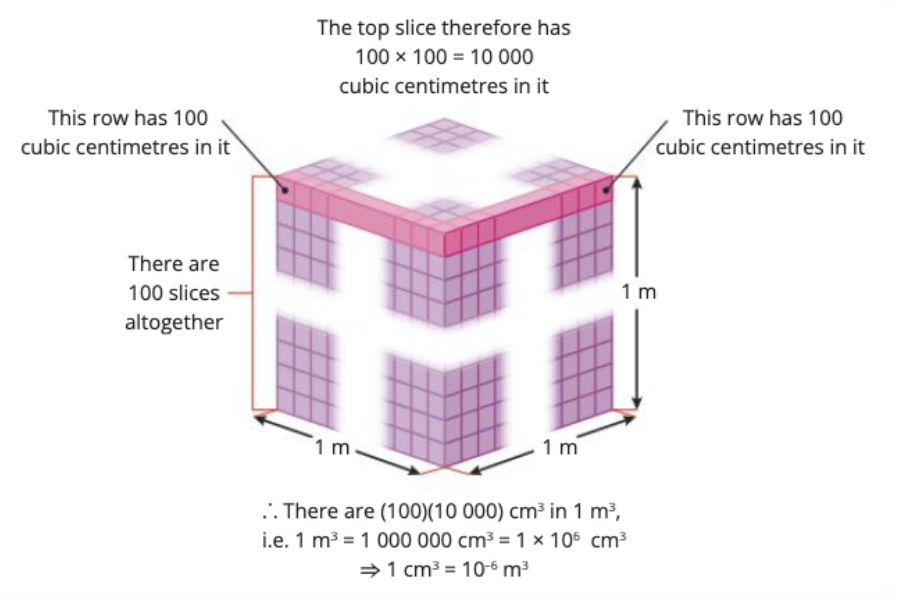
For example: 1 m³ = 1,000,000 cm³ (or cm³)
Scientific notation
Scientific notation is a method for expressing very large or very small numbers in a compact, standardised form. This is particularly useful in physics where we deal with quantities ranging from subatomic particles to astronomical distances.
The format of scientific notation
Any number in scientific notation is written as:
Where:
- a is a number between 1 and 10 ()
- n is an integer (positive, negative, or zero)
Converting to scientific notation
For large numbers (n is positive):
Example
Worked Example: Converting Large Numbers
Convert 3000 to scientific notation:
Step 1: Move the decimal point to the left until only one non-zero digit remains before it 3000 → 3.000
Step 2: Count how many places you moved - this becomes your positive exponent Moved 3 places to the left, so n = +3
Step 3: Write in scientific notation 3000 =
For small numbers (n is negative):
Example
Worked Example: Converting Small Numbers
Convert 0.0001 to scientific notation:
Step 1: Move the decimal point to the right until the first non-zero digit is just after the decimal point 0.0001 → 1.000
Step 2: Count how many places you moved - this becomes your negative exponent Moved 4 places to the right, so n = -4
Step 3: Write in scientific notation 0.0001 =
Order of magnitude estimates
An order of magnitude refers to the power of 10 in scientific notation. This helps us make quick estimates and compare the relative sizes of different quantities.
Note
For rough calculations:
- Convert numbers to scientific notation
- Round the coefficient to the nearest whole number
- Multiply the powers of 10
- Compare with the exact answer to check reasonableness
This technique is invaluable for checking whether your detailed calculations are in the right ballpark!
Significant figures
Significant figures represent the precision of a measurement. They tell us how accurately a quantity has been measured and help us express our confidence in experimental results.
Rules for identifying significant figures
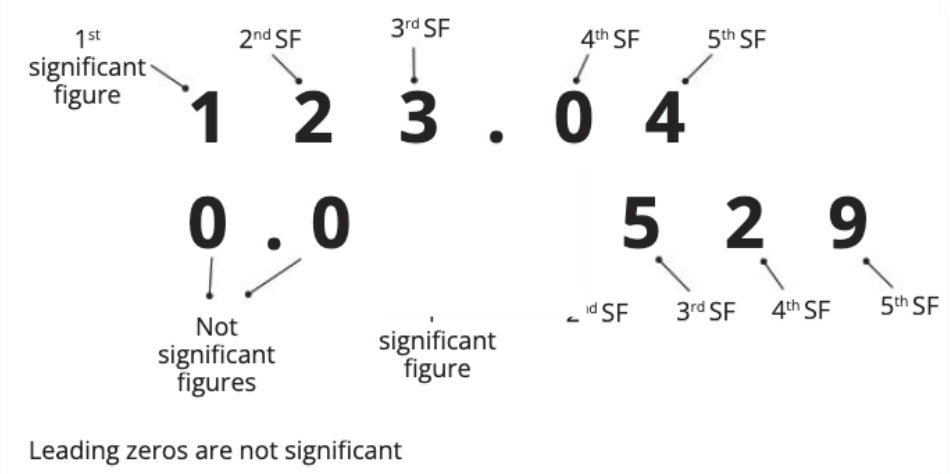
Important
Critical Rules for Significant Figures:
-
All non-zero digits are significant
- Example: 123.4 has 4 significant figures
-
Leading zeros are NOT significant
- They're just placeholders
- Example: 0.00234 has 3 significant figures (2, 3, 4)
-
Zeros between non-zero digits ARE significant
- Example: 1002 has 4 significant figures
-
Trailing zeros in decimal numbers ARE significant
- Example: 12.30 has 4 significant figures
-
Trailing zeros in whole numbers without a decimal point are ambiguous
- Example: 1200 could have 2, 3, or 4 significant figures
Calculations with significant figures
When performing calculations with measured quantities, the result should reflect the precision of the least precise measurement.
- Addition and subtraction: Round to the same number of decimal places as the measurement with the fewest decimal places
- Multiplication and division: Round to the same number of significant figures as the measurement with the fewest significant figures
Why significant figures matter
Note
Significant figures help us:
- Express the uncertainty in measurements
- Avoid false precision in calculations
- Communicate the reliability of experimental data
- Make meaningful comparisons between different measurements
When you write down a measurement, you're telling others how precisely you measured that quantity. Using the correct number of significant figures shows good scientific practice and honest reporting of experimental results.
Summary
Key Points to Remember:
-
Basic units are the seven fundamental SI units that measure independent physical quantities like length (metres), time (seconds), and mass (kilogrammes)
-
Derived units are formed by combining basic units through multiplication or division, such as speed (m/s) or force (kg⋅m⋅s⁻²)
-
Scientific notation () provides a compact way to express very large or small numbers, where 'a' is between 1 and 10
-
Significant figures indicate the precision of measurements - leading zeros don't count, but all other digits following the rules do count
-
Always match your final answer's precision to the least precise measurement in your calculation to maintain scientific accuracy