Measurement and Units (Leaving Cert Physics): Revision Notes
📚Revision Notes
Measurement and Units
Understanding measurement is fundamental to physics. Every investigation you conduct in physics will involve taking measurements, making this topic essential for your success in the subject.
Physical quantities
In physics, we study matter, energy, and how they interact with each other. Everything we observe and investigate involves measuring different properties.
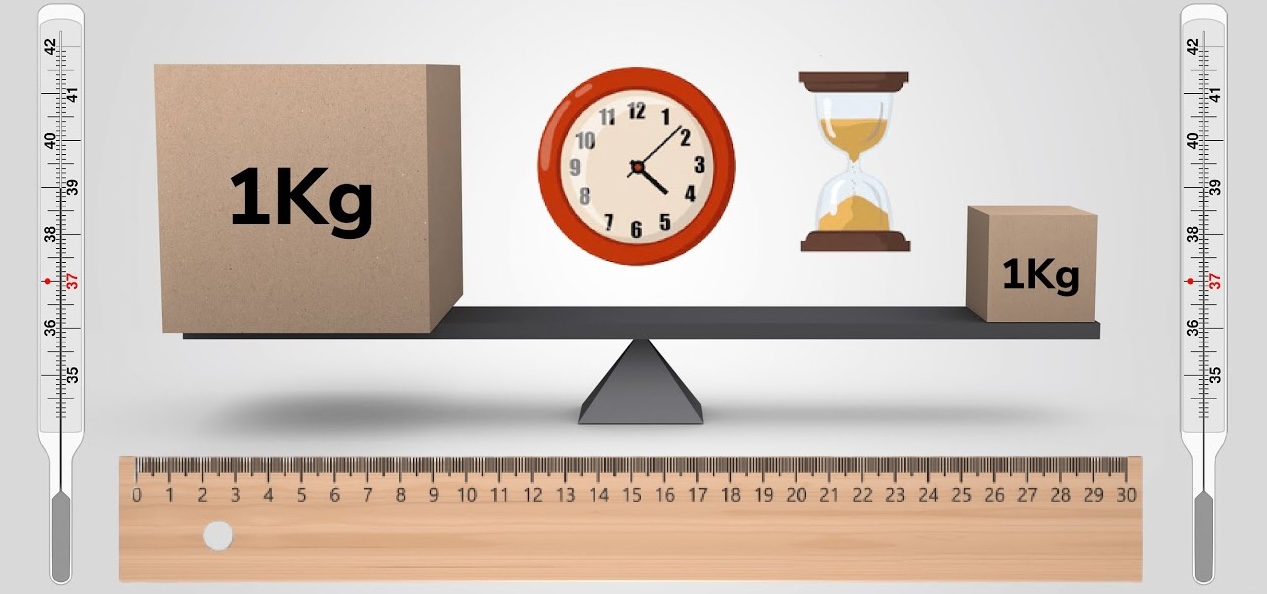
A physical quantity is any property of matter that can be measured. Put simply, if you can assign a numerical value to something, it's a physical quantity.
Note
The ability to measure and quantify properties is what makes physics a precise science. Without measurement, we couldn't make accurate predictions or test our theories against reality.
Physics involves measuring many different types of quantities. These span across all areas of physics, including:
- Mechanical quantities: time, length, area, volume, displacement, speed, velocity, acceleration, mass, density, momentum, force, pressure, work
- Energy and thermodynamics: energy, power, temperature
- Electrical and electromagnetic: potential difference, electric current, resistance, resistivity, magnetic flux, magnetic flux density, electric charge, electric field strength
- Other important quantities: gravitational field strength, frequency, activity of a radioactive source
Each of these quantities can be measured and given a numerical value, making them essential tools for describing and understanding the physical world.
What is measuring?
Measuring means comparing a quantity with a standard amount of the same type of quantity. This standard amount is called a unit.
Think of it this way - when you measure something, you're essentially asking "how many of this standard amount does my quantity contain?"
Example
Worked Example: Understanding Measurement
a) Measuring length: If you find that a piece of wire is 12 metres long, you're saying that this wire is 12 times longer than the standard unit called the metre. The metre is your unit of length.
b) Measuring electric current: If you discover that the electric current in a wire is 2 amperes, you're indicating that the current in this wire is twice as large as the standard unit called the ampere. The ampere is your unit of electric current.
Understanding magnitude
The result of any measurement consists of a number multiplied by a unit. This combination (the number and unit together) is called the magnitude or size of the quantity being measured.
For example:
- 12 metres (magnitude of length)
- 2 amperes (magnitude of electric current)
- 50 kilometres per hour (magnitude of speed)
SI units
In 1960, scientists worldwide agreed to use a standardised system of measurement called the International System of Units. Any unit from this system is called an SI unit. This ensures that scientists everywhere can communicate their findings clearly and accurately.
Important
SI units will be used throughout your physics course, and you'll encounter them in all your calculations and experiments. Mastering SI units is crucial for success in physics.
Common SI units
| Quantity | SI Unit |
|---|---|
| Time | second |
| Displacement | metre |
| Speed | metre per second |
| Force | newton |
| Resistance | ohm |
| Frequency | hertz |
Using SI units means your measurements and calculations will be understood by physicists anywhere in the world, making scientific communication much more effective.
Summary
Key Points to Remember:
- Physical quantities are any properties of matter that can be measured
- Measurement involves comparing a quantity with a standard unit of the same type
- Magnitude is the complete result of a measurement (number + unit)
- SI units are the internationally agreed standard units used in science
- Every measurement you take in physics will involve a physical quantity, a number, and a unit