The Nature of Scientific Knowledge (Leaving Cert Physics): Revision Notes
📚Revision Notes
The Nature of Scientific Knowledge
What is scientific knowledge?
Throughout human history, people have needed to understand their surroundings to survive and thrive. From our earliest ancestors, humans have had to develop mental pictures of the world around them - understanding how to find food, shelter, and safety, as well as how to interact with other people and their environment.
Scientific knowledge represents a particular type of understanding that helps us navigate and make sense of the world. It is knowledge that has been tested, verified, and proven to be more reliable and useful than other forms of knowledge. This type of knowledge enables us to explain various aspects of the world around us and make predictions about what might happen in different situations.
Important
The key feature that makes knowledge "scientific" is that it can be tested, shared with others, and built upon over time. Unlike personal opinions or cultural beliefs, scientific knowledge must be supported by evidence that others can examine and verify.
How do we obtain scientific knowledge?
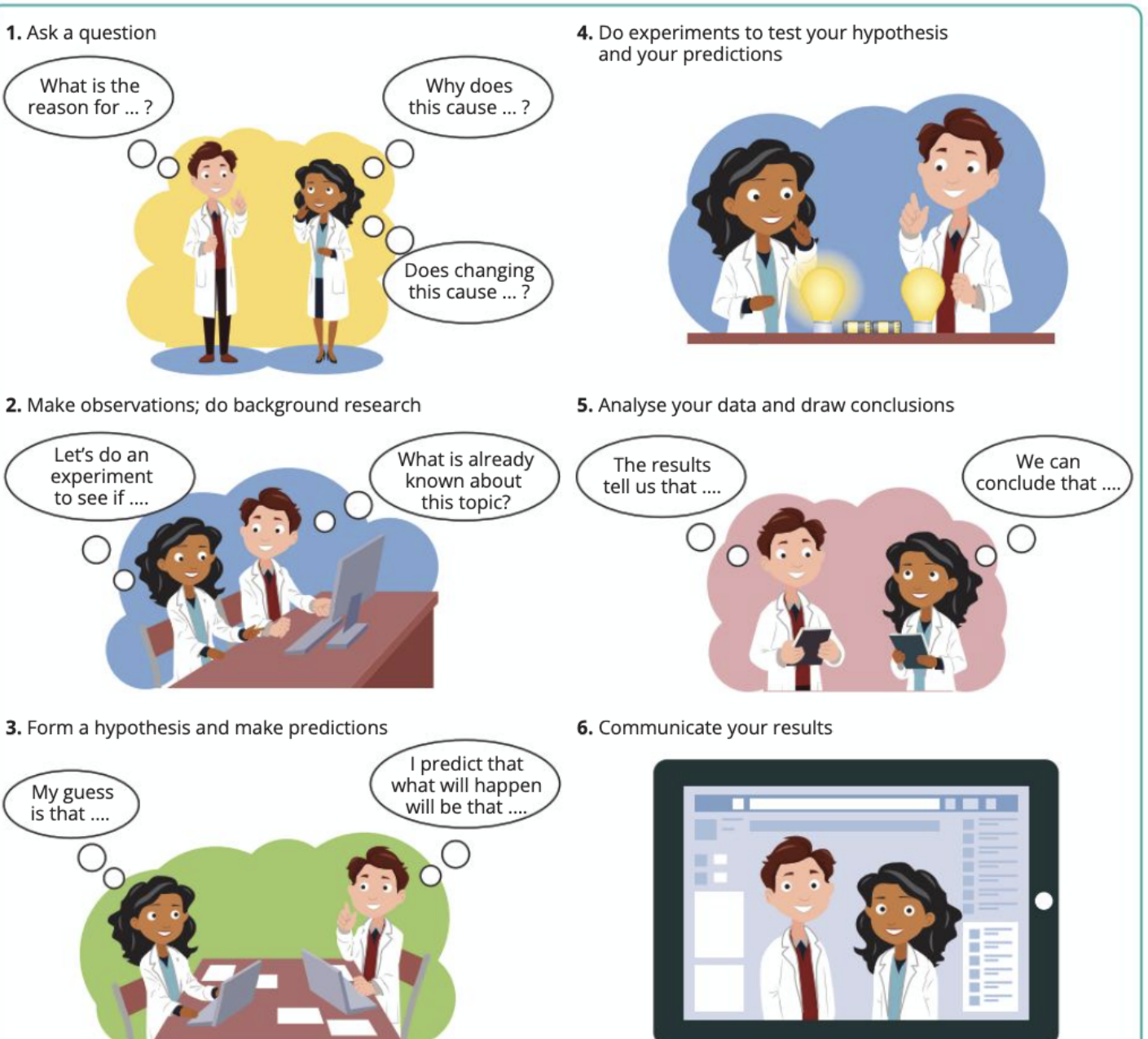
Scientific knowledge is acquired through a systematic approach called the scientific method. This method provides a step-by-step framework that helps scientists test ideas, answer questions, and discover new information about the natural world.
Note
The scientific method is not just a collection of random steps - it's a systematic and logical approach that ensures reliability and consistency in how we investigate the natural world.
The scientific method consists of six main steps:
1. Ask a question
Scientists begin by choosing an area or topic to investigate. They identify specific research questions that they want to find answers to. This might involve wondering "What causes this phenomenon?" or "Why does this happen?"
2. Make observations and do background research
Scientists carefully observe the phenomenon they are studying, noting what happens and when it occurs. They also research what other scientists have already discovered about similar topics. This background research helps them understand what is already known and what still needs to be investigated.
3. Form a hypothesis and make predictions
Based on their observations and research, scientists develop a hypothesis - an educated guess or proposed explanation for what they have observed. They then make specific predictions about what should happen if their hypothesis is correct.
4. Design and conduct experiments
Scientists design controlled experiments to test their hypothesis and predictions. These experiments must be carefully planned to ensure that the results will provide clear evidence about whether the hypothesis is correct or not.
5. Analyse data and draw conclusions
After collecting experimental data, scientists carefully examine and interpret their results. They determine whether their data supports their hypothesis or suggests that it needs to be modified or rejected entirely.
6. Communicate results
Scientists share their findings with the scientific community through research papers, conferences, and other forms of communication. This allows other scientists to learn from the work and potentially build upon it in their own research.
Important requirements for practising scientists
For scientific knowledge to remain reliable and trustworthy, scientists must follow certain important practices:
Clear communication
Scientists must be able to explain their ideas and discoveries clearly so that other scientists around the world can understand and make use of their work. They need to follow international standards and use accepted scientific language and notation systems.
Peer review
When scientists complete their research, their work is typically published in scientific journals or books. However, before publication, the work undergoes peer review - a process where other scientists who work in similar fields carefully examine the research.
Important
Peer review is essential for maintaining scientific quality. These reviewers check whether the research has been carried out correctly and whether the conclusions are valid. This system helps ensure that unreliable or false claims are not published.
Reproducibility and repeatability
Reproducibility means that if a scientist carries out an experiment and obtains a particular result, then other scientists using the same method should be able to get the same results. Repeatability ensures that when the original scientist repeats their own experiment, they get consistent results.
Important
If an experiment cannot be reproduced by others or repeated reliably, then the results cannot be considered trustworthy. This is why scientists must provide detailed descriptions of their methods and procedures.
Why is scientific knowledge important to us?
Scientific knowledge has fundamentally transformed human life and continues to shape our world in countless ways:
Improving quality of life
Scientific knowledge has enabled the development of modern medicine, technology, and industry. Consider how different life would be without:
- Medical advances: Antibiotics, anaesthetics, medical imaging (such as X-rays, MRIs, and CT scans), and radiation therapy have all been developed through scientific research
- Technology: Modern power supplies, transport systems, and communication technologies all depend on scientific knowledge
- Safety and comfort: Scientific understanding helps us build safer buildings, develop better food preservation methods, and create more efficient heating and cooling systems

Addressing modern challenges
Scientific knowledge is essential for tackling current global challenges, including:
- Environmental issues and climate change
- Sustainable development
- Public health and disease prevention
- Energy production and conservation
Critical thinking and decision-making
Understanding scientific principles helps people make informed decisions about important issues in their daily lives and as citizens. It enables us to evaluate claims critically and distinguish between reliable information and misinformation.
Note
In our information-rich world, the ability to think scientifically helps us evaluate the credibility of sources and make decisions based on evidence rather than opinion or speculation.
Data collection and privacy
In our modern digital world, vast amounts of personal data are collected by corporations and governments. Understanding how scientific methods work helps us evaluate these practices and make informed decisions about privacy and surveillance technologies.

Summary
Key Points to Remember:
-
Scientific knowledge is reliable, tested knowledge that helps us understand and navigate the world around us
-
The scientific method provides a systematic 6-step approach: ask questions, observe and research, form hypotheses, experiment, analyse data, and communicate results
-
Peer review ensures that scientific work is checked by other experts before publication, maintaining quality and reliability
-
Reproducibility and repeatability are essential - other scientists must be able to get the same results using the same methods
-
Scientific knowledge has revolutionised human life through advances in medicine, technology, and our understanding of the natural world