Potential Difference and Electromotive Force (Leaving Cert Physics): Revision Notes
📚Revision Notes
Potential Difference and Electromotive Force
What is potential difference?
Potential difference is a fundamental concept in electricity that describes how energy changes as electric charge moves through a circuit. When we talk about potential difference between two points in a circuit, we're measuring the energy that one coulomb of charge loses as it travels from one point to another.
The potential difference (V) between two points in a circuit represents the energy lost by one coulomb as it moves from one point to the other. This energy doesn't just disappear - it gets converted into other forms like heat, light, or mechanical energy.
Note
The SI unit of potential difference is the joule per coulomb (J C⁻¹). This unit is also called the volt (V), which is much easier to remember and use in calculations.
Energy changes in a simple electric circuit
Understanding how energy transforms in circuits helps us grasp why potential difference matters. When electric current flows through a conductor, something important happens to the energy.
In any conductor carrying current, electrical potential energy gets converted into heat energy. This happens because the moving electric charges (usually electrons) collide with atoms in the conductor material. Each collision transfers some kinetic energy to the atoms, making them vibrate more - and that's what we experience as heat.
Important
Understanding this energy conversion process is crucial:
- Charges start with high electrical potential energy
- As they move through the conductor, they encounter resistance
- This resistance causes energy conversion from electrical to thermal
- The charges end up with lower potential energy
- The "lost" energy appears as heat in the conductor
This is why electrical appliances like kettles, toasters, and heaters get warm when they're working - they're designed to convert electrical energy into heat energy efficiently.
Potential difference between two points in a circuit
Let's get more specific about measuring potential difference. The amount of electrical potential energy lost by one coulomb as it moves from one point to another in a circuit is called the potential difference between those two points.
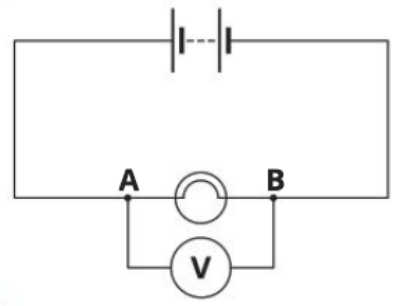
Since potential difference is measured in volts, we often just call it voltage. This makes sense because both terms describe exactly the same thing - the energy change per unit charge.
The mathematical relationship is straightforward:
Where:
- V = potential difference (voltage) in volts
- W = work done (energy converted) in joules
- q = charge in coulombs
Example
Worked Example: Calculating Potential Difference
If 4 joules of energy are converted when 1 coulomb of charge passes between two points, what is the potential difference?
Using the formula:
Therefore, the potential difference between those points is 4 volts.
The rate of heat production in current-carrying conductors
Power is the rate at which work is done, and it's also the rate at which energy converts from one form to another. In electrical circuits, we're particularly interested in how quickly electrical energy converts to other forms.
Power is measured in watts (W), where 1 watt equals 1 joule per second. For electrical circuits, we can calculate power using:
Where:
- P = power in watts
- V = voltage in volts
- I = current in amperes
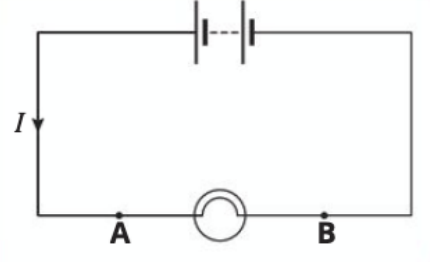
Note
This relationship makes intuitive sense. Higher voltage means more energy per coulomb, and higher current means more coulombs per second. Multiply these together, and you get the total energy conversion rate.
Example
Worked Example: Calculating Power
If a bulb operates at 230V and draws 2A of current, what is its power consumption?
Using the formula:
This means the bulb converts 460 joules of electrical energy into light and heat every second.
Voltages in series and parallel circuits
Understanding how voltage behaves in different circuit configurations is crucial for analysing more complex electrical systems.
Voltages in series
In series circuits, components connect end-to-end in a single path. The key principle here comes from conservation of energy.
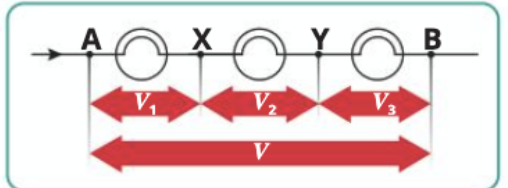
When components connect in series, the total voltage lost across all components equals the supply voltage. This makes perfect sense from an energy perspective - all the energy supplied must be accounted for somewhere in the circuit.
For a series circuit:
Important
This happens because each component in the series chain uses up some of the electrical energy. By the time the current completes its journey, all the original electrical potential energy has been converted to other forms.
Voltages in parallel
Parallel circuits work differently because they provide multiple paths for current to flow.
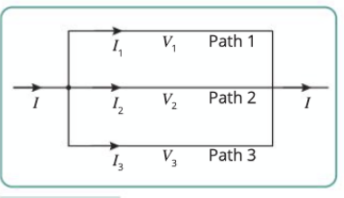
In parallel circuits, each component connects directly across the same two points. This means every component experiences the same potential difference - they all get the full supply voltage.
For parallel circuits:
Note
This happens because there's no energy loss in the connecting wires (assuming they're perfect conductors), so each parallel branch sees the full voltage difference between the supply terminals.
Measuring potential difference
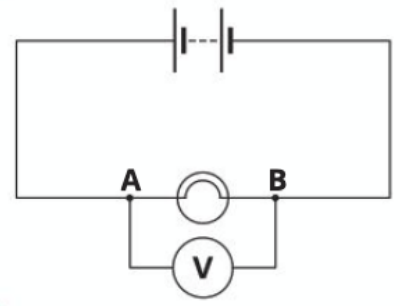
To measure potential difference in practice, we use an instrument called a voltmeter. The key to using a voltmeter correctly is understanding how to connect it.
Important
Critical Connection Rule: A voltmeter is always connected in parallel with the part of the circuit across which you want to measure the potential difference.
This parallel connection is essential because:
- The voltmeter needs to experience the same potential difference as the component you're measuring
- Connecting it in series would change the circuit's behaviour completely
- The parallel connection allows normal current flow through the original circuit while the voltmeter takes its own small measurement current
The voltmeter essentially measures how much energy each coulomb of charge loses as it passes through the component you're testing.
Electromotive force (emf)
To keep current flowing in a circuit, we need to maintain an electric field. This requires a potential difference between the ends of the circuit, which is provided by an electromotive force or emf.
What is emf?
Electromotive force is not actually a force - it's a voltage. The emf of a source (like a battery) represents the amount of electrical potential energy it gives to each coulomb of charge as the charge passes through the source.
Note
A source of electrical energy (such as a cell, battery, generator, or solar panel) converts energy from some other form into electrical potential energy. The emf tells us how much electrical potential energy the source provides per coulomb of charge.
Think of a battery as an energy converter:
- Chemical energy gets converted to electrical energy
- Each coulomb of charge gains energy as it passes through the battery
- This energy gain per coulomb is the emf
- The unit is the volt, just like potential difference
Battery construction
A cell typically contains two different metals separated by various chemicals in a container. Chemical reactions in the cell cause a voltage to develop between the two metals. When we say "1.5 volt AAA battery," we're describing a cell that provides 1.5 joules of energy to each coulomb of charge passing through it.
What we commonly call a "battery" is often actually several cells connected together to provide higher voltage or more energy storage.
Sources of emf connected in series
When several batteries or other sources of emf connect in series, their voltages add together, just like resistances in series circuits.
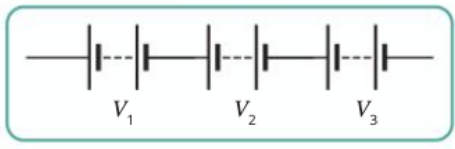
If several batteries connect in series (positive terminal of one connected to negative terminal of the next), then the total voltage equals the sum of individual voltages:
This principle explains many everyday applications:
- A torch using three 1.5V cells provides 4.5V total
- Car batteries often contain six 2V cells in series for 12V total
- Solar panels connect in series to achieve higher voltages
Note
The series connection works because each source adds its energy contribution to every coulomb of charge passing through the chain. By the time a coulomb completes its journey through all the sources, it has gained energy from each one.
Example
Worked Example: Series emf Calculation
Consider three batteries with emfs of 4V, 6V, and 2V connected in series. What is the total emf?
Using the series emf formula:
This means each coulomb of charge gains 12 joules of energy as it passes through the complete series combination.
Key formulas summary
Here are the essential equations you need to remember:
| Quantity | Formula | Units |
|---|---|---|
| Potential difference | V (volts) | |
| Power | W (watts) | |
| Series voltages | V (volts) | |
| Parallel voltages | V (volts) | |
| Series emf | V (volts) |
Summary
Key Points to Remember:
- Potential difference measures the energy lost per coulomb of charge moving between two points in a circuit
- The volt is the unit for both potential difference and emf, representing joules per coulomb
- Power (P = VI) tells us the rate at which electrical energy converts to other forms like heat and light
- In series circuits, voltages add up across components; in parallel circuits, each component gets the full supply voltage
- Voltmeters must always be connected in parallel with the component you're measuring, never in series