Diverging Lenses (Leaving Cert Physics): Revision Notes
📚Revision Notes
Diverging Lenses
What are diverging lenses?
Diverging lenses are concave lenses that are thinner in the centre and thicker at the edges. They cause parallel light rays to spread out (diverge) after passing through the lens. Unlike converging lenses, diverging lenses always produce virtual images that cannot be projected onto a screen.
Note
The term "diverging" comes from the Latin word meaning "to spread apart," which perfectly describes how these lenses affect light rays.
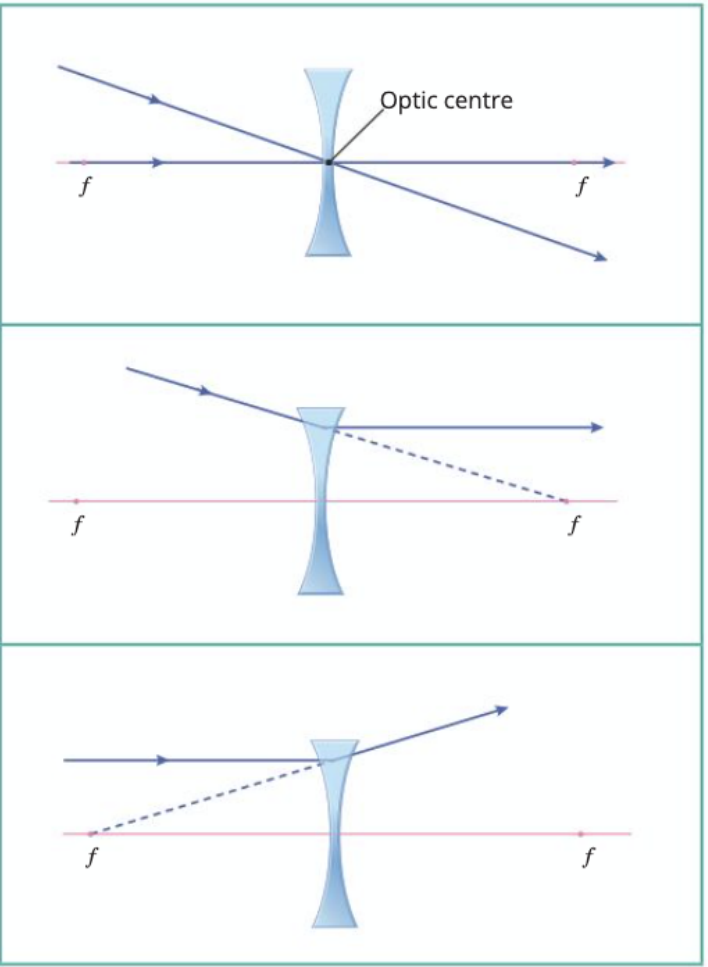
Ray tracing rules for diverging lenses
When tracing rays through a diverging lens, there are three important rules to follow. These rules help us predict where images will form and what they will look like.
The three key rays
Important
The Three Essential Ray Tracing Rules:
-
Ray through the optic centre: A ray that strikes the optic centre passes straight through the lens without bending. This ray travels in a straight line.
-
Parallel ray to the principal axis: A ray that travels parallel to the principal axis will be refracted so that it appears to come from the focal point on the same side as the object. The ray emerges from the lens as if it came from the focus.
-
Ray towards the focus: A ray that heads towards the focal point on the opposite side of the lens will emerge parallel to the principal axis after refraction.
These rules allow us to locate where the image forms and determine its characteristics.
Image formation by diverging lenses
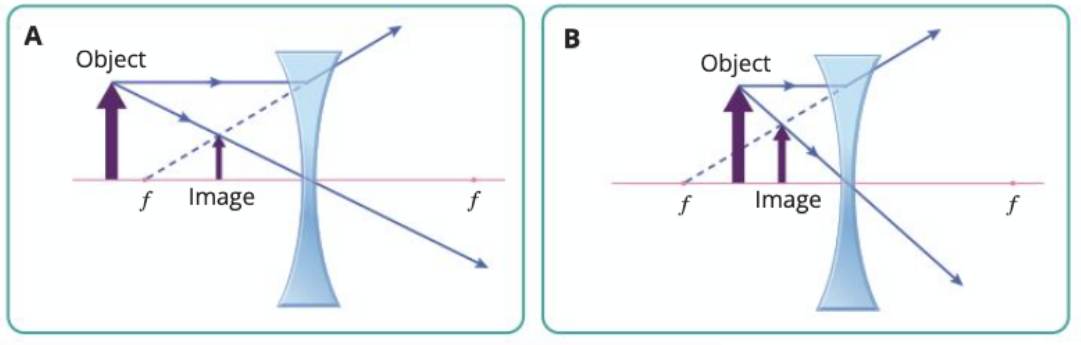
When an object is placed in front of a diverging lens, the image formed has specific characteristics that are always the same, regardless of where the object is positioned.
Characteristics of images formed by diverging lenses
Important
Image Characteristics - Always the Same:
For a diverging lens, the image is always:
- Virtual: The image cannot be projected onto a screen because the light rays don't actually meet - they only appear to meet when extended backwards
- Upright: The image has the same orientation as the object (not inverted)
- Diminished: The image is smaller than the original object
- Same side: The image forms on the same side of the lens as the object
The closer the object is to the lens, the larger the image becomes, but it remains virtual, upright, and diminished.
Formula for diverging lenses
The lens equation
The relationship between object distance, image distance, and focal length for any lens is given by:
However, for diverging lenses, we need to be careful about sign conventions.
Sign conventions for diverging lenses
Important
Critical Sign Conventions:
- u (object distance) is always positive
- v (image distance) is negative for virtual images (which is always the case for diverging lenses)
- f (focal length) is negative for diverging lenses
This means the formula becomes:
where f is negative for a diverging lens.
Example
Worked Example: Finding Image Position
Question: An object is placed 40 cm from a diverging lens of focal length 50 cm. Find the position and nature of the image.
Solution:
- Object distance: u = +40 cm
- Focal length: f = -50 cm (negative for diverging lens)
- Image distance: v = ?
Using the lens formula:
The negative sign confirms that the image is virtual and located 22.2 cm from the lens on the same side as the object.
Key differences from converging lenses
Understanding how diverging lenses differ from converging lenses helps clarify their unique properties:
Note
Diverging vs Converging Lenses:
- Converging lenses can form both real and virtual images depending on object position
- Diverging lenses always form virtual images regardless of object position
- Converging lenses have positive focal lengths
- Diverging lenses have negative focal lengths
Applications of diverging lenses
Diverging lenses are commonly used in various practical applications where their unique properties are beneficial:
- Spectacles for correcting short-sightedness (myopia)
- Peepholes in doors to provide a wide field of view
- Camera viewfinders to reduce image size
- Telescopes as eyepieces when combined with converging lenses
Summary
Key Points to Remember:
- Diverging lenses always produce virtual, upright, and diminished images
- The focal length of a diverging lens is always negative
- Image distance is negative for virtual images (same side as object)
- Ray tracing follows three key rules: straight through centre, parallel becomes divergent from focus, towards focus becomes parallel
- The lens formula applies but careful attention to sign conventions is essential