Applications of Total Internal Reflection (Leaving Cert Physics): Revision Notes
📚Revision Notes
Applications of Total Internal Reflexion
Total internal reflexion is not just a theoretical concept - it has many practical applications that we encounter in everyday life and in advanced technology. When light travels from a denser medium to a less dense medium at an angle greater than the critical angle, all the light is reflected back into the denser medium. This principle enables several important devices and technologies.
Cat's-eye reflectors
Cat's-eye reflectors are commonly found on our roads and provide an excellent example of total internal reflexion in action. These small glass or plastic devices are embedded in road surfaces and lane markings to help drivers see the road clearly at night.
Note
How Cat's-eye Reflectors Work
The working principle is straightforward. Light from a car's headlights enters the glass part of the reflector and strikes the back surface. At this boundary between glass and air, total internal reflexion occurs because the light hits at an angle greater than the critical angle. The light is then reflected back towards its source - the car that originally produced it.
This retroreflective property means that drivers see bright spots of light marking the road ahead, making night driving much safer. The reflected light appears bright because it returns directly to the observer rather than scattering in all directions.
Corner cube reflectors
Corner cube reflectors represent another practical application of total internal reflexion, though they work on a slightly different principle. These devices consist of three plane mirrors positioned at right angles to each other, just like the corner of a room where two walls meet the ceiling.
When a ray of light strikes one mirror in a corner cube, it reflects off all three mirrors in turn before emerging parallel to its original direction. This means the light travels back towards its source regardless of the angle at which it originally entered the device. Corner cubes can be made from glass or plastic, and the same retroreflective effect can be achieved using total internal reflexion at the three surfaces.
Important
Safety Applications
The principle behind corner cubes is utilised in safety reflectors on bicycles and cars. The material is often shaped into many small right-angled prisms to achieve the same effect as the three-mirror system. Light entering any of these tiny corner structures gets sent back in the direction it came from, making the reflective material highly visible to drivers.

These retroreflective devices appear as red, clear, and amber coloured reflectors in various shapes, commonly seen on vehicle rear lights, bicycle reflectors, and road safety equipment.
Optical fibres
Optical fibres represent one of the most important technological applications of total internal reflexion. These are extremely thin strands of transparent material, usually glass, through which light can travel by repeatedly undergoing total internal reflexion.
How optical fibres work
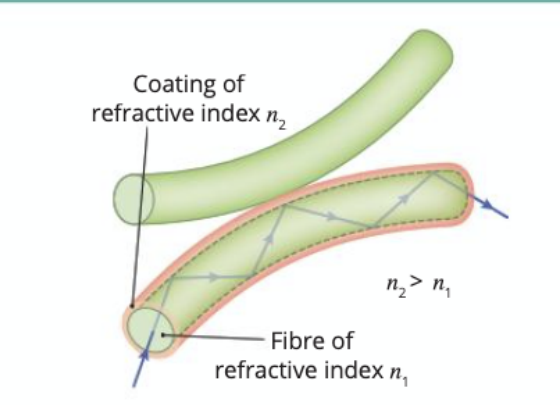
An optical fibre consists of a transparent core surrounded by a coating (called cladding) that has a lower refractive index than the core material. Light enters the fibre and travels along its length by bouncing off the boundary between the core and cladding.
Example
Worked Example: Light Transmission in Optical Fibres
Step 1: Light enters the fibre core
- Light must enter at an appropriate angle to the fibre axis
Step 2: Light strikes the core-cladding boundary
- The angle of incidence must be greater than the critical angle
Step 3: Total internal reflexion occurs
- Light bounces back into the core rather than escaping
Step 4: Process repeats continuously
- Light travels along the fibre length through repeated reflections
The key to successful light transmission is that the light must strike the core-cladding boundary at an angle greater than the critical angle. When this condition is met, total internal reflexion occurs and the light bounces back into the core rather than escaping into the cladding. This process continues repeatedly as the light travels along the fibre, even when the fibre is bent around corners.
Important
Fibre Bending Limitations
However, optical fibres cannot be bent too sharply. If the curvature becomes too extreme, the angle of incidence at the core-cladding boundary becomes less than the critical angle, and light begins to escape from the fibre.
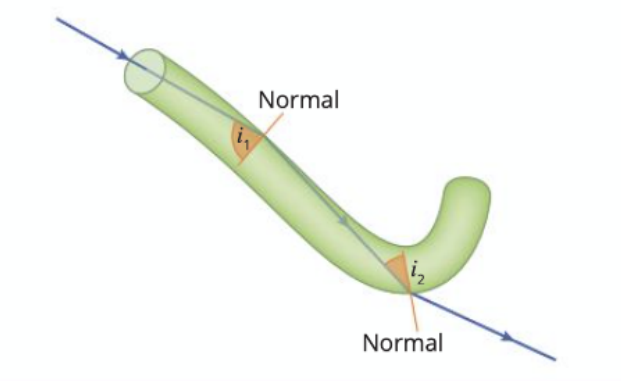
This diagram shows how light can escape from an overly curved optical fibre when the conditions for total internal reflexion are no longer satisfied.
Applications in technology and medicine
Telecommunications
Optical fibres have revolutionised telecommunications by enabling them to transmit data much faster than traditional copper wires, with less signal loss over long distances. The original electrical data is converted into corresponding light signals that travel through the fibre, then converted back to electrical signals at the other end.
Note
Advantages of Optical Fibres in Telecommunications
- Much smaller energy losses compared to copper wires
- Faster data transfer rates
- Higher bandwidth capacity
- Better security since they are harder to intercept
Medical applications - endoscopes
In medical applications, optical fibres enable doctors to see inside the human body without making large incisions. An endoscope uses optical fibres in two ways: one bundle carries light into the body to illuminate the area being examined, while another bundle carries the reflected light back out so the body part can be viewed on a screen.
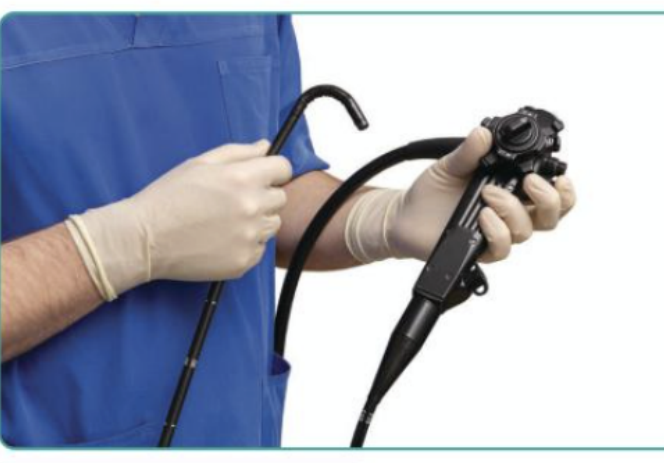
The endoscope is inserted through a natural opening in the body, such as the mouth to view the larynx, oesophagus, stomach, or small intestine, or through the rectum to view the colon. A camera screen can then be used to view the internal structures, allowing doctors to examine patients without the need for major surgery.
Laparoscopic surgery
Laparoscopic surgery takes this technology further, allowing surgeons to perform operations with much smaller incisions than traditional surgery. This minimally invasive approach provides several significant benefits to patients.
Note
Benefits of Laparoscopic Surgery
This minimally invasive approach:
- Reduces pain for patients
- Decreases the risk of complications
- Allows for faster recovery
- Usually requires shorter hospital stays
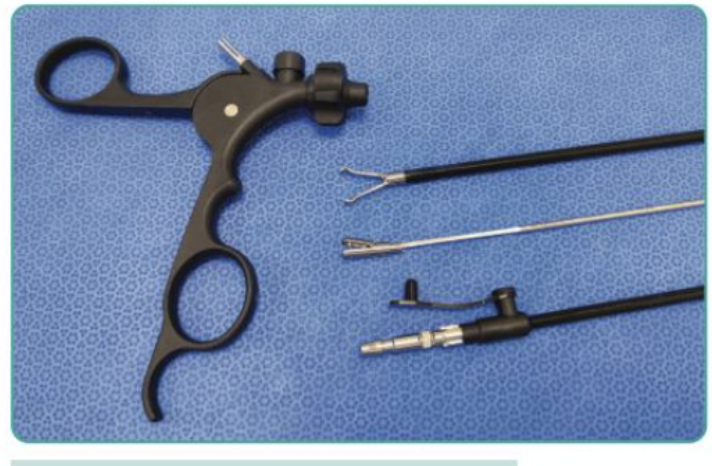
These laparoscopic instruments show the sophisticated tools that can be used alongside optical fibre technology to perform complex surgical procedures through tiny incisions.
Summary
Key Points to Remember:
-
Cat's-eye reflectors use total internal reflexion to send light back to drivers, improving road safety at night by making lane markings and road edges clearly visible
-
Corner cube reflectors contain three perpendicular mirrors (or use total internal reflexion in shaped plastic) to retroreflect light back to its source, making them ideal for safety equipment on vehicles and bicycles
-
Optical fibres transmit light along their length through repeated total internal reflexion at the core-cladding boundary, enabling high-speed data transmission and medical imaging
-
Medical applications of optical fibres include endoscopes for internal body examination and laparoscopic surgery for minimally invasive procedures, both of which improve patient outcomes and recovery times
-
All these applications depend on light travelling from a denser medium to a less dense medium at angles greater than the critical angle, causing total internal reflexion rather than refraction