The Laws of Refraction of Light and Refractive Index (Leaving Cert Physics): Revision Notes
📚Revision Notes
The Laws of Refraction of Light and Refractive Index
Introduction to refraction laws
When light travels from one medium to another, it undergoes refraction - a change in direction as it crosses the boundary between the two materials. Understanding how this happens follows two fundamental laws that govern all refraction behaviour.
The key insight is that when light encounters a new medium, the angle at which it bends depends on the properties of both materials involved. This bending occurs because light travels at different speeds in different substances.
Note
The speed of light in different materials is what causes refraction to occur. Light always takes the path that requires the least time to travel between two points, which means it must change direction when entering a medium where it travels at a different speed.
The first law of refraction of light
The first law of refraction establishes the geometric relationship between the light rays involved in refraction:
The incident ray, the normal at the point of incidence, and the refracted ray all lie in the same plane.
This law tells us that refraction is a predictable, two-dimensional process. The normal is an imaginary line drawn perpendicular to the surface at the point where light hits the boundary between the two media.
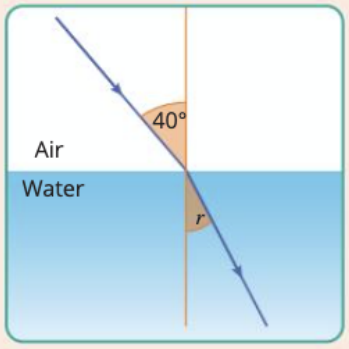
This diagram shows how a light ray travelling from air into water follows the first law - all three elements (incident ray, normal, and refracted ray) exist within the same geometric plane.
Snell's law (second law of refraction)
The second law of refraction, commonly known as Snell's law, provides the mathematical relationship for calculating refraction angles:
The ratio of the sine of the angle of incidence to the sine of the angle of refraction is a constant.
Mathematically, this is expressed as:
Where:
- i = angle of incidence (measured from the normal)
- r = angle of refraction (measured from the normal)
- n = refractive index (a constant for the materials involved)
Important
Snell's law only applies when light is travelling in a straight line through each medium. It cannot be used for curved interfaces or when light is scattered by particles in the medium.
This law was discovered by Dutch mathematician Willebrord Snellius in 1621, though it wasn't published until after his death. Snell's law allows us to predict exactly how much light will bend when moving between any two transparent materials.
Refractive index of a medium
Definition and calculation
The refractive index of a medium is a number that describes how much light slows down and bends when entering that material from air or a vacuum.
For light travelling from air (or vacuum) into a medium:
This means the refractive index equals the ratio of the sine of the incident angle to the sine of the refracted angle.
Note
The refractive index is always measured relative to vacuum (or air, which is nearly identical). This gives us a standard reference point for comparing how different materials affect light.
The refractive index tells us about the optical density of a material. Materials with higher refractive indices are optically denser and cause more bending of light.
Common refractive indices
Here are the refractive indices for materials you'll commonly encounter:
| Substance | Refractive index |
|---|---|
| Vacuum | 1.0 |
| Air | 1.0003 ≈ 1 |
| Water | 1.33 |
| Crown glass | 1.5 |
| Flint glass | 1.6 |
| Diamond | 2.42 |
Key observations about this table:
- Vacuum has the lowest possible refractive index (1.0)
- Air is so close to vacuum that we often treat it as n = 1
- The higher the refractive index, the more the material slows down light
- Diamond has an exceptionally high refractive index, which contributes to its brilliant appearance
Note
Notice how the refractive index increases as we move from less dense to more dense materials. This pattern helps explain why light bends more dramatically when entering very dense materials like diamond.
The refractive index between two media
When light travels between any two materials (not just from air), we need to consider the relative refractive index between the two media.
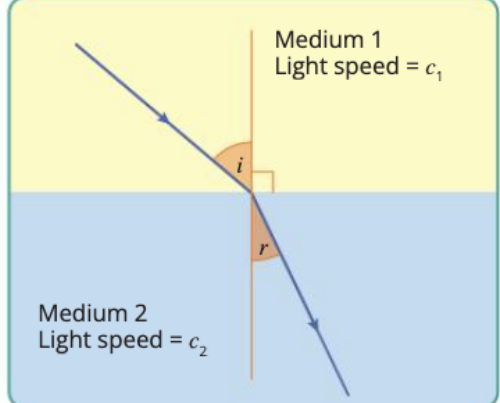
Important
When working with two different media, you cannot simply use the absolute refractive index of one material. You must calculate the relative refractive index between the two materials to get the correct refraction angle.
The relationship between the refractive indices of two media can be expressed as:
Where:
- n₁₂ = refractive index of medium 2 relative to medium 1
- n₂ = absolute refractive index of medium 2
- n₁ = absolute refractive index of medium 1
This relationship helps us understand what happens when light moves in either direction between two materials. For example, if light travels from glass to water, the relative refractive index would be different than if it travels from water to glass.
Refractive index in terms of relative speeds
The refractive index is fundamentally related to how fast light travels in different materials. This relationship provides another way to understand and calculate refractive indices.
The speed relationship is:
Where:
- n = refractive index of the medium
- c = speed of light in vacuum ()
- v = speed of light in the medium
This tells us that:
- Higher refractive index = slower light speed in that medium
- Lower refractive index = faster light speed in that medium
For any medium, we can also express this as:
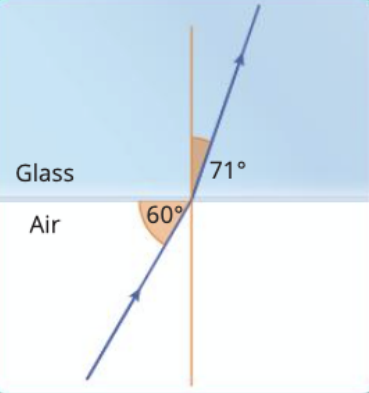
This diagram shows light moving from a denser medium (glass) to a less dense medium (air), demonstrating how the speed change affects the refraction angle.
Important consequences
Note
Understanding the Speed-Bending Connection
The speed relationship explains several key phenomena:
- Light travels fastest in vacuum and air
- The greater the refractive index of a medium, the more it slows down light as it enters
- If two different media have the same refractive index, light won't change direction when moving between them
- When light returns from a slower medium to a faster one, it bends away from the normal
Worked examples and calculations
Understanding refraction requires practice with calculations. Here are some key examples to demonstrate the application of these principles:
Example
Worked Example 1: Finding refractive index
A ray of light enters crown glass from air. The angle of incidence is 30° and the angle of refraction is 19°.
Step 1: Identify the known values
- Angle of incidence (i) = 30°
- Angle of refraction (r) = 19°
Step 2: Apply Snell's law
Step 3: Substitute and calculate
Answer: The refractive index of crown glass is 1.54
Example
Worked Example 2: Calculating refraction angle
Light enters water from air. If the incident angle is 40°, find the refraction angle using water's refractive index of 1.33.
Step 1: Identify known values
- Angle of incidence (i) = 40°
- Refractive index of water (n) = 1.33
Step 2: Rearrange Snell's law to solve for r
Step 3: Substitute and calculate
Answer: The refraction angle is 28.9°
Example
Worked Example 3: Relative refractive index
The refractive index from flint glass to water is 0.85. What is the refractive index from water to flint glass?
Step 1: Understand the relationship If , then is the reciprocal.
Step 2: Calculate the reciprocal
Answer: The refractive index from water to flint glass is 1.18
These examples show how Snell's law and refractive index calculations work in practice, helping you solve problems involving light refraction.
Summary
Key Points to Remember:
-
The first law of refraction: The incident ray, normal, and refracted ray all lie in the same plane - refraction is always a 2D process.
-
Snell's law: - this constant ratio allows you to calculate any unknown angle or refractive index in refraction problems.
-
Higher refractive index means more bending: Materials like diamond (n=2.42) bend light much more than water (n=1.33) or air (n≈1).
-
Speed connection: Refractive index equals the speed of light in vacuum divided by the speed of light in the medium - slower light means higher refractive index.
-
Direction of bending: Light bends towards the normal when entering a denser medium (higher n) and away from the normal when entering a less dense medium (lower n).