Electromagnetic Radiation and Its Wave-Like Nature (Grade 10 NSC Matric Physical Sciences): Revision Notes
📚Revision Notes
Electromagnetic Radiation and Its Wave-Like Nature
What is electromagnetic radiation?
Electromagnetic radiation is energy that travels through space as waves. The most familiar example is visible light, which you encounter every day when light bounces off objects and enters your eyes. However, visible light represents only a tiny portion of the complete electromagnetic spectrum.
Electromagnetic radiation is called "electromagnetic" because it consists of electric and magnetic fields that work together to create the radiation. This type of energy has several remarkable properties that make it unique in physics.
Note
The term "electromagnetic" comes from the fact that this radiation involves both electric and magnetic components working together. These two components are inseparable and create the wave-like motion that allows energy to travel through space.
Key properties of electromagnetic radiation
Electromagnetic radiation has five important characteristics that distinguish it from other types of waves:
-
Huge spectrum: Visible light is only a small part of the complete electromagnetic spectrum. The spectrum includes radio waves, microwaves, infrared radiation, visible light, ultraviolet radiation, X-rays, and gamma rays.
-
Nature's speed limit: Nothing in the universe travels faster than the speed of light. All electromagnetic radiation travels at the same speed in a vacuum.
-
Wave nature: All electromagnetic radiation can behave like a wave, showing properties such as wavelength and frequency.
-
Particle nature: All electromagnetic radiation can also behave like particles, which we call particle-like behaviour.
-
No medium required: Unlike sound waves that need air or water to travel through, electromagnetic waves can travel through empty space (vacuum).
Two crucial points emerge from these properties:
- Electromagnetic waves can travel without any medium
- Electromagnetic radiation exhibits both particle and wave behaviour
Note
The fact that electromagnetic waves require no medium was revolutionary when first discovered. This explains how sunlight can reach Earth through the vacuum of space, and how we can communicate with satellites and spacecraft.
Wave-particle duality
Electromagnetic radiation demonstrates a fascinating concept called wave-particle duality. This means that light and other electromagnetic radiation can show either wave-like or particle-like properties, depending on the type of experiment you perform.
Think of this like observing a line of ants walking up a wall. From far away, the ants appear as one continuous black line. However, when you look closer, you can see that the line consists of thousands of individual ants.
Similarly, electromagnetic radiation appears as a continuous wave in some experiments, but in other experiments, it reveals itself to be made up of individual energy packets. Light exhibits both wave-like and particle-like properties, but it only shows one behaviour at a time.
Important
You cannot test both the wave and particle nature simultaneously. This is a fundamental limitation in quantum mechanics - the act of measuring one property prevents you from simultaneously measuring the other.
Photons
When electromagnetic radiation behaves like particles, these individual energy packets are called photons.
Definition: Photon A photon is a quantum (energy packet) of light.
Electric and magnetic fields
Electromagnetic waves originate from accelerating charges. When electric charges accelerate, they emit electromagnetic waves through a process involving electric and magnetic fields.
The key principle is that a changing electric field generates a magnetic field, and a changing magnetic field generates an electric field. This creates what we call mutual induction - the fields regenerate each other continuously.
Important
The concept of mutual induction is crucial for understanding how electromagnetic waves propagate. Without this self-sustaining relationship between electric and magnetic fields, electromagnetic radiation could not travel through empty space.
The process works like this:
- An oscillating electric field in one plane produces an oscillating magnetic field
- This magnetic field oscillates in a plane at right angles to the electric field
- The oscillating magnetic field then produces another oscillating electric field
- This cycle continues, allowing the electromagnetic wave to propagate through space
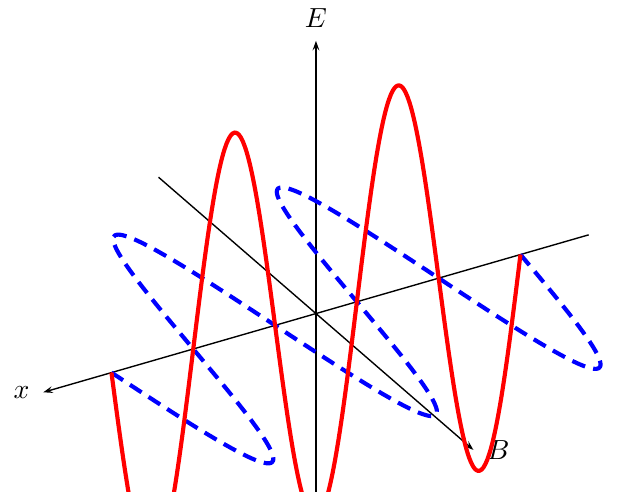
The diagram shows how the electric field (represented by the red solid line) and magnetic field (represented by the blue dashed line) oscillate perpendicular to each other as the electromagnetic wave travels.
We use the symbol E to represent electric fields and B to represent magnetic fields.
Speed and wave equation
These mutually regenerating fields travel through empty space at a constant speed of approximately 3 × 10⁸ m⋅s⁻¹. We represent this speed with the symbol c.
Although electromagnetic waves can travel through various media (such as water and air), they travel slower in these materials compared to their speed in vacuum.
Since electromagnetic radiation behaves as a wave, we can use the standard wave equation:
Where:
- c = speed of light (3 × 10⁸ m⋅s⁻¹)
- f = frequency (Hz)
- λ = wavelength (m)
Note
This wave equation is fundamental to solving problems involving electromagnetic radiation. Remember that the speed of light c is constant in vacuum, so if you know any two of the three variables, you can always calculate the third.
Worked examples
Example
Worked Example 1: Calculating frequency from wavelength
Question: Calculate the frequency of an electromagnetic wave with a wavelength of 4.2 × 10⁻⁷ m.
Solution:
Step 1: Identify the wave equation We use the formula to calculate frequency. The speed of light is constant at 3 × 10⁸ m⋅s⁻¹.
Step 2: Calculate
Step 3: State the final answer The frequency is 7.14 × 10¹⁴ Hz.
Example
Worked Example 2: Finding frequency from wavelength in nanometres
Question: An electromagnetic wave has a wavelength of 200 nm. What is the frequency of the radiation?
Solution:
Step 1: Identify what we know All electromagnetic radiation travels at the speed of light (c) in vacuum. Since the question does not specify the medium, we assume vacuum conditions.
Given:
Step 2: Apply the wave equation
Step 3: State the final answer The frequency is 1.5 × 10¹⁵ Hz.
Remember!
Summary
Key Points to Remember:
- Electromagnetic radiation includes visible light and many other types of waves that form the electromagnetic spectrum
- All electromagnetic radiation travels at the speed of light () in vacuum
- Electromagnetic waves exhibit wave-particle duality - they can behave as either waves or particles, but not both simultaneously
- The particle form of electromagnetic radiation is called a photon
- Use the equation to solve problems involving electromagnetic radiation