Properties of Longitudinal Waves (Grade 10 NSC Matric Physical Sciences): Revision Notes
📚Revision Notes
Properties of Longitudinal Waves
What are compressions and rarefactions?
Longitudinal waves have a unique structure that makes them different from other types of waves. These waves create regions of high and low particle density as they travel through a medium.
Compression is a region in a longitudinal wave where the particles are closest together. Think of it as a "crowded" area where the medium is squeezed or compressed.
Rarefaction is a region in a longitudinal wave where the particles are furthest apart. This is like a "stretched" area where the medium is spread out or expanded.
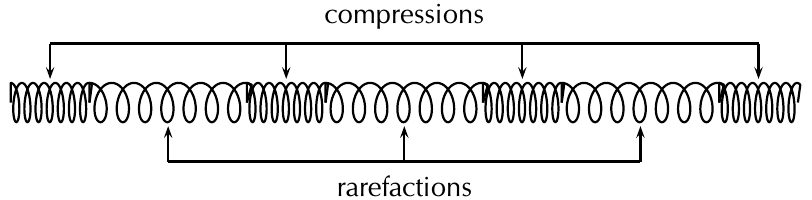
These compressions and rarefactions alternate as the wave travels through the medium. When you see a longitudinal wave diagram, the tightly packed areas represent compressions, whilst the more spaced-out areas show rarefactions.
Note
A helpful way to remember: Compressions are Crowded (particles close together) while Rarefactions are Rare (particles spread apart).
Wavelength and amplitude
Wavelength
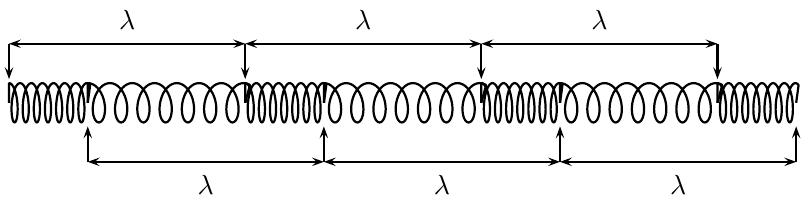
Wavelength in a longitudinal wave is the distance between two consecutive points that are in phase. This means you can measure wavelength as:
- The distance between two consecutive compressions, OR
- The distance between two consecutive rarefactions
Important
The symbol for wavelength is λ (lambda) and it is measured in metres (m). Remember that you can measure wavelength between any two consecutive identical points on the wave.
Amplitude
Amplitude is the maximum displacement from equilibrium. For longitudinal waves, which are pressure waves, amplitude represents the maximum increase or decrease in pressure from the equilibrium pressure. This occurs when a compression or rarefaction passes through a point.
The amplitude can also be thought of as the distance from the equilibrium position of the medium to a compression or rarefaction.
Period and frequency
Period
Period of a wave is the time taken by the wave to move one wavelength. The symbol used for period is T and it is measured in seconds (s).
Frequency
Frequency of a wave is the number of wavelengths per second. The symbol for frequency is f and it is measured in hertz (Hz).
The relationship between period and frequency
Period and frequency are inversely related. This means:
- If frequency increases, period decreases
- If frequency decreases, period increases
Important
Critical Relationship: Period and frequency are mathematical inverses of each other.
The mathematical relationship is:
or alternatively:
Speed of longitudinal waves
The speed of a longitudinal wave is defined in the same way as any other wave. Wave speed is the distance a wave travels per unit time.
- Quantity: Wave speed (v)
- Unit name: speed
- Unit: m⋅s⁻¹
Deriving the wave equation
The distance between two successive compressions is one wavelength (λ). In a time of one period (T), the wave will travel one wavelength in distance. Therefore, the speed of the wave is:
Note
Since , we can substitute to get a more useful form of the equation.
Since , we can substitute to get:
Important
The Wave Equation: This gives us the fundamental wave equation that applies to all types of waves:
Where:
- v = speed in m⋅s⁻¹
- λ = wavelength in m
- f = frequency in Hz
Worked examples
Example
Worked Example 1: Calculating Wave Speed
Question: The musical note "A" is a sound wave. The note has a frequency of 440 Hz and a wavelength of 0.784 m. Calculate the speed of the musical note.
Solution:
Step 1: Determine what is given and what is required
- f = 440 Hz
- λ = 0.784 m
- Need to calculate the speed of the musical note "A"
Step 2: Determine the approach We are given frequency and wavelength, so we can use:
Step 3: Calculate the wave speed
Step 4: Write the final answer The musical note "A" travels at 345 m⋅s⁻¹.
Example
Worked Example 2: Effect of Changing Wave Speed
Question: A longitudinal wave travels into a medium in which its speed increases. How does this affect:
- period?
- wavelength?
Solution:
Step 1: Determine what is required We need to determine how period and wavelength change when wave speed increases.
Step 2: Determine the approach
We need to find the link between period, wavelength and wave speed.
Step 3: Discuss how period changes The frequency of a longitudinal wave depends on the frequency of the vibrations that create the wave. Therefore, frequency remains unchanged when the wave enters a new medium. Since period is the inverse of frequency (), the period also remains the same.
Step 4: Discuss how wavelength changes The frequency remains unchanged. According to the wave equation , if f remains the same and v increases, then λ (wavelength) must also increase.
Summary
Key Points to Remember:
- Compressions are regions where particles are closest together, whilst rarefactions are where particles are furthest apart
- Wavelength is measured between two consecutive compressions or two consecutive rarefactions
- Period and frequency are inversely related:
- The wave equation connects speed, wavelength, and frequency
- When a wave enters a new medium, frequency stays constant but wavelength and speed can change