Potential Energy (Grade 10 NSC Matric Physical Sciences): Revision Notes
📚Revision Notes
Potential Energy
What is potential energy?
Potential energy is the energy that an object possesses because of its position or state. This means an object can have stored energy simply by being in a particular location or condition, even when it's not moving.
There are several types of potential energy, including gravitational potential energy, elastic potential energy, and chemical potential energy. In this section, we focus specifically on gravitational potential energy.
Note
Understanding potential energy is crucial because it helps explain how energy is stored in objects based on their position. This stored energy can later be converted into other forms of energy, such as kinetic energy when objects move.
Gravitational potential energy
Gravitational potential energy is the energy an object has due to its position in a gravitational field relative to some reference point. On Earth, this means the energy an object has because of its height above the ground.
The higher an object is positioned above the ground, the more gravitational potential energy it possesses. This energy can be converted to other forms of energy, such as kinetic energy, when the object moves.
The formula for gravitational potential energy
Gravitational potential energy can be calculated using the formula:
Where:
- = gravitational potential energy (measured in joules, J)
- = mass of the object (measured in kilograms, kg)
- = gravitational acceleration (9.8 m⋅s⁻² on Earth)
- = perpendicular height from the reference point (measured in metres, m)
The reference point is usually chosen as ground level, where the height () equals zero.
Understanding the relationship between height and potential energy
Important
Objects have maximum potential energy when they are at their maximum height above the reference point. As objects move closer to the reference point (usually the ground), their potential energy decreases.
When an object reaches the ground level (), its gravitational potential energy becomes zero, assuming we use the ground as our reference point.
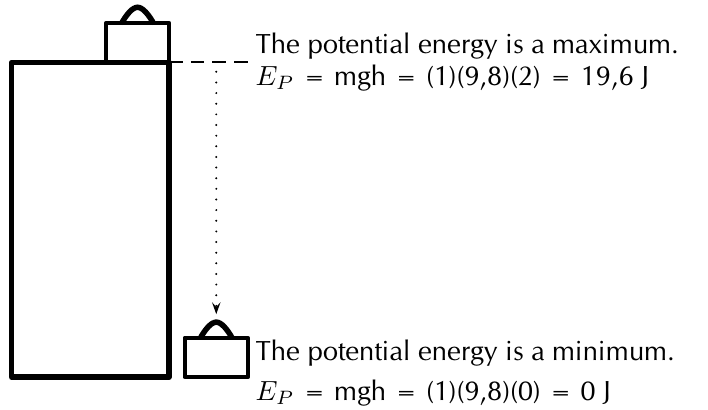
Worked example 1: Basic gravitational potential energy calculation
Example
Worked Example: Basic Potential Energy Calculation
Question: A brick with a mass of 1 kg is lifted to the top of a 4 m high roof. It slips off the roof and falls to the ground. Calculate the gravitational potential energy of the brick at the top of the roof and on the ground once it has fallen.
Solution:
Step 1: Analyse the given information
- Mass of the brick: kg
- Height when lifted: m
- All quantities are in SI units
Step 2: Identify what we need to find
- Gravitational potential energy at the top of the roof
- Gravitational potential energy when the brick reaches the ground
Step 3: Calculate the potential energy at the top of the roof
Step 4: Calculate the potential energy on the ground
When the brick is on the ground, m:
Worked example 2: Multiple position calculations
Example
Worked Example: Multiple Position Calculations
Question: A netball player, who is 1.7 m tall, holds a 0.5 kg netball 0.5 m above her head and shoots for the goal net which is 2.5 m above the ground. What is the gravitational potential energy of the ball:
- when she is about to shoot it into the net?
- when it gets right into the net?
- when it lands on the ground after the goal is scored?
Solution:
Step 1: Analyse the given information
- Player height: 1.7 m
- Ball mass: 0.5 kg
- Ball held 0.5 m above player's head
- Net height: 2.5 m above ground
Step 2: Calculate the ball's height when shooting
Height when shooting = player height + height above head
Step 3: Calculate potential energy when shooting
Step 4: Calculate potential energy at the net
At the net, m:
Step 5: Calculate potential energy on the ground
When the ball lands on the ground, m:
Key principles to remember
Understanding these fundamental principles will help you master gravitational potential energy concepts:
- Gravitational potential energy is directly proportional to height - the higher the object, the greater its potential energy
- The choice of reference point affects the calculated value, but the ground is typically used as the reference ()
- Gravitational acceleration on Earth is constant at 9.8 m⋅s⁻²
- Potential energy can be converted to other forms of energy when objects change position
- Objects at the same height have the same potential energy per unit mass
Summary
Key Points to Remember:
- Gravitational potential energy is the energy an object has due to its position in a gravitational field
- Use the formula where is in joules, is in kg, is 9.8 m⋅s⁻², and is in metres
- Higher positions mean greater potential energy - maximum height gives maximum potential energy
- Ground level (reference point) typically has zero potential energy
- Always identify your reference point when calculating potential energy values