Acceleration (Grade 10 NSC Matric Physical Sciences): Revision Notes
📚Revision Notes
Acceleration
What is acceleration?
Acceleration is a measure of how quickly an object's velocity changes over time. When you press the accelerator pedal in a car, you're increasing the car's velocity - this change in velocity is what we call acceleration.
Note
Definition: Average acceleration is the change in velocity divided by the time taken for that change to occur.
The formula for acceleration is:
Where:
- a = acceleration (in m·s⁻²)
- Δv = change in velocity (in m·s⁻¹)
- Δt = change in time (in s)
Units: Acceleration is measured in metres per second squared (m·s⁻²)
Understanding acceleration as a vector
Acceleration is a vector quantity, which means it has both magnitude (size) and direction. This is crucial for understanding motion because acceleration doesn't tell us how fast an object is moving - it only tells us how the motion is changing.
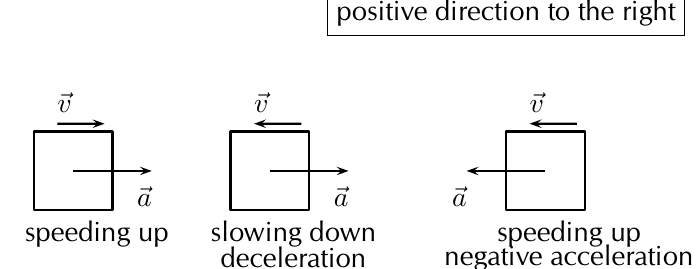
The direction of acceleration relative to velocity determines whether an object speeds up or slows down:
Important
Key relationships between velocity and acceleration:
- Same direction (both positive or both negative): The object speeds up
- Opposite directions: The object slows down (decelerates)
Important tip: Avoid using the word "deceleration" to mean negative acceleration. An object can slow down with either positive or negative acceleration, depending on the direction of its velocity.
Worked example: calculating acceleration
Let's work through a step-by-step example to understand how to calculate acceleration in different scenarios.
Example
Worked Example: Calculating Acceleration in Multiple Phases
Example problem A car accelerates uniformly from an initial velocity of 2 m·s⁻¹ to a final velocity of 10 m·s⁻¹ in 8 seconds. It then slows down uniformly to a final velocity of 4 m·s⁻¹ in 6 seconds. Calculate the acceleration during both phases.
Solution
Step 1: Choose a reference frame
- Set the car's initial direction of motion as positive
- Use the starting point as the origin
Step 2: Identify the given information
For the first 8 seconds (acceleration phase):
- Initial velocity (vᵢ) = 2 m·s⁻¹
- Final velocity (vf) = 10 m·s⁻¹
- Initial time (tᵢ) = 0 s
- Final time (tf) = 8 s
For the next 6 seconds (deceleration phase):
- Initial velocity (vᵢ) = 10 m·s⁻¹
- Final velocity (vf) = 4 m·s⁻¹
- Initial time (tᵢ) = 8 s
- Final time (tf) = 14 s
Step 3: Calculate the acceleration
For the first 8 seconds:
For the next 6 seconds:
Interpretation of results
-
First 8 seconds: The car had a positive acceleration of 1 m·s⁻². Since both velocity and acceleration were positive, the car was speeding up.
-
Next 6 seconds: The car had a negative acceleration of -1 m·s⁻². Since the velocity was positive but acceleration was negative, the car was slowing down.
Key concepts for exam success
Understanding acceleration requires a systematic approach to problem-solving and awareness of common misconceptions. Here's how to master this topic:
Problem-solving steps:
- Choose a reference frame - decide which direction is positive
- Identify given information - list all known values
- Apply the acceleration formula - substitute values carefully
- Interpret the result - explain what the sign and magnitude mean
Common exam tips:
- Always include units in your final answer
- Pay attention to the signs of velocity and acceleration
- Remember that constant acceleration means average acceleration equals instantaneous acceleration
- Be clear about what each phase of motion represents
Note
Typical exam traps:
- Confusing negative acceleration with slowing down
- Forgetting to consider direction when determining if an object speeds up or slows down
- Mixing up initial and final velocities in multi-phase problems
Summary
Remember!
- Acceleration measures how velocity changes over time, not how fast an object moves
- The formula is a = Δv/Δt, where Δv is change in velocity and Δt is change in time
- Same signs (velocity and acceleration) = speeding up
- Opposite signs (velocity and acceleration) = slowing down
- Units are always m·s⁻² for acceleration problems