Instantaneous Velocity and Speed (Grade 10 NSC Matric Physical Sciences): Revision Notes
📚Revision Notes
Instantaneous Velocity and Speed
Understanding instantaneous quantities
When we study motion, we often want to know exactly what is happening at a specific moment in time, rather than just looking at averages over longer periods. This is where instantaneous velocity and instantaneous speed become important concepts.
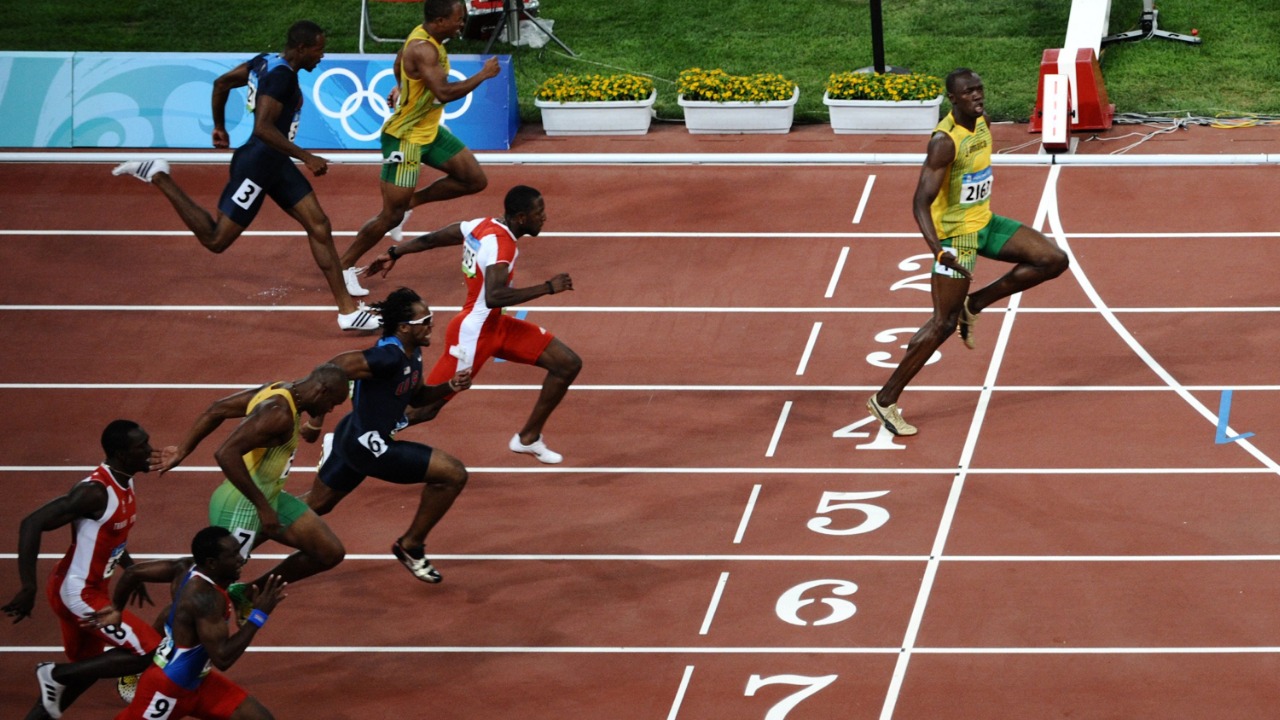
Think about sprinters in a race - their speed changes throughout the race, and we might want to know their exact velocity at any given moment during their run.
Note
The concept of "instantaneous" quantities is fundamental to understanding motion in physics. While average quantities tell us about motion over a period of time, instantaneous quantities give us a snapshot of what's happening at one precise moment.
What is instantaneous velocity?
Instantaneous velocity tells us how fast an object is moving and in which direction at a specific instant in time. Unlike average velocity, which looks at motion over a longer time period, instantaneous velocity captures what's happening at one precise moment.
To find instantaneous velocity, we look at the change in position over an extremely small time interval - so small that it approaches zero.
Definition of instantaneous velocity
Important
Instantaneous velocity is the change in position over the change in a very small time interval (where approaches 0).
- Quantity: Instantaneous velocity ()
- Unit: metre per second ()
- Type: Vector quantity (has both magnitude and direction)
What is instantaneous speed?
Instantaneous speed is simpler than instantaneous velocity - it only tells us how fast an object is moving, without worrying about the direction.
Definition of instantaneous speed
Important
Instantaneous speed is the magnitude of instantaneous velocity.
- Quantity: Instantaneous speed ()
- Unit: metre per second ()
- Type: Scalar quantity (magnitude only, no direction)
Key difference between instantaneous velocity and speed
Important
The main difference is that:
- Instantaneous velocity is a vector - it has both size and direction
- Instantaneous speed is a scalar - it only has size (magnitude) but no direction
Both have the same numerical value, but velocity includes directional information while speed does not.
Understanding through the sprinter example
Example
Practical Example: Sprinters During a Race
Consider photographs of sprinters during a race. Even though their average velocity for the entire race might remain fairly constant, their instantaneous velocity changes throughout the race:
- At the start: They accelerate quickly from rest
- Mid-race: They maintain high speed with relatively constant velocity
- Near finish: They might slow down slightly due to fatigue
If you could capture their motion in a "snapshot" at any instant in time, that would show their instantaneous velocity at that precise moment.
Important exam tips
Note
Key Exam Considerations:
- An instant in time is different from a time interval - it's useful to use the symbol for an instant in time (for example, during the 4th second) and for a time interval (for example, during the first 5 seconds of motion)
- Remember that when we say "very small time interval", we mean mathematically approaching zero ()
- Always specify whether you're dealing with velocity (vector) or speed (scalar) in exam questions
Remember!
Summary
Key Points to Remember:
- Instantaneous velocity measures how fast and in which direction an object moves at a specific instant in time
- Instantaneous speed is just the magnitude (size) of instantaneous velocity - no direction included
- Both use the same units: metres per second ()
- Instantaneous velocity is a vector, instantaneous speed is a scalar
- These quantities are found by looking at change in position over an extremely small time interval (approaching zero)