Techniques of Vector Addition (Grade 10 NSC Matric Physical Sciences): Revision Notes
📚Revision Notes
Techniques of Vector Addition
Understanding equilibrant vectors
Before exploring vector addition techniques, it's important to understand a special type of vector called the equilibrant.
Important
Definition: Equilibrant
The equilibrant is a vector that has the same magnitude but opposite direction to the resultant vector.

When you add the resultant vector and the equilibrant vector together, the answer is always zero because the equilibrant cancels the resultant out completely. This concept is crucial for understanding force balance and equilibrium situations.

Note
For example, if a resultant force is 35 N to the right, the equilibrant would be 35 N to the left. When these forces are combined, they produce zero net force.
Graphical techniques
Graphical techniques involve drawing accurate scale diagrams to show individual vectors and their resultants. The most common graphical method is the head-to-tail method.
Head-to-tail method of vector addition
The head-to-tail method is a systematic approach for adding vectors graphically. Follow these steps carefully:
Important
Method: Head-to-tail method of vector addition
- Draw a rough sketch of the situation
- Choose a scale and include a reference direction
- Choose any vector and draw it as an arrow in the correct direction with the correct length (remember to put an arrowhead on the end)
- Take the next vector and draw it starting from the arrowhead of the first vector, in the correct direction and length
- Continue until you have drawn each vector, always starting from the head of the previous vector
- Draw the resultant from the tail of the first vector to the head of the last vector. Its magnitude can be determined from the scale, and its direction from the diagram
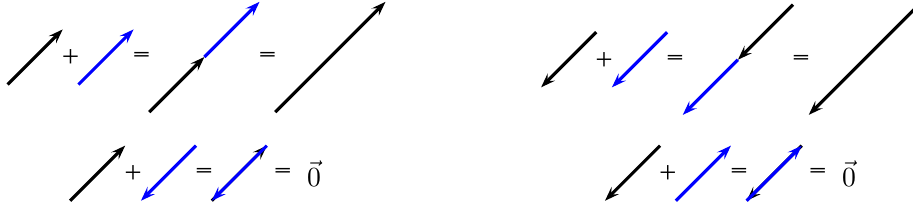
The key principle is that vectors are connected "head-to-tail" - each new vector starts where the previous one ended. When vectors point in the same direction, they add together. When they point in opposite directions, they effectively subtract from each other.
Example
Worked Example: Head-to-tail addition 1
Question: A car breaks down and you and your friend help push-start it. You push with a force of 50 N and your friend pushes with a force of 45 N. What is the resultant force on the car?
Solution:
Step 1: Choose a scale and reference direction
- Let's choose the direction to the right as positive
- Scale: 1 cm = 10 N
Step 2: Draw the first vector
- Draw the 50 N force as a 5 cm arrow pointing right
Step 3: Draw the second vector
- Since both forces are in the same direction, draw the 45 N force (4.5 cm) starting from the head of the first vector
Step 4: Measure the resultant
- Draw the resultant from the tail of the first vector to the head of the second vector
- The resultant measures 9.5 cm, which equals 95 N to the right
Example
Worked Example: Head-to-tail addition 2
Question: A rugby player has two teammates pushing him forwards with forces of 60 N and 90 N respectively, while two opposing players push him backwards with forces of 100 N and 65 N. Find the resultant force.
Solution:
Step 1: Choose scale and reference direction
- Scale: 0.5 cm = 10 N
- Positive direction: to the right
Step 2-5: Draw all vectors head-to-tail
- N (right): 3 cm arrow
- N (right): 4.5 cm arrow from head of
- N (left): 5 cm arrow from head of
- N (left): 3.25 cm arrow from head of
Step 6: Measure resultant
- The resultant vector measures 0.75 cm = 15 N to the left
Algebraic techniques
When vectors act along a straight line, you can use simple algebraic methods instead of scale drawings. This approach is often faster and more precise.
Vectors in a straight line
Important
Method: Addition/subtraction of vectors in a straight line
- Choose a positive direction (for example, choose west as positive for east-west displacements)
- Add or subtract the magnitudes using appropriate signs (positive for the chosen direction, negative for the opposite)
- State the direction in words (positive results are in the positive direction, negative results are in the opposite direction)
Example
Worked Example: Adding vectors algebraically 1
Question: A tennis ball rolls towards a wall 10 m away. After striking the wall, it rolls 2.5 m back along the ground. Calculate the ball's resultant displacement.
Solution:
Step 1: Choose positive direction
- Let's choose towards the wall as positive
- Therefore, away from the wall is negative
Step 2: Define vectors algebraically
- m (towards wall)
- m (away from wall)
Step 3: Add the vectors
Step 4: State the result The resultant displacement is 7.5 m towards the wall.
Example
Worked Example: Subtracting vectors algebraically
Question: A tennis ball is thrown horizontally towards a wall at 3 m⋅s⁻¹. After striking the wall, it returns at 2 m⋅s⁻¹. Determine the change in velocity.
Solution:
Step 1: Choose positive direction
- Towards the wall = positive
- Away from wall = negative
Step 2: Define vectors
- m⋅s⁻¹ (initial velocity)
- m⋅s⁻¹ (final velocity)
Step 3: Calculate change in velocity
Step 4: State the result The change in velocity is 5 m⋅s⁻¹ away from the wall.
Example
Worked Example: Adding forces algebraically
Question: A man applies a force of 5 N on a crate. The crate pushes back with a force of 2 N. Calculate the resultant force.
Solution:
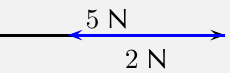
Step 1: Choose positive direction
- Towards the crate (direction of man's push) = positive
Step 2: Define forces algebraically
- N
- N (opposite to man's force)
Step 3: Calculate resultant
Step 4: State result The resultant force is 7 N towards the crate.
Summary
Key Exam Tips
- Graphical methods are best when vectors are not in a straight line
- Algebraic methods work only for vectors in a straight line
- Always choose a positive direction first in algebraic problems
- Include direction in your final answer (don't just give magnitude)
- In graphical methods, accuracy of scale drawing is crucial for correct answers
- Check your work by seeing if the answer makes physical sense
Summary
Key Points to Remember
- Equilibrant vectors have the same magnitude but opposite direction to the resultant vector
- Head-to-tail method connects vectors by placing each new vector at the head of the previous one
- Algebraic addition only works for vectors in a straight line - choose a positive direction first
- Graphical methods use scale drawings to find resultants accurately
- Vector subtraction follows the rule:
- Always include both magnitude and direction in your final answer