River Capture and Rejuvenation (Grade 12 NSC Matric Geography): Revision Notes
📚Revision Notes
River Capture and Rejuvenation
Rivers are dynamic systems that constantly change their landscapes through erosion and deposition. Two important processes that can dramatically alter river systems are rejuvenation and river capture. These processes reshape river valleys and create distinctive landforms that geographers can identify and explain.
Understanding rejuvenation
Rejuvenation occurs when a river gains additional energy, allowing it to erode more powerfully both downwards (vertically) and sideways (laterally). This renewed energy transforms the river's profile and creates new landscape features.
What causes rejuvenation
Rivers become rejuvenated due to two main factors:
Note
Understanding the causes of rejuvenation is essential for explaining why river systems change over time and how they develop their characteristic features.
- Increased water volume: When a river receives more water, it gains greater erosive power
- Land uplift: When the land rises or sea levels drop, the river's gradient becomes steeper, giving it more energy to cut downwards
Changes in river cross-profiles during rejuvenation
Rejuvenation affects different parts of a river system in distinct ways, creating recognisable patterns that help geographers identify where this process has occurred:
Upper course changes: The valley becomes much steeper and more V-shaped as the river cuts deeper into the landscape. The increased energy allows rapid downward erosion.
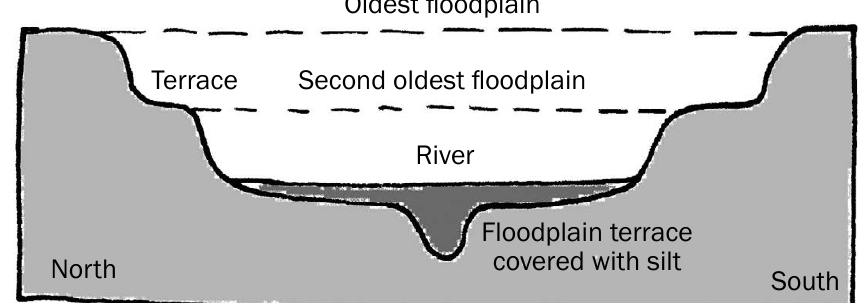
Middle course changes: The river begins forming a valley within a valley. As it cuts down, it creates a second U-shaped valley inside the original broader valley.
Lower course changes: The river creates stepped terraces along the valley sides. These terraces represent old floodplains that are now elevated above the current river level. When meanders are present, they become deeply incised as the river cuts downwards whilst maintaining its winding pattern.
Changes in longitudinal profile
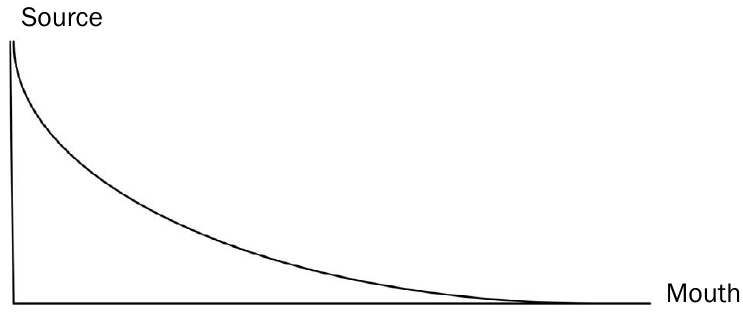
Before rejuvenation, a mature river has a smooth, concave longitudinal profile called a graded profile. This represents the river's natural equilibrium state. However, when rejuvenation occurs, this smooth profile is disrupted.
The rejuvenated river creates an ungraded profile with distinctive breaks called knickpoints. These knickpoints appear as sudden steep drops in the river's profile where the water cascades down.
Note
Knickpoints are like geological "scars" that show where rejuvenation has interrupted the river's natural flow. They provide clear evidence of past changes in the river system's energy levels.
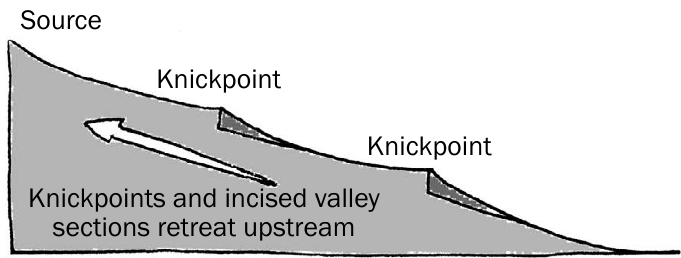
Over time, these knickpoints migrate upstream as the river continues to erode backwards. Eventually, the river will smooth out these irregularities and return to a graded profile, but this process takes thousands of years.
Important
Exam tip: Look for knickpoints on longitudinal profiles to identify where rejuvenation has occurred. Remember that graded profiles are smooth and concave, while ungraded profiles show sharp breaks.
River capture explained
River capture, also known as stream piracy, happens when one energetic river system "steals" water from another river system. This dramatic process reshapes drainage patterns across landscapes.
How river capture occurs
The process begins with headward erosion - when the source of a river gradually extends backwards towards a watershed. This occurs because rejuvenated rivers have increased energy for erosion.
Note
Think of headward erosion as a river "eating" its way backwards through the landscape, gradually extending its reach towards neighbouring river systems.
Headward erosion becomes more effective when:
- A river flows over a steeper gradient, increasing its speed
- A river has a larger volume of water flowing through it
- A river flows over less resistant rock types
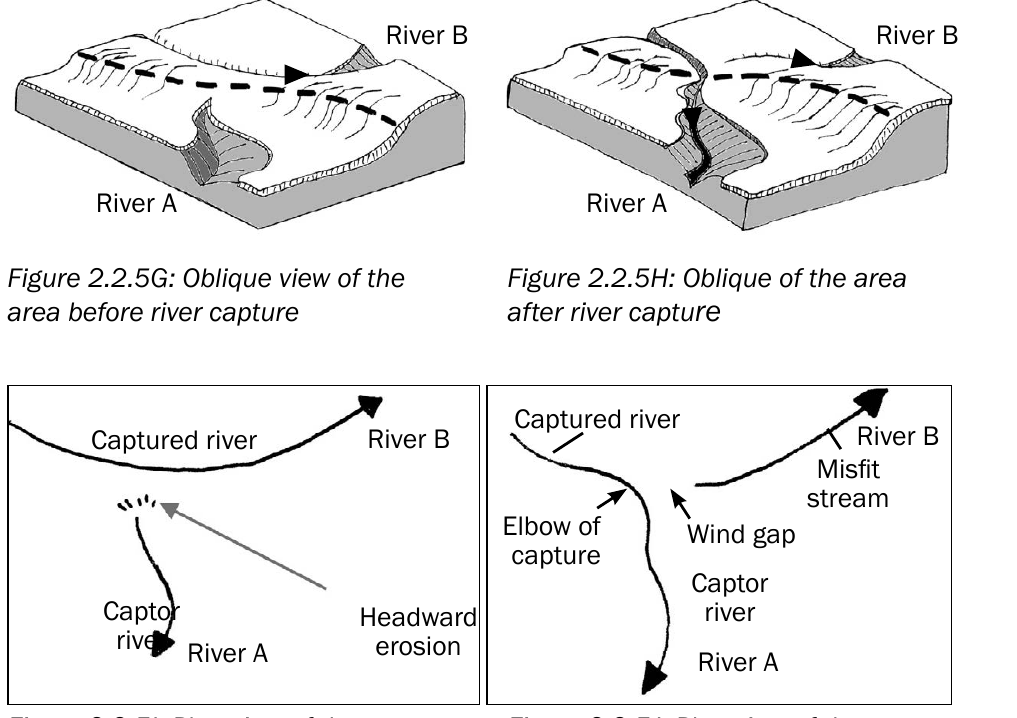
Eventually, the energetic stream (called the captor river) cuts back far enough to intercept and capture the water from another river system (the captured river). This creates an entirely new drainage pattern.
Landscape features created by river capture
Once river capture has taken place, several distinctive features become visible in the landscape that tell the story of this dramatic geological event:
Captor river: This is the energetic stream that successfully cuts backwards and takes over another river's water. It becomes rejuvenated due to its increased discharge.
Captured river: This river has lost its water source to the captor river. The section that continues to flow is often much smaller than before.
Misfit stream: The remaining portion of the captured river that has lost most of its water. It appears too small for the valley it occupies, hence the term "misfit". This is also called a beheaded stream.
Elbow of capture: This marks the exact point where the river changes direction due to capture. The sharp bend creates an distinctive elbow shape.
Wind gap: This dry valley section lies between the elbow of capture and the misfit stream. Water no longer flows here, leaving exposed gravels and sediments.
Waterfall: Often forms where the captured river drops down to join the captor river, creating a sudden change in elevation.
River capture demonstrates how energetic streams can completely reorganise drainage systems. The captor stream benefits from increased water volume and becomes rejuvenated, while the captured system is left diminished.
Note
River capture is essentially a "winner takes all" scenario in the natural world, where the most energetic river system gains at the expense of less powerful neighbouring streams.
Important
Exam tip: When describing river capture, explain the process step-by-step and use the correct terminology. Practice identifying these features on diagrams and be prepared to describe how river capture occurs.
Summary
Key Points to Remember:
- Rejuvenation occurs when rivers gain more energy, creating knickpoints, terraces, and valley-in-valley formations
- Knickpoints are breaks in the longitudinal profile that indicate rejuvenation has occurred
- River capture happens through headward erosion when one energetic river intercepts another's water supply
- Key features of river capture include the captor river, misfit stream, elbow of capture, and wind gap
- Terraces in river valleys show evidence of past rejuvenation events and former floodplain levels