DNA – Deoxyribonucleic Acid (Grade 12 NSC Matric Life Sciences): Revision Notes
📚Revision Notes
DNA – Deoxyribonucleic Acid
What is DNA?
DNA, or deoxyribonucleic acid, is one of the most important molecules in all living organisms. Think of DNA as nature's instruction manual - it contains all the information needed to build and maintain life. DNA consists of smaller building blocks called nucleotides, which work together to store genetic information that can be passed from parents to their offspring.
Note
DNA is found in virtually every cell of every living organism on Earth, from the smallest bacteria to the largest mammals. This universal presence makes DNA one of the strongest pieces of evidence for the common ancestry of all life.
The building blocks of DNA: nucleotides
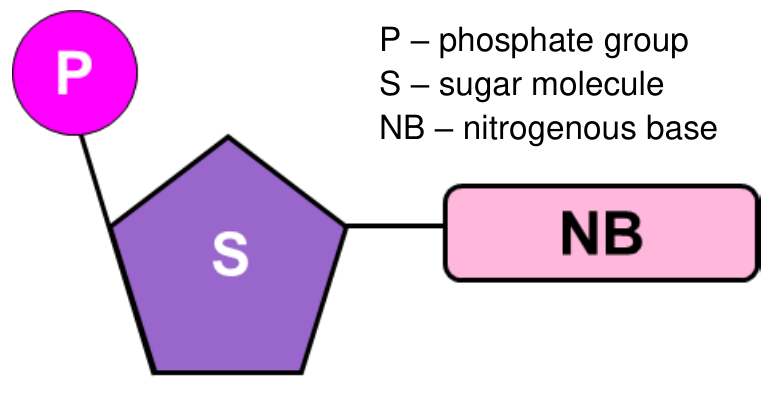
Every DNA molecule is made up of thousands of smaller units called nucleotides. Each nucleotide is like a puzzle piece that contains three essential parts that work together:
Important
Understanding these three components is crucial for grasping how DNA works:
- Phosphate group (P): Acts like the backbone of DNA, providing structure and stability
- Deoxyribose sugar (S): A five-carbon sugar molecule that connects other parts together
- Nitrogenous base (NB): The part that actually carries genetic information
The four letters of the genetic code
DNA uses a simple four-letter alphabet to store all genetic information. These four nitrogenous bases are the building blocks of the genetic code.
Each base has a specific role:
- Adenine (A) and Thymine (T) always pair together
- Guanine (G) and Cytosine (C) always pair together
Important
This base pairing rule is absolutely essential and never changes - it's one of the most important concepts in biology! The pairing is not random but follows strict chemical rules that ensure DNA stability and accurate replication.
The structure of DNA: a twisted ladder
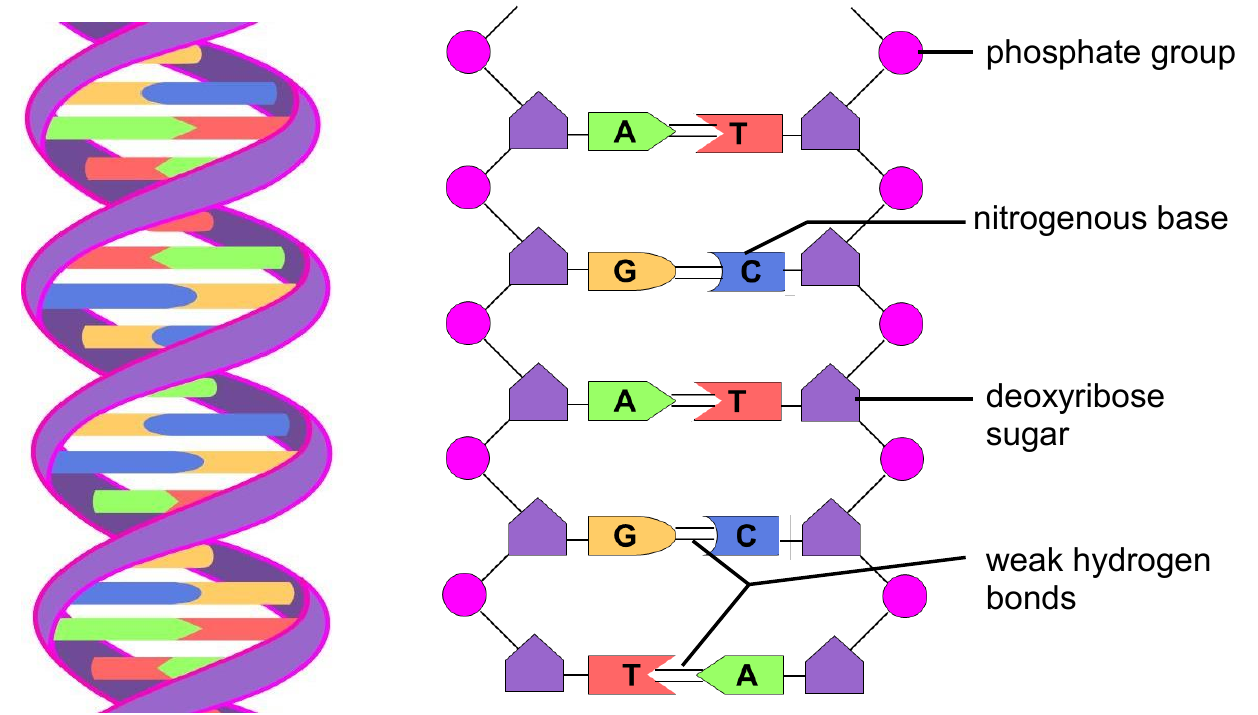
DNA has a remarkable structure that scientists call a double helix. Imagine a ladder that has been twisted into a spiral shape - that's exactly what DNA looks like!
Note
The double helix structure works like this:
- Two long chains (strands) of nucleotides run parallel to each other
- The phosphate groups and sugar molecules form the "backbone" or sides of the ladder
- The nitrogenous bases form the "rungs" or steps of the ladder
- Weak hydrogen bonds hold the complementary bases together
- The entire structure twists into a spiral shape
Complementary base pairing: nature's perfect match
One of the most elegant features of DNA is how the bases pair up. They fit together like puzzle pieces, with each base having only one perfect partner:

Important
Base Pairing Rules - Never Forget These:
- Adenine (A) always bonds with Thymine (T)
- Guanine (G) always bonds with Cytosine (C)
The bases are held together by weak hydrogen bonds, which are strong enough to keep the DNA stable but weak enough to allow separation when needed (like during DNA replication).
Example
Memory Aid for Base Pairing:
Remember the base pairing rules using simple memory aids like "Apple-Tree" for A-T and "Go-Car" for G-C!
Where can we find DNA in cells?
DNA is not randomly scattered throughout cells - it has specific locations that are important for its function:
Nuclear DNA (the majority):
- Found in the nucleus of cells
- Contains most of the genetic information
- Controls most cellular functions and inherited traits
Extra-nuclear DNA (smaller amounts):
- Mitochondrial DNA: Found in mitochondria (the powerhouses of cells)
- Chloroplastic DNA: Found in chloroplasts of plant cells only
- These types are especially useful for tracing ancestry and evolutionary relationships
Note
Extra-nuclear DNA is inherited differently from nuclear DNA. Mitochondrial DNA is typically inherited only from the mother, making it particularly valuable for genealogical and evolutionary studies.
The role and importance of DNA
DNA serves several critical functions that make life possible:
Primary functions:
- Stores hereditary information: Contains all the instructions needed to build and maintain an organism
- Controls cellular functions: Determines how cells behave and what proteins they make
- Enables inheritance: Passes characteristics from parents to offspring
- Codes for proteins: Provides the blueprint for making all the proteins the body needs
Note
Important notes about DNA function:
- Most DNA sections don't actually code for proteins - scientists call this "non-coding DNA"
- Genes are specific sections of DNA that code for particular traits
- DNA determines everything from your blood type to your eye colour, and even influences behaviour in some organisms
Important
Common misconception: Students often think all DNA codes for something specific, but actually most DNA is non-coding and scientists are still researching its importance!
A brief historical context
The discovery of DNA structure is one of science's greatest achievements:
- 1952: Rosalind Franklin used X-ray photography to study DNA structure
- 1953: Watson and Crick proposed the double helix model based on Franklin's work
- 1962: Watson and Crick received the Nobel Prize for their discovery
Note
This discovery revolutionised our understanding of genetics and heredity, leading to modern advances in medicine, forensics, and biotechnology. Franklin's crucial contribution was initially overlooked, but is now properly recognised by the scientific community.
Summary
Key Points to Remember:
- DNA is made of nucleotides, each containing a phosphate group, deoxyribose sugar, and nitrogenous base
- The four DNA bases are Adenine, Thymine, Guanine, and Cytosine - remember A pairs with T, and G pairs with C
- DNA has a double helix structure that looks like a twisted ladder, held together by hydrogen bonds
- Most DNA is found in the nucleus (nuclear DNA), with small amounts in mitochondria and chloroplasts (extra-nuclear DNA)
- DNA's primary job is to store and pass on hereditary information that controls how organisms develop and function