Puberty (Grade 12 NSC Matric Life Sciences): Revision Notes
📚Revision Notes
Puberty
What is puberty?
Puberty represents a crucial developmental stage when young people transition from childhood to sexual maturity. This important period typically occurs between the ages of 11 to 15 years, although the exact timing can vary significantly from person to person. Some individuals may begin puberty earlier or later than this average range, which is completely normal.
Note
Individual variation in puberty timing is completely natural. Factors such as genetics, nutrition, and overall health can influence when puberty begins for each person.
During puberty, the body undergoes remarkable changes driven by the production of sex hormones. These powerful chemical messengers trigger the development of reproductive capabilities and cause the appearance of secondary sexual characteristics - physical features that distinguish males from females beyond their reproductive organs.
Hormonal changes during puberty
The onset of puberty is controlled by hormones produced by the endocrine system. In males, the primary hormone responsible for pubertal changes is testosterone, whilst in females, two key hormones work together: oestrogen and progesterone. These hormones not only stimulate the process of gametogenesis (the production of sex cells) but also orchestrate the dramatic physical transformations that occur during this period.
Important
Sex hormones are the driving force behind ALL pubertal changes. Without these hormones, the transition from childhood to sexual maturity cannot occur.
Physical changes during puberty
The effects of these hormones result in distinct patterns of development that differ between males and females. Understanding these changes helps young people know what to expect during this natural process.
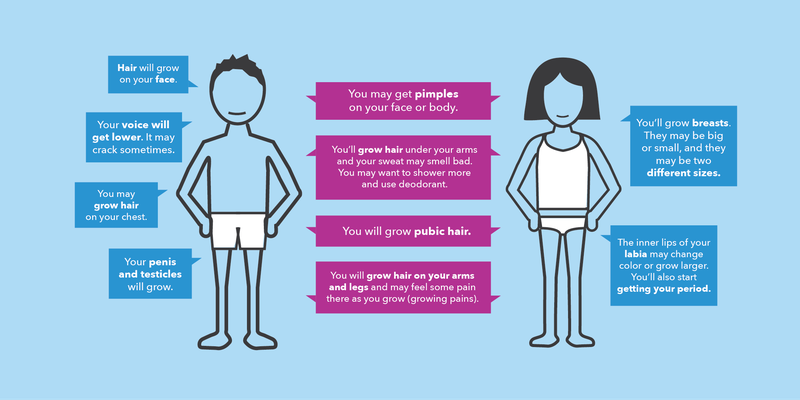
Changes in males during puberty
Male adolescents experience several characteristic developments as testosterone levels increase:
- Hair growth: New hair begins to appear in several areas, including around the scrotum (pubic hair), in the armpits, and on the face
- Voice changes: The larynx enlarges, causing the voice to become deeper and sometimes resulting in temporary voice "cracking"
- Muscle development: Muscles enlarge throughout the body, and the shoulders become broader, giving males a more angular physique
- Reproductive organ development: Both the penis and testes increase in size as they mature
Note
Voice changes in males can be unpredictable during puberty. The voice may "crack" or change pitch unexpectedly as the vocal cords adjust to their new size.
Changes in females during puberty
Female adolescents experience their own unique set of changes as oestrogen and progesterone production increases:
- Hair growth: Like males, females develop hair in the pubic area (around the vulva) and in the armpits
- Body shape changes: The hips become wider, and fat is deposited below the skin, particularly in the hips and thighs, creating the characteristic female body shape
- Breast development: One of the most noticeable changes, as breast tissue begins to develop and grow
Common changes for both sexes
Both males and females experience growth spurts during puberty, with increases in height and weight. Hair growth in the armpits occurs in both sexes, representing one of the universal changes during this developmental period.
Important
Puberty is a gradual process that doesn't happen overnight. The changes occur over several years, and individuals may develop at different rates. This variation is perfectly normal and shouldn't cause concern.
The physical changes during puberty serve important biological functions, preparing the body for potential reproduction in adulthood. However, reaching physical maturity doesn't mean someone is emotionally or psychologically ready for adult responsibilities.
Exam tip
Note
Exam Strategy:
When answering questions about puberty, remember to distinguish between primary sexual characteristics (the actual reproductive organs) and secondary sexual characteristics (the physical changes that develop during puberty). The changes listed above are all secondary sexual characteristics.
Summary
Key Points to Remember:
- Puberty typically occurs between ages 11-15, but timing varies between individuals
- Sex hormones (testosterone in males, oestrogen and progesterone in females) drive all pubertal changes
- Males develop broader shoulders, deeper voices, facial hair, and enlarged reproductive organs
- Females develop wider hips, breast tissue, and characteristic body fat distribution
- Both sexes experience growth spurts and hair development in the armpits and pubic areas