Neurons (Grade 12 NSC Matric Life Sciences): Revision Notes
📚Revision Notes
Neurons
What are neurons?
Neurons are specialised cells that form the basic building blocks of the nervous system. These remarkable cells serve as the communication network that links your brain and spinal cord to every other part of your body. Think of them as biological electrical wires that carry messages throughout your body, allowing you to sense your environment, think, and respond appropriately.
The primary role of neurons is to transmit electrical signals called nerve impulses. These impulses travel at incredible speeds, allowing your body to respond quickly to changes in your surroundings.
Note
The human brain contains approximately 86 billion neurons, each capable of forming thousands of connections with other neurons. This creates an incredibly complex network that enables all conscious thought, memory, and bodily control.
Basic structure of a neuron
All neurons share a similar basic structure, though they may vary slightly depending on their specific function. Understanding each part helps explain how these cells can transmit signals so effectively.
Dendrites
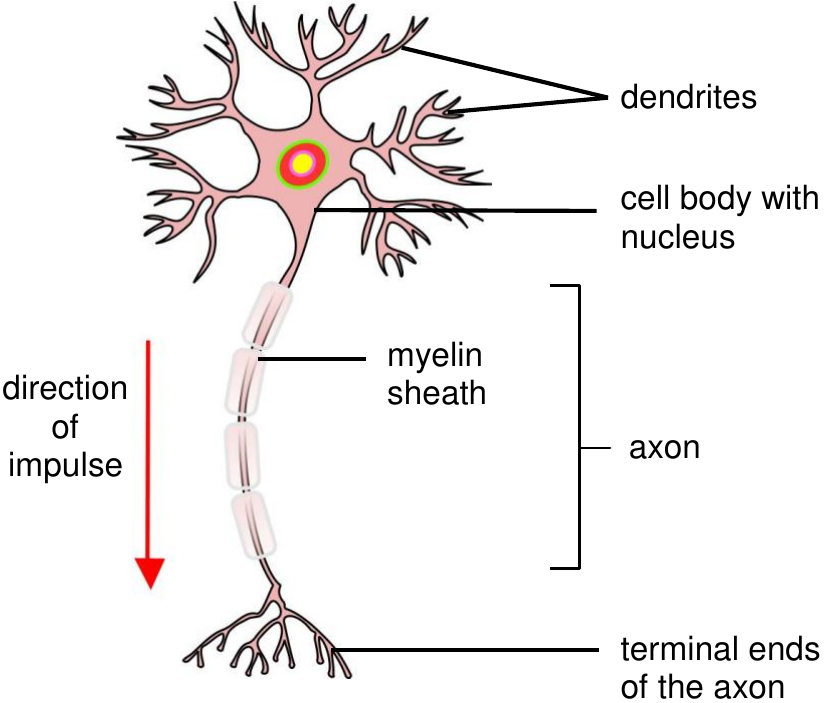
Dendrites are branch-like extensions that project from the cell body, resembling the branches of a tree. These structures act as the receiving stations of the neuron. Their main function is to collect incoming nerve impulses from other neurons or sensory receptors and carry these signals towards the cell body. The branched structure increases the surface area, allowing the neuron to receive signals from multiple sources simultaneously.
Cell body and nucleus
The cell body, also called the soma, contains the nucleus and most of the cell's organelles. This is the control centre of the neuron, where all the cell's metabolic activities are coordinated. The nucleus houses the genetic material and controls protein synthesis, ensuring the neuron can maintain itself and function properly. The cell body processes the incoming signals from the dendrites and determines whether to generate an outgoing impulse.
Axon
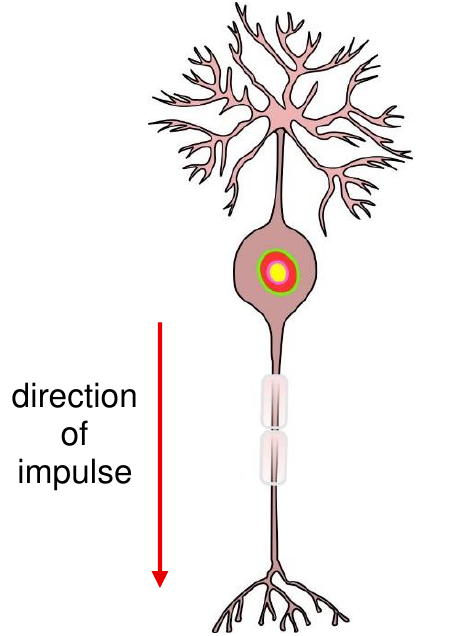
The axon is a long projection that extends away from the cell body. Its primary purpose is to carry nerve impulses away from the cell body towards other neurons, muscles, or glands. Axons can vary dramatically in length - some are microscopic, while others can extend over a metre in length, such as those running from your spinal cord to your toes.
Note
Memory Aid: Remember "Axons carry signals Away" from the cell body, while "Dendrites carry signals Directly towards" the cell body.
Myelin sheath and neurilemma
Many axons are surrounded by a white, fatty substance called the myelin sheath. This sheath acts like insulation around an electrical wire, serving two crucial functions. Firstly, it prevents electrical signals from leaking out of the axon, ensuring efficient transmission. Secondly, it dramatically increases the speed at which impulses travel along the axon - myelinated axons can conduct impulses up to 100 times faster than unmyelinated ones.
The myelin sheath is enclosed by a thin membrane called the neurilemma. This membrane plays a vital role in neuron repair and regeneration when damage occurs, helping to guide the regrowth of damaged axons.
Axon terminals
At the end of the axon, the fibre branches into smaller endings called axon terminals or terminal branches. These structures contain tiny sacs filled with chemical messengers that will be released when a nerve impulse reaches the end of the axon.
Types of neurons
The nervous system contains three main types of neurons, each with a specific role in processing and transmitting information. Understanding these types helps explain how your body coordinates complex responses to stimuli.
Sensory neurons
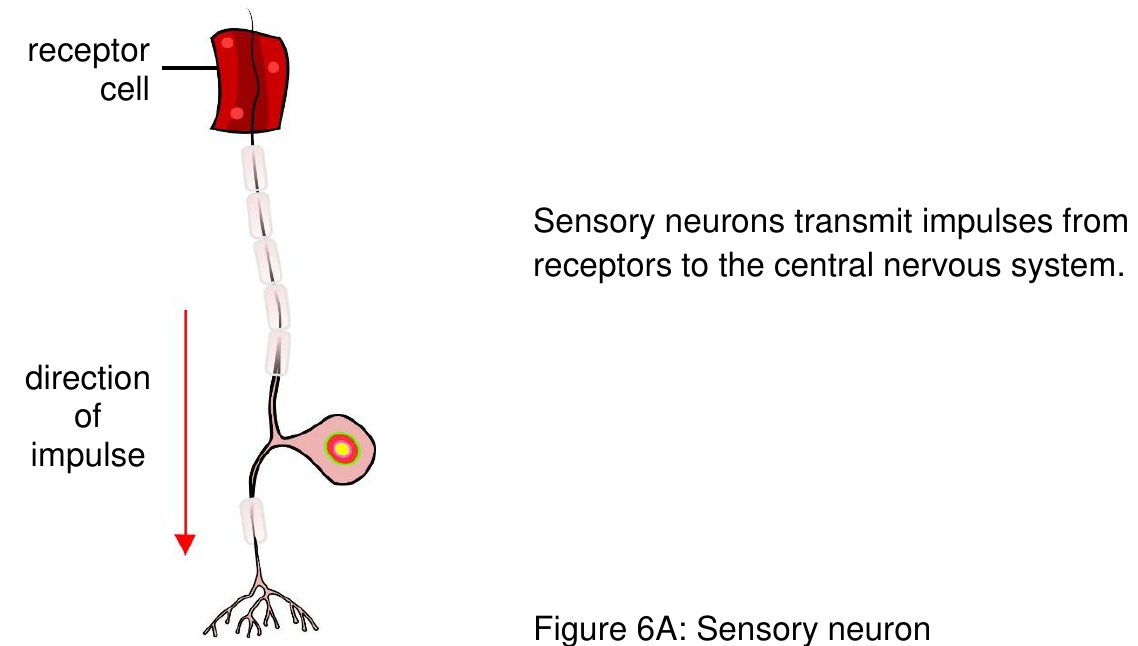
Sensory neurons are your body's information gatherers. They collect data from both your external environment and internal body conditions. These neurons have specialised receptor cells that can detect various stimuli such as light, sound, temperature, pressure, or chemical changes.
The key characteristic of sensory neurons is that they carry impulses from receptors towards the central nervous system (brain and spinal cord). For example, when you touch something hot, sensory neurons in your skin detect the high temperature and send this information to your brain for processing.
Interneurons
Interneurons serve as the connecting links in the nervous system. These neurons are found entirely within the central nervous system and act as intermediaries between sensory and motor neurons. When a sensory neuron delivers information to the spinal cord or brain, interneurons process this information and determine the appropriate response.
Interneurons are crucial for complex processing tasks such as memory formation, decision-making, and coordinating reflexes. They allow the nervous system to integrate multiple inputs and produce coordinated outputs.
Motor neurons
Motor neurons are the action-takers of the nervous system. They carry impulses away from the central nervous system towards effector organs - primarily muscles and glands. When your brain decides to move your hand or when your body needs to release a hormone, motor neurons deliver these commands.
The axon terminals of motor neurons connect to muscles or glands, where they release chemicals that trigger the desired response. For instance, when you decide to pick up a pen, motor neurons carry this command from your brain to the appropriate muscles in your arm and hand.
Important
Direction of Signal Flow:
- Sensory neurons: Receptors → CNS (towards the brain/spinal cord)
- Motor neurons: CNS → Effectors (away from the brain/spinal cord)
- Interneurons: Within the CNS only (connecting sensory to motor)
Remember: The direction of impulse flow is always dendrites → cell body → axon → axon terminals for all neuron types.
Synapses
What is a synapse?
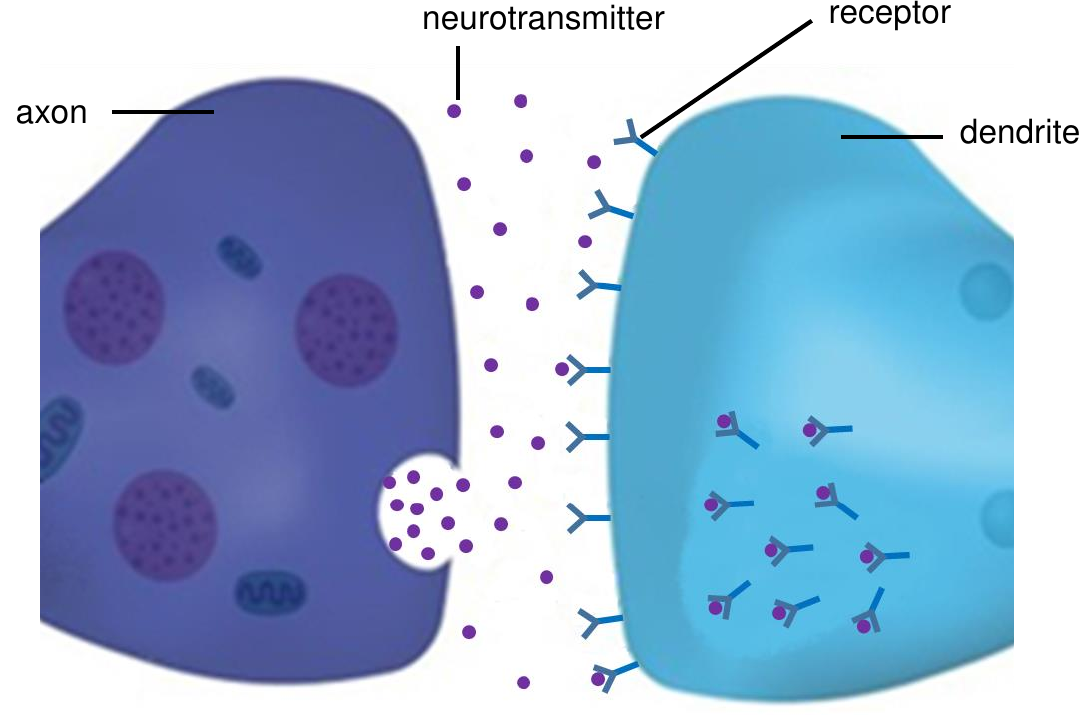
A synapse represents the functional connection point between two neurons. However, neurons don't actually touch each other directly. Instead, there's a tiny gap called the synaptic cleft between the axon terminal of one neuron and the dendrite of the next neuron.
How synapses work
When a nerve impulse reaches the end of an axon, it cannot simply jump across the gap to the next neuron. Instead, the impulse triggers the release of special chemicals called neurotransmitters from the axon terminal. These chemical messengers diffuse across the synaptic cleft and bind to specific receptor proteins on the dendrite of the receiving neuron.
When enough neurotransmitters bind to the receptors, they generate a new electrical impulse in the receiving neuron. This process converts an electrical signal into a chemical signal, then back into an electrical signal, allowing communication between neurons.
Note
Signal Conversion Process: Electrical signal → Chemical signal (neurotransmitters) → Electrical signal
This conversion process occurs at every synapse, ensuring precise control of nerve transmission.
Importance of synapses
Synapses serve several critical functions that are essential for proper nervous system operation:
Unidirectional transmission: Synapses ensure that nerve impulses travel in only one direction. Since neurotransmitters are only released from axon terminals and receptors are only found on dendrites, signals cannot flow backwards. This prevents confusion and maintains organised information flow.
Prevention of continuous stimulation: After neurotransmitters deliver their message, they are quickly removed from the synaptic cleft through various mechanisms. This prevents the receiving neuron from being continuously stimulated, allowing the system to reset and be ready for the next signal.
Signal integration: Synapses allow neurons to integrate multiple inputs. A single neuron may receive signals from hundreds of other neurons through different synapses. The neuron can then "decide" whether to generate its own impulse based on the combined input it receives.
Plasticity and learning: The strength of synaptic connections can change over time, forming the basis for learning and memory formation.
Common misconceptions and exam tips
Important
Common Misconception: Many students think that electrical impulses jump directly from one neuron to another.
Reality: Impulses are converted to chemical signals at synapses, then converted back to electrical signals. There is no direct electrical connection between neurons.
Exam tip: Remember that the direction of impulse flow is always: dendrites → cell body → axon → axon terminals. This applies to all types of neurons.
Exam tip: When describing neuron types, focus on the direction of signal transmission:
- Sensory: towards CNS
- Motor: away from CNS
- Interneuron: within CNS
Note
South African Context: Understanding neurons is crucial for comprehending conditions that affect many South Africans, such as diabetes-related nerve damage (diabetic neuropathy) and the effects of traditional medicines on nervous system function.
Summary
Key Points to Remember:
-
Neurons are specialised cells that transmit electrical signals throughout the body, connecting the brain and spinal cord to all body parts
-
The three main parts of a neuron work together: dendrites receive signals, the cell body processes them, and the axon transmits them away
-
Three types of neurons have specific roles: sensory neurons carry information to the CNS, motor neurons carry commands from the CNS, and interneurons connect them within the CNS
-
Synapses use chemical messengers called neurotransmitters to transmit signals between neurons, ensuring one-way communication and preventing continuous stimulation
-
The myelin sheath speeds up impulse transmission and helps repair damaged neurons through the neurilemma membrane