The Central Nervous System (Grade 12 NSC Matric Life Sciences): Revision Notes
📚Revision Notes
The Central Nervous System
How humans respond to their environment
Every day, your body experiences countless changes that require responses. These changes are called stimuli (singular: stimulus). Think of stimuli as signals that tell your body "something's happening - you need to react!"
Note
Understanding stimuli is fundamental to grasping how your nervous system works. Your body is constantly monitoring both internal conditions and external environment to maintain balance and ensure survival.
Stimuli can come from two sources:
Internal stimuli occur inside your body and include:
- Changes in body temperature when you have a fever
- Low blood sugar levels when you're hungry
- High carbon dioxide levels when you've been exercising
- Changes in water levels when you're dehydrated
External stimuli come from your environment and include:
- Pain when you touch something sharp
- Bright light when you step outside
- Cold temperature when winter arrives
- Dangerous situations that require quick reactions
Your ability to detect and respond to these stimuli is essential for survival. This is where your nervous system becomes crucial - it's like your body's control and communication network.
Understanding the central nervous system
The central nervous system (CNS) serves as your body's main control centre. It consists of two major components that work together seamlessly:
- The brain - the master controller
- The spinal cord - the main communication highway
Important
The brain and spinal cord must work together as an integrated system. The brain makes decisions and processes complex information, while the spinal cord serves as the vital communication link between the brain and the rest of your body.
These two structures are responsible for processing information, making decisions, and coordinating your body's responses to stimuli.
The brain - your body's control centre
Why does the brain need so much protection?
Your brain is made of extremely delicate nervous tissue that cannot repair itself if damaged. Imagine trying to fix a complex computer circuit - once it's broken, it's nearly impossible to restore. This is why your brain requires exceptional protection through three important mechanisms:
- The cranium - a strong, bony skull that acts like a protective helmet
- The meninges - three special membranes that wrap around the brain like protective layers
- Cerebrospinal fluid - a cushioning liquid that absorbs shocks and impacts
Important
Critical Concept: Unlike other body tissues that can heal and regenerate, brain tissue has very limited repair capabilities. This is why prevention of brain injury through proper protection mechanisms is absolutely essential.
Major brain regions and their roles
Your brain isn't just one large mass - it's organised into different regions, each with specialised functions. Let's explore the main areas and what they do for you:
The cerebrum is your brain's largest region and handles your most complex activities. It's divided into two halves (hemispheres) connected by a bridge called the corpus callosum. The cerebrum is responsible for:
- Controlling voluntary movements like walking, writing, and speaking
- Processing information from your senses (what you see, hear, feel, taste, and smell)
- Managing higher-level thinking including memory formation, problem-solving, and reasoning
- Ensuring the two brain halves can communicate with each other
The cerebellum is your brain's balance and coordination specialist. Located at the back and below the cerebrum, it:
- Coordinates your muscles to maintain balance while you move
- Ensures smooth, controlled movements during activities like walking or running
- Maintains proper posture when you're sitting or standing
- Keeps your muscles at the right tension level
The medulla oblongata is located at the base of your brain where it connects to the spinal cord. This region controls your most vital life functions:
- Managing your breathing rhythm and depth
- Controlling your heartbeat and blood circulation
- Coordinating swallowing and digestive movements (peristalsis)
- Managing simple reflexes like coughing, sneezing, and blinking
- Transmitting messages between your brain and spinal cord
The hypothalamus is a small but mighty region that acts as your body's control centre for basic needs:
- Regulating when you feel hungry or thirsty
- Controlling your sleep-wake cycles
- Managing your body temperature
- Influencing your emotions and stress responses
Example
Worked Example: Brain Regions Working Together
When you're playing a sport like basketball:
Step 1: Your cerebrum processes what you see (the ball coming towards you) and decides to catch it
Step 2: Your cerebellum coordinates your arm and hand movements to ensure smooth, balanced motion
Step 3: Your medulla oblongata automatically increases your heart rate and breathing to supply more oxygen
Step 4: Your hypothalamus may trigger thirst signals if you become dehydrated
This shows how all brain regions work as an integrated team!
The spinal cord - your communication highway
Structure and organisation
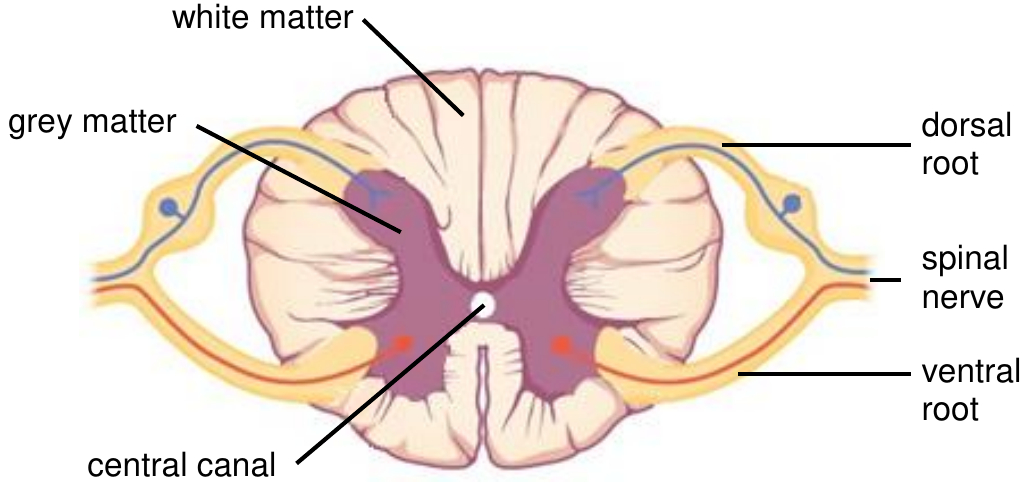
The spinal cord extends from the medulla oblongata down through your back, serving as the main communication pathway between your brain and the rest of your body. When you look at a cross-section of the spinal cord, you'll notice a distinctive butterfly or H-shaped pattern:
Note
The butterfly shape in spinal cord cross-sections is created by the arrangement of grey and white matter. This distinctive pattern helps identify different regions and understand how the spinal cord processes information.
The spinal cord contains two types of nervous tissue:
- Grey matter (the butterfly-shaped centre) contains nerve cell bodies and processes information
- White matter (the outer region) contains nerve fibres that carry messages up and down the spinal cord
Nerve roots extend from each side of the spinal cord:
- Dorsal roots bring sensory information into the spinal cord
- Ventral roots carry motor commands out from the spinal cord
- These roots combine to form spinal nerves that connect to different parts of your body
The central canal runs through the middle of the grey matter and contains cerebrospinal fluid.
Protection of the spinal cord
Like your brain, the spinal cord requires excellent protection due to its delicate nature:
- 33 vertebrae (backbone bones) surround the spinal cord, with cartilage discs between them acting as shock absorbers
- Three meninges (the same protective membranes that cover the brain) wrap around the spinal cord
- Cerebrospinal fluid fills the spaces around the spinal cord, providing cushioning
Important
The spinal cord uses the same three-layer protection system as the brain: bony protection (vertebrae instead of cranium), meninges, and cerebrospinal fluid. This triple protection is essential because spinal cord damage can cause permanent paralysis.
Functions of the spinal cord
Your spinal cord performs two essential functions:
- Message transmission: It carries nerve impulses between your brain and body parts. Sensory information travels up to the brain, while motor commands travel down to muscles and organs.
- Reflex processing: The spinal cord contains reflex centres that can respond automatically to protect your body. These reflexes don't need to involve the brain, allowing for immediate protective responses.
Note
Spinal reflexes are incredibly fast because they don't require the signal to travel all the way to the brain and back. This speed can be the difference between minor injury and serious harm in dangerous situations.
Neurons - the building blocks
Neurons are specialised cells that form the basic functional units of your nervous system. They create the communication network that connects your brain and spinal cord to every part of your body.
Each neuron has three main parts:
- Dendrites - branch-like extensions that receive incoming messages
- Cell body - contains the nucleus and controls the cell's metabolism
- Axon - a long projection that carries messages away from the cell body
Note
Think of neurons like a telephone network: dendrites are like the receivers picking up calls, the cell body is like the processing centre that decides what to do with the information, and the axon is like the wire that carries the message to its destination.
Summary
Key Points to Remember:
-
The central nervous system consists of the brain and spinal cord working together to process information and control body responses
-
Your brain has four main regions: the cerebrum (thinking and voluntary movement), cerebellum (balance and coordination), medulla oblongata (vital functions), and hypothalamus (basic needs)
-
Both the brain and spinal cord are protected by the cranium/vertebrae, meninges, and cerebrospinal fluid because nervous tissue cannot repair itself
-
The spinal cord serves as a two-way communication highway between the brain and body, and also processes simple reflexes automatically
-
Neurons are the specialised cells that make up the nervous system, with dendrites receiving messages, cell bodies controlling metabolism, and axons transmitting messages