Geotropism (Grade 12 NSC Matric Life Sciences): Revision Notes
📚Revision Notes
Geotropism
What is geotropism?
Geotropism refers to how plants respond to the force of gravity by adjusting their growth direction. This fascinating plant behaviour ensures that different parts of the plant grow in the most beneficial directions for survival. When you place a potted plant on its side in complete darkness, something remarkable happens - the stem will curve and grow upward while the roots continue to grow downward, all without any light to guide them.
This response occurs because plants have evolved to detect gravitational pull and use this information to orient themselves properly for optimal growth and resource acquisition.
Note
The amazing thing about geotropism is that it works even in complete darkness. This proves that plants don't need light to know which direction is up or down - they can sense gravity directly through specialised cells that contain dense particles called statoliths.
Types of geotropism
Understanding geotropism becomes clearer when we examine its two distinct types, which affect different parts of the plant in opposite ways.
Positive geotropism
Positive geotropism occurs when plant parts grow in the same direction as gravitational pull. Roots exhibit this type of response by consistently growing downward into the soil. This downward growth is essential because it allows roots to:
- Anchor the plant firmly in the ground
- Access water and minerals deeper in the soil
- Establish a strong foundation for the plant's support
Even if seeds land upside down or sideways, the emerging roots will always curve and grow towards the centre of the Earth.
Example
Demonstration: Roots Always Grow Down
Take a germinating bean seed and plant it upside down with the root pointing upward. Within 24-48 hours, you'll observe that the root has curved 180 degrees to grow downward into the soil, regardless of its initial position. This clearly shows positive geotropism in action.
Negative geotropism
Negative geotropism happens when plant parts grow in the opposite direction to gravity. Stems and shoots demonstrate this response by growing upward, away from the gravitational pull. This upward growth enables shoots to:
- Reach towards sunlight for photosynthesis
- Position leaves optimally for light capture
- Elevate reproductive structures for better pollination and seed dispersal
The stem's ability to grow against gravity is crucial for the plant's survival and reproductive success.
Role of auxins in geotropism
The mechanism behind geotropism involves plant hormones called auxins, which are responsible for controlling cell growth and elongation. These hormones create the directional growth patterns we observe in geotropic responses.
How auxins work in upright plants
When a plant grows in its normal upright position, auxins are produced at the tips of roots and distributed evenly throughout the growing regions. This balanced distribution results in:
- Equal growth on all sides of the root, causing straight downward growth
- Even development that maintains the plant's vertical orientation
- Proper coordination between root and shoot growth patterns
What happens when plants are placed horizontally
The situation changes dramatically when a plant is placed on its side. Gravity causes auxins to accumulate on the lower side of both roots and shoots, but the effects are completely different:
In roots: High concentrations of auxins on the lower side actually slow down or inhibit cell growth. Meanwhile, the upper side with fewer auxins experiences faster growth. This unequal growth pattern causes the root to curve downward towards gravity.
In shoots: High concentrations of auxins on the lower side promote rapid cell elongation and growth. This increased growth on the lower side causes the shoot to curve upward, away from gravity.
Important
Critical Concept: Opposite Effects of Auxins
Remember that auxins have completely opposite effects in roots versus shoots:
- In roots: High auxin concentration = inhibited growth
- In shoots: High auxin concentration = promoted growth
This opposite response to the same hormone is what creates the bending effect in geotropism.
Geotropism in germinating seeds
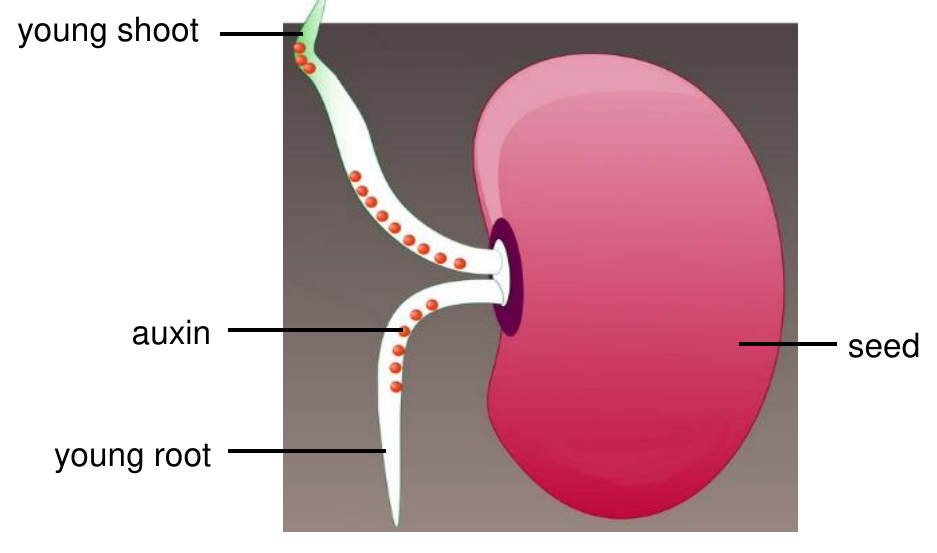
One of the most impressive demonstrations of geotropism occurs during seed germination. Seeds can land in any orientation when they fall or are planted, yet they consistently produce properly oriented seedlings.
When a seed begins to germinate, auxins are distributed throughout the emerging root and shoot structures. Due to gravity, these hormones accumulate on the lower surfaces of both structures. The same principle applies here:
- The developing root responds to high auxin concentrations by having its upper portion grow faster, causing the root to bend and grow downward
- The emerging shoot experiences accelerated growth on its lower side due to high auxin levels, causing it to curve upward
Example
Worked Example: Seed Germination Orientation
Scenario: A bean seed is planted sideways in soil.
Step 1: Initial germination begins with equal auxin distribution
Step 2: Gravity causes auxins to accumulate on the lower side of both root and shoot
Step 3: In the root - upper cells grow faster (fewer auxins), lower cells grow slower (more auxins)
Step 4: In the shoot - lower cells grow faster (more auxins), upper cells grow slower (fewer auxins)
Step 5: Result - root curves down, shoot curves up, achieving proper orientation
This ensures that regardless of how a seed lands in the soil, the root will always grow deep into the ground while the shoot grows towards the surface.
Common misconceptions and exam tips
Understanding common mistakes can help you avoid them and achieve better results in examinations.
Important
Common Misconception Alert
Students often think that auxins always promote growth everywhere in the plant. This is incorrect!
Remember: Auxins have opposite effects in roots versus shoots - they inhibit root growth but promote shoot growth at high concentrations. This is the key mechanism that makes geotropism work.
Note
Exam Success Tips
When describing geotropism, always:
- Specify whether you're discussing positive or negative geotropism
- Clearly state which plant parts are involved (roots vs shoots)
- Explain the role of auxin redistribution
- Use precise scientific terminology
Memory aid: Think "roots are positive about going down" and "shoots are negative about gravity, so they go up."
Summary
Key Points to Remember:
- Geotropism is a plant's growth response to gravity, ensuring proper orientation for survival
- Positive geotropism causes roots to grow downward with gravity for better anchorage and nutrient access
- Negative geotropism makes shoots grow upward against gravity to reach light and optimise photosynthesis
- Auxins are the key hormones controlling geotropic responses, but they affect roots and shoots in opposite ways
- Geotropism in germinating seeds guarantees proper plant orientation regardless of how seeds land in the soil