Ovipary, Ovovivipary, and Vivipary (Grade 12 NSC Matric Life Sciences): Revision Notes
📚Revision Notes
Ovipary, Ovovivipary and Vivipary
Understanding reproductive strategies
Reproductive strategies in vertebrates represent different approaches to ensuring offspring survival and species continuation. The three main reproductive strategies - ovipary, ovovivipary, and vivipary - differ in several crucial aspects including where fertilisation occurs, where the embryo develops, how the developing young receives nutrition, and whether eggs are involved in the process.
These strategies represent an evolutionary spectrum from complete external development to full internal development with maternal support. Understanding these differences helps explain why certain animals reproduce in particular ways and how these strategies relate to their environments and survival needs.
Note
These reproductive strategies have evolved as different solutions to the same fundamental challenge: how to maximise offspring survival while balancing the energy costs to the parent. Each strategy represents millions of years of evolutionary refinement.
Background: Internal vs external fertilisation
Before exploring the three reproductive strategies, it's important to understand the fundamental difference between internal and external fertilisation, as this forms the basis for classifying reproductive methods.

Internal fertilisation occurs when sperm and egg meet inside the female's body, as seen in mammals like wolves and birds like sparrows. This method provides several advantages including protection from environmental factors and increased fertilisation success rates.
External fertilisation requires water and results in many gametes being released, but with high mortality rates. Internal fertilisation needs no water, involves fewer gametes, but provides better protection for offspring through either the mother's body or protective shells.
The three reproductive strategies explained
The three reproductive strategies can be understood as different solutions to the challenge of protecting and nourishing developing offspring. Each strategy represents a different balance between parental investment and offspring independence.
Ovipary (egg-laying)
Ovipary involves laying eggs that develop completely outside the mother's body. This strategy can involve either external or internal fertilisation, depending on the species. In oviparous animals, the developing embryo relies entirely on nutrients stored in the yolk sac within the egg.
The eggs produced are typically either jelly-like (as in amphibians) or have hard calcareous shells (as in birds). This strategy requires the female to invest significant energy in producing nutrient-rich eggs, but once laid, there's no further energy investment required from the mother.
Example
Examples of Ovipary:
- Fish: Most fish species release eggs into water where external fertilisation occurs
- Birds: All birds lay hard-shelled eggs after internal fertilisation
- Amphibians: Frogs lay jelly-like eggs in water
- Reptiles: Many reptiles like turtles bury leather-shelled eggs in sand or soil
The main advantage is that the mother can produce many offspring without the physical burden of carrying them. However, the eggs and young are vulnerable to predators and environmental conditions.
Ovovivipary (egg retention)
Ovovivipary represents a middle ground between ovipary and vivipary. In this strategy, fertilisation is internal, and eggs are retained within the female's body during development. However, the embryo still depends primarily on yolk stored within the egg rather than receiving nutrition directly from the mother.
The eggs in ovoviviparous species typically have calcareous or leathery shells. The young develop inside these eggs within the mother's body and are born live, but they remain essentially independent of direct maternal nutrition during development.
Note
The key distinguishing feature of ovovivipary is that while the young are born live, they still developed inside eggs and relied on yolk for nutrition - not direct maternal feeding.
This strategy provides protection from external predators and environmental conditions while still allowing the mother to avoid the high metabolic cost of directly nourishing the developing young. Examples include some sharks, snakes, and lizards.
Vivipary (live birth)
Vivipary involves internal fertilisation with the embryo developing entirely within the mother's body. The key characteristic of this strategy is that the developing young receives nutrition directly from the mother's body through a specialised structure called the placenta.
Viviparous animals don't produce eggs in the traditional sense. Instead, the embryo develops in direct contact with maternal tissues, allowing for efficient nutrient and gas exchange. This represents the highest level of parental investment during development.
Example
Vivipary in Action:
Human pregnancy demonstrates classic vivipary:
- Internal fertilisation occurs in the fallopian tubes
- The embryo implants in the uterine wall
- The placenta develops to provide oxygen and nutrients
- No egg shell exists - the embryo develops in direct contact with maternal blood supply
- Birth occurs after approximately 9 months of direct maternal support
The main advantage is maximum protection and optimal nutrition for the developing offspring, leading to higher survival rates. However, this requires significant energy investment from the mother and limits the number of offspring that can be produced at once. Most mammals exhibit this reproductive strategy.
Key differences summary
The fundamental differences between these strategies lie in four main areas:
Fertilisation method: Ovipary can involve either external or internal fertilisation, while both ovovivipary and vivipary require internal fertilisation for the subsequent development within the mother's body.
Development location: Ovipary involves external development, while both ovovivipary and vivipary involve development inside the mother's body. This internal development provides protection from predators and environmental hazards.
Nutrition source: The source of nutrition differs significantly. Oviparous embryos depend solely on yolk stored in the egg. Ovoviviparous embryos also rely on yolk but develop inside the mother. Viviparous embryos receive direct nutrition from the mother through the placenta.
Egg presence: Oviparous animals produce eggs with protective shells or coatings. Ovoviviparous animals also produce eggs, but these remain inside the mother's body. Viviparous animals don't produce traditional eggs at all.
Real-world applications and examples
Understanding these reproductive strategies helps explain animal behaviour and adaptation. For instance, many South African reptiles like certain snake species use ovovivipary, which allows them to regulate the temperature and protection of developing young while avoiding the energy cost of placental nutrition.
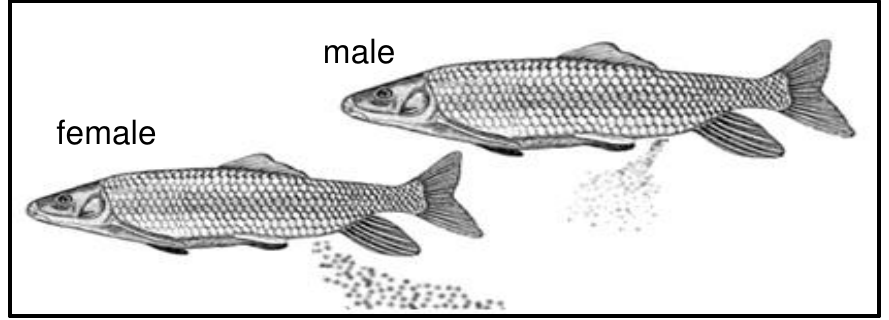
Example
Fish Reproduction Strategy:
The diagram shows how external fertilisation works in fish:
- Female fish release large numbers of eggs into the water
- Male fish simultaneously release sperm to fertilise the eggs
- This synchronised release maximises fertilisation success
- High egg numbers compensate for the high mortality rates in aquatic environments
Fish reproduction often demonstrates ovipary with external fertilisation, where large numbers of eggs are produced to compensate for high mortality rates.
Common misconceptions and exam tips
Important
Common misconception: Students often confuse ovovivipary with vivipary because both involve live birth. Remember that ovovivipary still involves eggs and yolk nutrition, while vivipary has no eggs and uses placental nutrition.
Important
Exam tip: When identifying reproductive strategies, focus on two key questions: "Is there an egg?" and "Where does the embryo get its nutrition?" This will help you distinguish between the three strategies.
Note
Exam tip: Practice drawing and labelling the comparison table from memory, as this is a common exam question format in NSC papers.
Important
Common mistake: Don't assume that all internal fertilisation leads to vivipary. Both ovovivipary and many oviparous animals (like birds) use internal fertilisation.
Remember!
Summary
Key Points to Remember:
- Ovipary = External development with yolk nutrition only (eggs laid outside)
- Ovovivipary = Internal development but still yolk-dependent (eggs retained inside mother)
- Vivipary = Internal development with direct maternal nutrition through placenta (no eggs)
- The progression from ovipary → ovovivipary → vivipary represents increasing parental investment and offspring protection
- All three strategies are successful evolutionary solutions - the "best" strategy depends on the species' environment and ecological niche