Negative Feedback (Grade 12 NSC Matric Life Sciences): Revision Notes
📚Revision Notes
Negative Feedback
What is negative feedback?
Negative feedback is a crucial control mechanism that helps maintain balance in your body. It works like a thermostat in your home - when things get too hot or too cold, the system automatically makes adjustments to bring conditions back to normal.
Note
Think of negative feedback like a thermostat: when your house gets too cold, the heating turns on; when it gets too warm, the heating turns off. Your body uses the same principle to maintain stable internal conditions.
In biological terms, a negative feedback mechanism involves an interaction between different hormones and body systems. When one hormone causes an increase in another hormone, that second hormone will eventually work to reduce or stop the first hormone's activity. This creates a balancing effect that keeps your body functioning properly.
How does negative feedback work?
The negative feedback process follows a specific sequence that ensures your body maintains homeostasis (internal balance). Here's how it works step by step:
Example
The Negative Feedback Sequence:
Step 1: An imbalance occurs somewhere in your body and gets detected by specialised receptors
Step 2: These receptors send signals to stimulate a control centre (usually in your brain)
Step 3: The control centre processes this information and responds appropriately
Step 4: A message gets sent to target organs called effectors, which are responsible for making changes
Step 5: The effector responds by taking action to oppose or reverse the original imbalance
Step 6: Finally, balance gets restored and homeostasis is achieved
This sequence demonstrates how your body continuously monitors and corrects imbalances to maintain optimal function.
Understanding the homeostatic mechanism
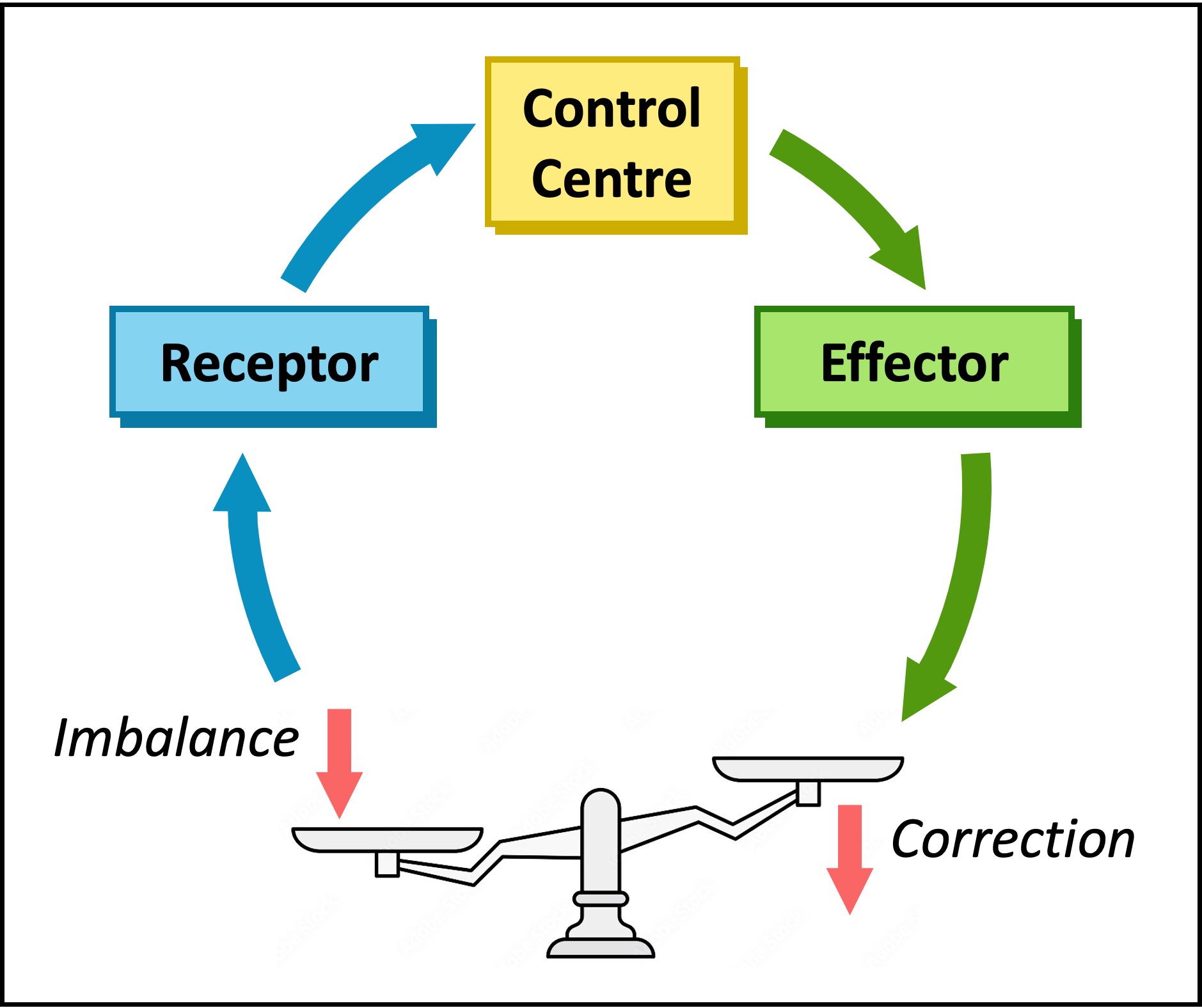
The diagram above shows exactly how your body maintains balance through a continuous cycle. Let's break down what happens at each numbered step:
When an imbalance disrupts your body's homeostasis (shown by the balance scale), it triggers a response at step 1. This disturbance gets detected by receptors at step 2, which are like biological sensors constantly monitoring your internal conditions. These receptors then send information to the control centre at step 3 - think of this as your body's command centre that decides what action to take.
Note
Receptors are specialised cells or organs that can detect changes in your body's internal environment. They act like biological sensors, constantly monitoring conditions such as temperature, hormone levels, or chemical concentrations.
The control centre responds by sending instructions to effectors at step 4. These effectors are the organs or tissues that can actually make the necessary changes to fix the problem. Finally, at step 5, the effector's response works to reverse the original imbalance, bringing your body back to its balanced state.
This creates a circular process that continuously monitors and adjusts your internal environment.
Why is homeostatic control important?
Your body consists of trillions of cells, and each one needs very specific conditions to function properly. The tissue fluid that surrounds all your cells forms what we call the internal environment. The health and function of your cells depends entirely on maintaining the right conditions in this internal environment.
When your body faces changes from either external factors (like temperature changes) or internal factors (like exercise or eating), homeostatic mechanisms kick in to control these effects and maintain stability.
Important
Without proper homeostatic control, your organs and body systems would be negatively affected, and ultimately your entire organism could suffer serious consequences. Every cell in your body relies on stable internal conditions to survive and function.
Key variables controlled by homeostasis
Your body must carefully regulate several important factors to maintain health. Each of these variables requires constant monitoring and adjustment to keep you healthy and functioning optimally.
Note
Essential Controls Include:
- Maintenance of water levels throughout your body
- Regulation of salt concentrations in your blood and tissues
- Control of thyroxin hormone levels that affect metabolism
- Maintenance of glucose levels for proper energy supply
- Regulation of carbon dioxide concentrations in your blood
- Control of body temperature within a narrow range
These variables are interdependent - changes in one often affect the others, which is why your body needs sophisticated control systems.
Main mechanisms for maintaining homeostasis
Your body has developed sophisticated systems to control different aspects of your internal environment. Here are some key examples that demonstrate how different organs work as effectors:
Water regulation: All the chemical reactions happening in your cells (metabolism) require a careful balance of water and salt concentrations in your blood and surrounding tissue fluid. Your kidneys and skin work together as effectors to maintain this balance.
Salt regulation: The amount of dissolved salts in your blood and tissue fluid determines the osmotic pressure, which affects whether your cells gain or lose water through osmosis. This directly impacts the balance of body fluids, and your kidneys serve as the primary effector for controlling salt levels.
Example
Worked Example: Water Balance Control
Scenario: You become dehydrated after exercising
Step 1: Receptors in your brain detect increased salt concentration in your blood
Step 2: The control centre (hypothalamus) processes this information
Step 3: Effectors respond:
- Kidneys reduce water loss by producing concentrated urine
- You feel thirsty, encouraging water intake
- Skin reduces water loss through sweating
Result: Water balance is restored and homeostasis is maintained
These regulatory mechanisms show how different organs work as effectors to respond to imbalances and restore proper conditions in your body.
Summary
Key Points to Remember:
- Negative feedback opposes change - when something increases, the feedback mechanism works to decrease it, and vice versa
- The homeostatic cycle follows a clear pattern - imbalance → receptor detects → control centre responds → effector acts → balance restored
- Your internal environment must remain stable for your cells to function properly and maintain health
- Multiple variables need constant regulation including water, salts, glucose, temperature, and gas concentrations
- Different organs act as effectors - like kidneys for water/salt balance and skin for temperature control