The Difference Between the Important Secretory Glands (Grade 12 NSC Matric Life Sciences): Revision Notes
📚Revision Notes
The Difference Between the Important Secretory Glands
Understanding secretory glands
Mammals have two main types of secretory glands that produce and release important substances in our bodies. These glands work differently and have distinct structures that determine how they deliver their secretions to where they're needed. Understanding the difference between exocrine and endocrine glands is essential for grasping how our body maintains homeostasis and carries out vital functions.
Note
The ability to distinguish between these two gland types is fundamental to understanding how the body coordinates its many functions and maintains internal balance.
Exocrine glands vs endocrine glands
The human body contains both exocrine and endocrine glands, each serving different purposes and using different methods to deliver their secretions to target locations. The key structural difference lies in how they transport their secretions to target locations. Let's explore the key differences between these two important types of glands.
Exocrine glands - the glands with ducts
Exocrine glands are characterised by having specialised tubes called ducts that carry their secretions to specific locations. These glands release their products either onto body surfaces (like the skin) or into body cavities (such as the mouth or stomach). The duct system acts like a delivery pipeline, ensuring that secretions reach exactly where they're needed.
Common examples of exocrine glands include:
- Salivary glands - produce saliva that helps with digestion and keeping the mouth moist
- Sweat glands - release sweat onto the skin surface to help cool the body
- Sebaceous glands - produce oils to keep skin and hair moisturised
Endocrine glands - the ductless hormone producers
Endocrine glands operate very differently from exocrine glands. They are ductless, meaning they don't have tubes to carry their secretions. Instead, these glands release chemical messengers called hormones directly into the bloodstream. The blood then transports these hormones throughout the body to reach their target organs and tissues.
Important examples of endocrine glands include:
- Pituitary gland - produces ADH (antidiuretic hormone) which helps regulate water balance
- Thyroid gland - releases TSH (thyroid stimulating hormone) which controls metabolism
- Pancreas - secretes insulin which regulates blood sugar levels
How these glands work differently
The structural differences between these glands determine how they function and deliver their secretions.
Important
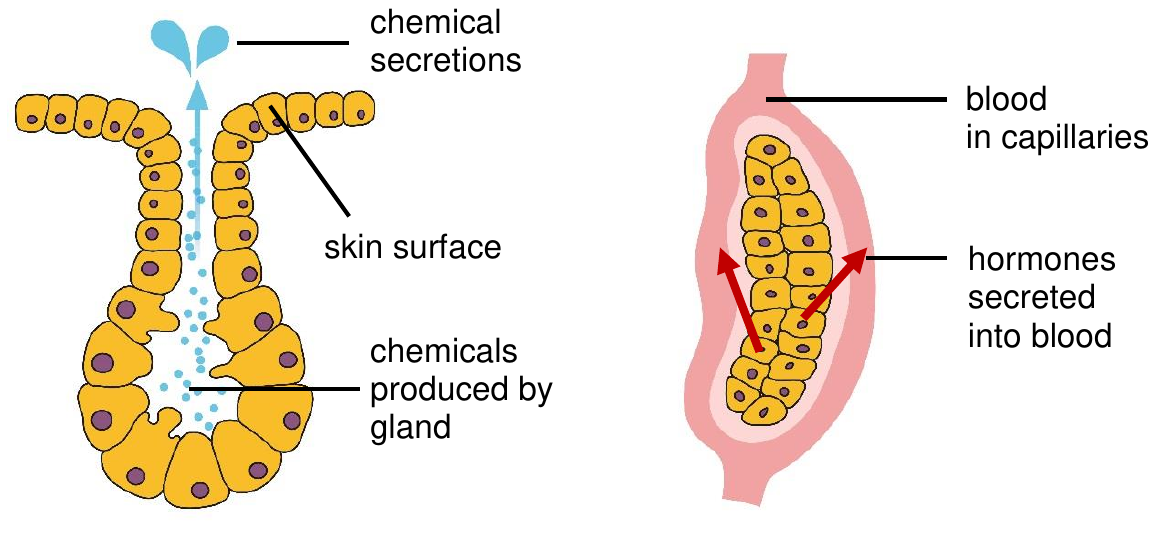
The diagram above clearly shows the fundamental difference in how these glands operate. The exocrine gland on the left uses its duct system to deliver chemical secretions directly to the skin surface, while the endocrine gland on the right releases hormones into the surrounding blood capillaries for transport throughout the body.
Special case - dual function glands
Note
Dual Function Glands
Some glands can function as both exocrine and endocrine glands, demonstrating the remarkable versatility of our body's secretory systems.
The pancreas is an excellent example of this dual functionality:
- As an exocrine gland: The pancreas produces digestive enzymes that travel through ducts to the small intestine to help break down food
- As an endocrine gland: The pancreas releases hormones like insulin and glucagon directly into the bloodstream to regulate blood sugar levels
Understanding hormones and their functions
Hormones are remarkable chemical messengers that coordinate many body functions. These organic compounds are primarily proteins, although some are steroids (lipids). What makes hormones particularly effective is that they only need to be present in very small amounts to produce significant effects, and their responses last much longer than nerve impulses.
Key functions of hormones
Hormones serve three main purposes in maintaining body function:
- Reproduction, growth and development - controlling sexual maturation, growth rates, and reproductive cycles
- Maintenance of the internal environment - this involves either stimulating or inhibiting the function of specific cells and organs to maintain balance
- Regulation of metabolism - controlling how the body produces, uses, and stores energy from food
Antagonistic hormone action
Example
Worked Example: Antagonistic Hormone Action
Many hormones work in pairs with opposite effects, known as antagonistic action. This means that when one hormone increases a particular substance in the body, another hormone will decrease it.
Perfect example: Insulin and glucagon
- Insulin lowers blood glucose levels when they are too high
- Glucagon raises blood glucose levels when they are too low
- Result: Precise control over blood sugar levels through opposing actions
This antagonistic relationship helps maintain precise control over important body functions, ensuring that optimal balance is maintained even when conditions change.
Summary
Key Points to Remember:
- Exocrine glands have ducts that carry secretions to surfaces or cavities (like salivary and sweat glands)
- Endocrine glands are ductless and release hormones directly into the bloodstream (like the pituitary and thyroid glands)
- Hormones are chemical messengers that coordinate body functions and only need small amounts to be effective
- Some glands like the pancreas can function as both exocrine and endocrine glands
- Antagonistic hormones work in opposite ways to maintain precise control over body functions, such as insulin and glucagon regulating blood sugar levels