Addition, Elimination, and Substitution Reactions (Grade 12 NSC Matric Physical Sciences): Revision Notes
📚Revision Notes
Addition, Elimination, and Substitution Reactions
Organic molecules undergo three main types of reactions that transform their structure and properties. Understanding these reaction patterns is essential for predicting how organic compounds behave and interact with other substances.
Overview of reaction types
Addition reactions occur when two or more reactants combine to form a single product. The atoms that were present in the reactants all appear in the final product. Addition reactions happen with unsaturated compounds (those containing carbon-carbon double or triple bonds).
General equation:
Elimination reactions occur when a reactant is broken up into two products. These reactions happen with saturated compounds (those containing only single bonds) and result in the formation of unsaturated products.
General equation:
Substitution reactions occur when an exchange of elements in the reactants takes place. The initial reactants are transformed or swapped around to give a final product.
General equation:
Note
These three reaction types form the foundation of organic chemistry. Remember that addition and elimination reactions are essentially opposite processes - addition creates saturated compounds from unsaturated ones, while elimination creates unsaturated compounds from saturated ones.
Addition reactions
Addition reactions involve adding atoms or groups of atoms to unsaturated compounds, specifically across carbon-carbon double bonds. During these reactions, the double bond breaks and becomes a single bond, making the compound saturated.
1. Hydrohalogenation
Hydrohalogenation involves the addition of a hydrogen atom and a halogen atom to an unsaturated compound containing a carbon-carbon double bond. The halogen can be fluorine (F), chlorine (Cl), bromine (Br) or iodine (I).
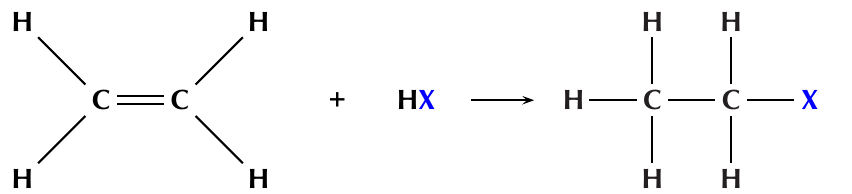
During hydrohalogenation, the hydrogen atom bonds to one carbon of the double bond, while the halogen atom bonds to the other carbon atom.
Major and minor products
When more than one product is possible, the major product will be the compound where:
- The hydrogen atom is added to the least substituted carbon atom (the carbon with the least number of carbon atoms bonded to it)
- The halogen atom is added to the more substituted carbon atom (the carbon with the most number of carbon atoms bonded to it)
Important
This follows Markovnikov's rule - a fundamental principle in organic chemistry that helps predict the major product in addition reactions. The rule states that hydrogen adds to the carbon with fewer carbon neighbours, creating the more stable product.
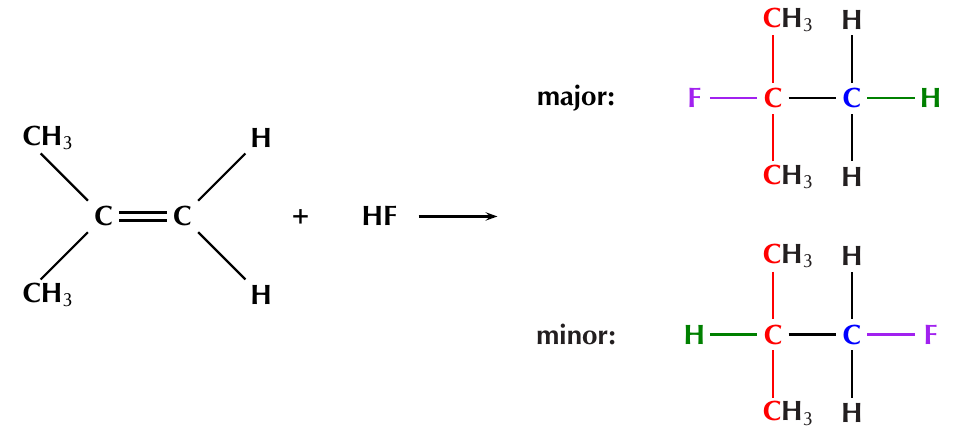
Reaction conditions:
- No water present in the reaction
2. Halogenation
Halogenation is very similar to hydrohalogenation, but a diatomic halogen molecule is added across the double bond instead of a hydrogen halide.
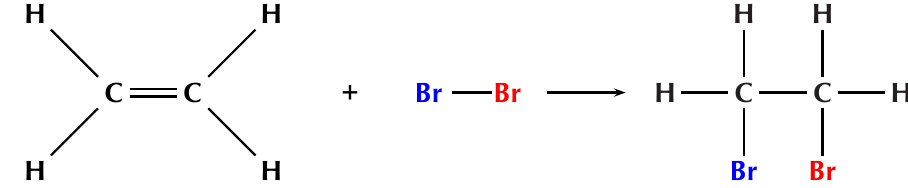
In halogenation, both halogen atoms from the diatomic molecule (such as Br₂) add to the carbons that previously formed the double bond.
3. Hydration
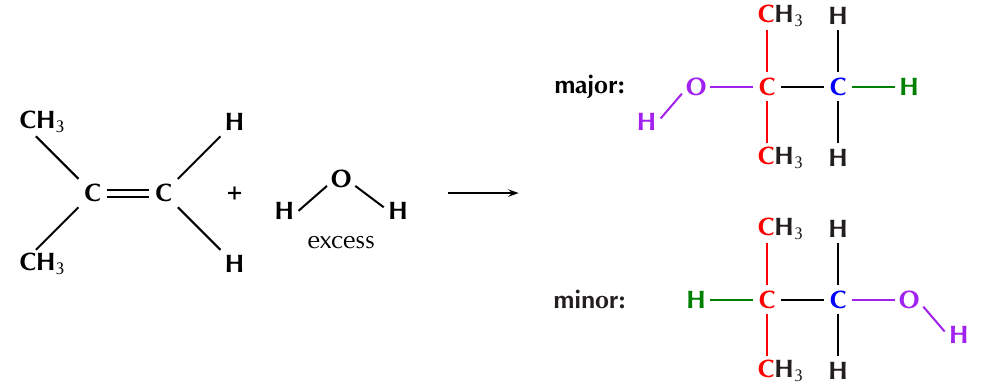
A hydration reaction involves the addition of water (H₂O) to an unsaturated compound. This is one way of preparing an alcohol from the corresponding alkene.
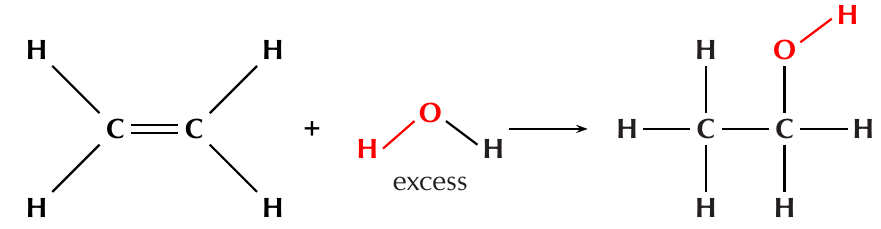
When more than one product is possible, the major product follows Markovnikov's rule:
- The hydrogen atom from water is added to the least substituted carbon atom
- The hydroxyl group (OH⁻) is added to the more substituted carbon atom
Note
Reaction conditions for hydration:
- Water must be present in excess
- An acid catalyst is needed for this reaction to take place
- The catalyst most commonly used is phosphoric acid (H₃PO₄)
4. Hydrogenation
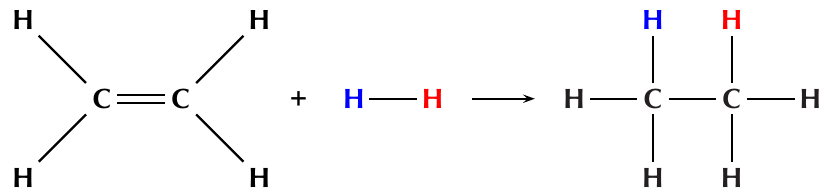
Hydrogenation involves adding hydrogen (H₂) to an alkene. During hydrogenation, the double bond is broken and more hydrogen atoms are added to the molecule.
Note
Reaction conditions for hydrogenation:
- A catalyst such as platinum (Pt), palladium (Pd) or nickel (Ni) is needed
- Heating is required
- The reaction must be done under an inert atmosphere (not air, e.g. N₂ gas atmosphere)
A common industrial example is the hydrogenation of vegetable oils to form margarine.
5. Polymerisation reactions
A polymer is made up of lots of smaller units called monomers. When these monomers are added together, they form a polymer. Polymerisation can occur through an addition reaction.
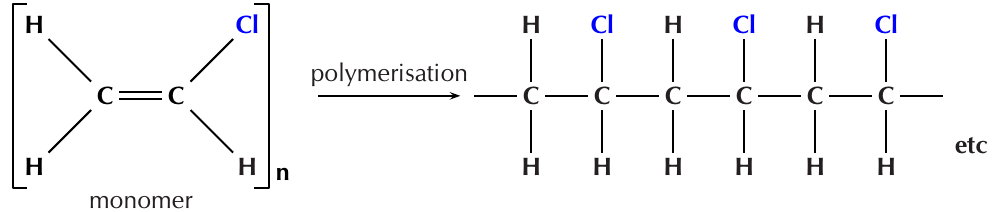
In this example, vinyl chloride monomers undergo addition polymerisation to form polyvinyl chloride (PVC), which is used in construction and clothing.
Elimination reactions
Elimination reactions involve removing atoms or groups of atoms from saturated compounds to form unsaturated products. These reactions are essentially the reverse of addition reactions.
1. Dehydrohalogenation
In dehydrohalogenation, a haloalkane is exposed to a base. The base helps eliminate the halogen and a hydrogen atom, forming a double bond (alkane → alkene).

Note
Reaction conditions for dehydrohalogenation:
- Heat under reflux (approximately 70°C)
- A concentrated, strong base (e.g. NaOH, KOH)
- The base must be dissolved in pure ethanol (hot ethanolic base)
When more than one product is possible, the major product will be the compound where:
- The hydrogen atom is removed from the more substituted carbon atom
- This creates the more substituted (more stable) alkene
Example
Worked Example: Dehydrohalogenation of 2-bromobutane
Starting material: CH₃-CHBr-CH₂-CH₃ + NaOH → products + NaBr + H₂O
Major product: CH₃-CH=CH-CH₃ (but-2-ene - internal double bond) Minor product: CH₂=CH-CH₂-CH₃ (but-1-ene - terminal double bond)
The major product forms because the hydrogen is removed from the carbon with more carbon neighbours.
2. Dehydration of alcohols
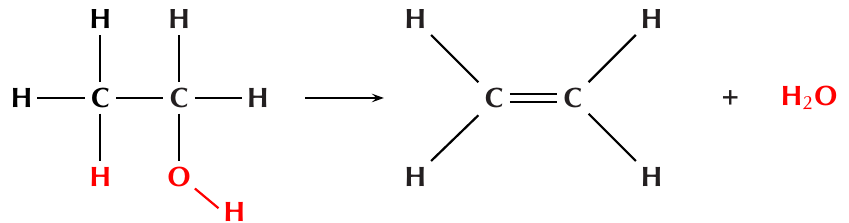
During the dehydration of an alcohol, the hydroxyl (-OH) group and a hydrogen atom are eliminated from the reactant. A molecule of water is formed as a product in the reaction, along with an alkene.
Note
Reaction conditions for dehydration:
- An excess of a strong acid catalyst (generally H₂SO₄ or H₃PO₄)
- High temperature (approximately 180°C)
When more than one elimination product is possible, the major product will be the compound where the hydrogen atom is removed from the carbon atom bonded to the most number of carbon atoms (the more substituted carbon atom).
Example
Worked Example: Dehydration of butan-2-ol
Starting material: CH₃-CH(OH)-CH₂-CH₃ → products + H₂O
Major product: CH₃-CH=CH-CH₃ (but-2-ene) Minor product: CH₂=CH-CH₂-CH₃ (but-1-ene)
The major product has the double bond in a more substituted position, making it more stable.
Substitution reactions
In substitution reactions, one atom or group of atoms in a molecule is replaced by a different atom or group of atoms.
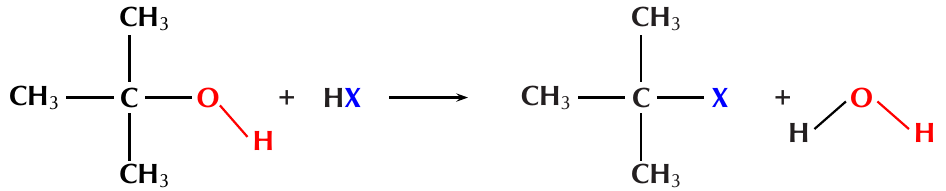
1. Formation of haloalkanes from alcohols
Haloalkanes can be formed when the hydroxyl (-OH) group of an alcohol is replaced by a halogen atom (X = Cl, Br, I). This reaction works best with tertiary alcohols where it can occur at room temperature.
Example
Worked Example: Formation of tert-butyl chloride
(CH₃)₃C-OH + HCl → (CH₃)₃C-Cl + H₂O
The hydroxyl group is substituted by the chlorine atom from hydrogen chloride.
2. Hydrolysis
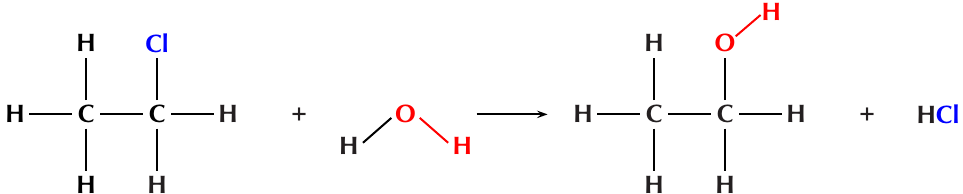
Hydrolysis is a substitution reaction where alcohols can be formed from haloalkanes. In this reaction, the halogen atom is replaced by a hydroxyl group when the haloalkane reacts with water.
Note
Reaction conditions for efficient hydrolysis:
- Low temperatures (around room temperature)
- A dilute solution of a strong base (e.g. NaOH)
- The solution must be aqueous (in water)
Example
Worked Example: Hydrolysis of ethyl bromide
C₂H₅Br + KOH → C₂H₅OH + KBr
The bromine atom is replaced by a hydroxyl group to form ethanol.
3. Formation of haloalkanes from alkanes
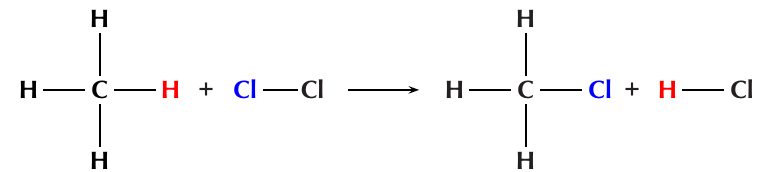
Another way of forming a haloalkane involves the removal of a hydrogen atom from a saturated compound. The hydrogen atom is replaced by a halogen (F, Cl, Br or I) to form a haloalkane.
Example
Worked Example: Chlorination of methane
CH₄ + Cl₂ → CH₃Cl + HCl
Note
Reaction conditions:
- Energy in the form of light is needed for this reaction
This is a free radical substitution mechanism where light provides the energy to break the Cl-Cl bond and initiate the reaction.
Important exam considerations
Understanding these reaction patterns will help you succeed in organic chemistry assessments:
Identifying reaction types:
- Look for double bonds being formed or broken to distinguish addition vs elimination
- Check if atoms are being exchanged to identify substitution
- Pay attention to reaction conditions (temperature, catalysts, solvents)
Predicting major products:
- Apply Markovnikov's rule for addition reactions
- For elimination reactions, the more substituted alkene is usually the major product
- Consider the stability of the products formed
Important
Key reaction conditions to remember:
- Addition reactions often need catalysts and specific temperatures
- Elimination reactions require heat and strong bases
- Substitution reactions have varying conditions depending on the specific reaction type
Summary
Key Points to Remember:
-
Addition reactions add atoms to unsaturated compounds, converting double bonds to single bonds ()
-
Elimination reactions remove atoms from saturated compounds, creating double bonds ()
-
Substitution reactions replace one atom or group with another ()
-
Markovnikov's rule states that in addition reactions, hydrogen adds to the carbon with fewer carbon neighbours, creating the more stable major product
-
Major products are more likely to form than minor products due to greater stability, following predictable patterns based on molecular structure