Alcohols (Grade 12 NSC Matric Physical Sciences): Revision Notes
📚Revision Notes
Alcohols
What are alcohols?
Alcohols are organic compounds that contain a hydroxyl functional group (-OH) attached to a carbon atom. This hydroxyl group is the defining characteristic that makes a compound an alcohol.
Note
The general formula for a simple alcohol is , where n represents the number of carbon atoms in the molecule.
Molecular representations
Alcohols can be represented in several different ways, each showing different levels of detail about the molecular structure:
1. Structural formula - Shows how all atoms are bonded together 2. Condensed structural formula - Shows the molecular structure in a simplified written form 3. Molecular formula - Shows only the types and numbers of atoms present
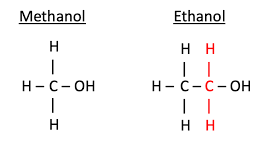
Methanol ()
Methanol is the simplest alcohol with only one carbon atom.
- Structural formula: Shows the carbon bonded to three hydrogens and one OH group
- Condensed formula:
- Molecular formula:
Ethanol ()
Ethanol contains two carbon atoms and is commonly found in alcoholic beverages.
- Structural formula: Shows two carbon atoms with the OH group attached to one end
- Condensed formula:
- Molecular formula:
- 3D model: Ball-and-stick representation showing spatial arrangement
Types of alcohols
Alcohols are classified based on the type of carbon atom to which the hydroxyl group is attached:
Primary alcohols
- The -OH group is attached to a primary carbon atom
- A primary carbon is bonded to only one other carbon atom
- Example: Butan-1-ol (OH group at the end of the chain)
Secondary alcohols
- The -OH group is attached to a secondary carbon atom
- A secondary carbon is bonded to two other carbon atoms
- Example: Butan-2-ol (OH group in the middle of the chain)
Tertiary alcohols
- The -OH group is attached to a tertiary carbon atom
- A tertiary carbon is bonded to three other carbon atoms
- Example: 2-methylpropan-2-ol (OH group attached to a branched carbon)
Example
Classification Example: Identifying Alcohol Types
To determine if an alcohol is primary, secondary, or tertiary:
- Locate the carbon atom with the -OH group
- Count how many other carbon atoms are directly bonded to it
- Classify: 1 carbon = primary, 2 carbons = secondary, 3 carbons = tertiary
Common uses of alcohols
Alcohols have many practical applications in everyday life and industry:
- Ethanol is the only alcohol safe for human consumption in alcoholic drinks
- Methylated spirits contains ethanol mixed with methanol to make it unsuitable for drinking
- Industrial solvent - ethanol dissolves many substances
- Antiseptic properties - ethanol kills bacteria and viruses
- Fuel source - both methanol and ethanol can be used as clean-burning fuels
- Medical and cosmetic applications - used in medicines, perfumes, and plant essences
Safety considerations
Important
Critical Safety Warning: Methanol Toxicity
Methanol is highly toxic and extremely dangerous if consumed. Even small amounts can cause:
- Blindness
- Coma
- Death
- Formation of harmful formic acid or formate salts in the body
Never consume methanol or products containing it. Only ethanol in appropriate concentrations is safe for human consumption.
Exam tips
Summary
Key Points to Remember for Exams:
- Remember the general formula for simple alcohols
- Be able to identify and draw the hydroxyl functional group (-OH)
- Know the difference between primary, secondary, and tertiary alcohols based on carbon attachment
- Understand that ethanol is the only safe alcohol for human consumption
- Practice drawing structural, condensed, and molecular formulas for given alcohols
Remember!
Summary
Essential Takeaways:
- Alcohols contain the hydroxyl functional group (-OH) attached to a carbon atom
- The general formula for simple alcohols is
- Alcohols are classified as primary, secondary, or tertiary based on the carbon type
- Methanol () and ethanol () are the most common simple alcohols
- Only ethanol is safe for human consumption - methanol is highly toxic and can cause death