Applications of Organic Chemistry (Grade 12 NSC Matric Physical Sciences): Revision Notes
📚Revision Notes
Applications of Organic Chemistry
Organic chemistry has numerous practical applications in our daily lives and industrial processes. This section explores two major applications: the use of alkanes as fossil fuels and the production and uses of esters.
Alkanes as fossil fuels
Note
Fossil fuels are energy sources formed through the natural decomposition of organisms over millions of years under conditions of high heat and pressure. These fuels contain a high percentage of carbon and include materials such as coal, petrol, and natural gas. Importantly, fossil fuels are classified as non-renewable resources because they cannot be replaced within a human lifetime.
Hydrocarbon cracking
Important
Hydrocarbon cracking is the process of breaking carbon-carbon bonds in long-chain hydrocarbons to form simpler, shorter-chain hydrocarbons.
This industrial process is essential for converting large, bulky alkane molecules into smaller, more useful compounds. The process produces shorter alkanes and alkenes that have greater commercial value and practical applications.
There are two main types of hydrocarbon cracking:
- Thermal cracking - occurs at high pressures and temperatures without using a catalyst
- Catalytic cracking - occurs at lower pressures and temperatures but uses a catalyst to speed up the reaction
The products of catalytic cracking are particularly valuable because they include both useful alkanes and unsaturated alkenes that can be used in various industrial processes.
Fractional distillation
Once crude oil has been processed through cracking, the various hydrocarbon products can be separated using fractional distillation. This separation technique works because different hydrocarbons have different boiling points.
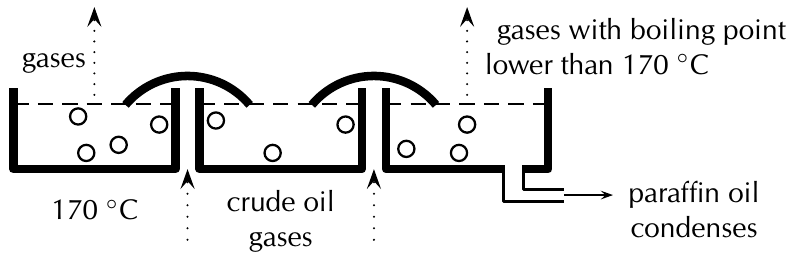
The fractional distillation process works as follows:
- Crude oil is heated to approximately 700°C in a furnace
- The hot vapours rise through a fractionating column containing multiple trays
- Each tray is maintained at a specific temperature
- As the vapours cool while rising, compounds with higher boiling points condense first
- Lighter compounds with lower boiling points continue rising and condense at higher levels
The result is a systematic separation of hydrocarbons based on their molecular size:
- Smaller molecules (1-4 carbon atoms) are collected at the top as gases and liquid petroleum gas
- Medium-sized molecules are collected as petrol, diesel, and paraffin
- Larger molecules are collected lower down as heavier oils and waxes
Combustion of alkanes
Note
Combustion is a chemical reaction where a substance reacts with an oxidising agent (typically oxygen), releasing heat and light energy.
Alkanes serve as our most important fossil fuels because their combustion reactions are highly exothermic, meaning they release large amounts of energy. This makes them ideal for heating, electricity generation, and powering vehicles.
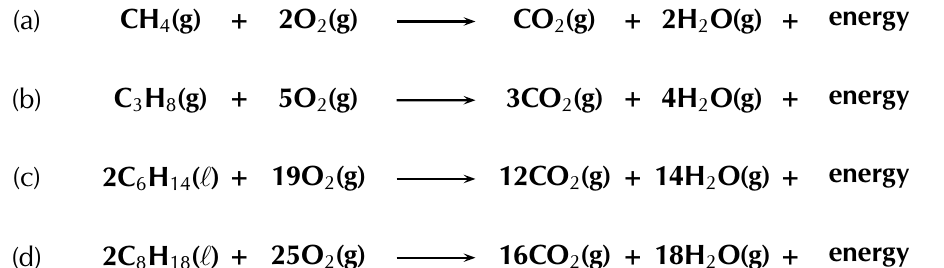
The general equation for complete combustion of any alkane is:
Specific examples of complete combustion include:
- Methane:
- Propane:
- Hexane:
- Octane:
Balancing combustion equations
When balancing combustion equations, follow this systematic approach:
Step 1: Balance carbon atoms first
Step 2: Balance hydrogen atoms second
Step 3: Balance oxygen atoms last
Step 4: Ensure all coefficients are whole numbers
Example
Worked Example: Balancing Combustion Equations
Balance
Step 1 - Carbon atoms: 4 carbons on left, so need on right
Step 2 - Hydrogen atoms: 10 hydrogens on left, so need on right
Step 3 - Oxygen atoms: Right side has 8 + 5 = 13 oxygen atoms, so need on left
Step 4 - Whole numbers: Multiply entire equation by 2 to get:
Esters
Esters are organic compounds formed through the reaction between alcohols and carboxylic acids. They are important in both industry and biology due to their distinctive properties and pleasant fragrances.
Production of esters
Note
Esters are produced through a process called acid-catalysed condensation or esterification. This reaction combines an alcohol and a carboxylic acid in the presence of an acid catalyst to form an ester and water.
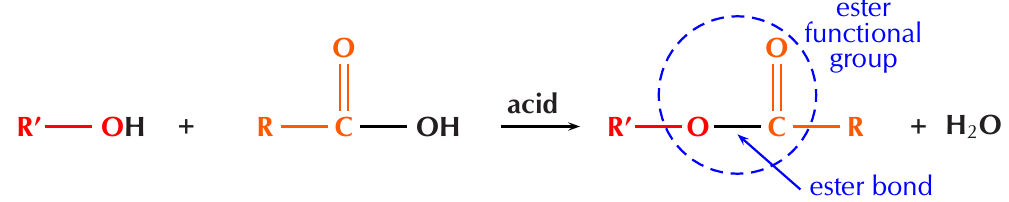
The general equation for esterification is:
More specifically:
Where R and R' represent different alkyl or aryl groups.

A specific example shows the reaction between butanol and propanoic acid:
This produces butyl propanoate and water as products.
Naming esters
Ester names follow a specific pattern that reflects their formation from alcohols and carboxylic acids:
- The first part of the name comes from the alcohol and ends in -yl
- The second part of the name comes from the carboxylic acid and ends in -oate
Example
Worked Example: Naming Esters
Determine the name of the ester formed from hexanol and propanoic acid:
Step 1: The alcohol (hexanol) contributes "hexyl"
Step 2: The carboxylic acid (propanoic acid) contributes "propanoate"
Step 3: The ester name is hexyl propanoate
Properties and uses of esters
Esters have several distinctive properties that make them valuable in various applications:
- Distinctive fragrances - many esters have pleasant, fruity smells
- Lower water solubility compared to their parent alcohols and acids
- Volatile nature - many esters evaporate easily at room temperature
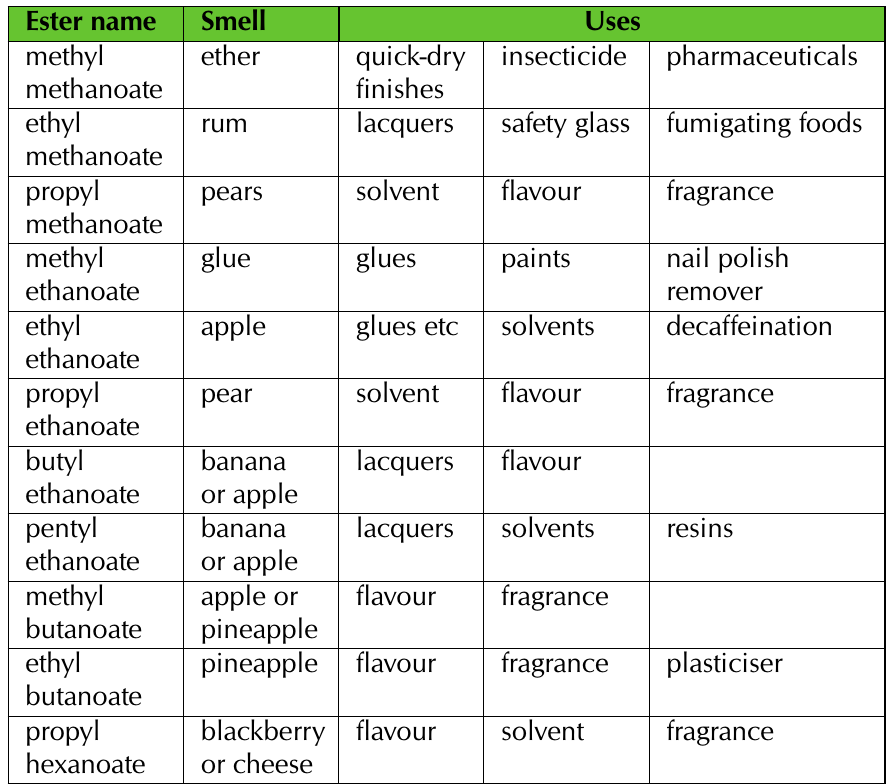
Common applications of esters include:
- Flavourings - artificial fruit flavours in food products
- Fragrances - perfumes and cosmetic products
- Solvents - nail polish remover, paint thinners
- Plasticisers - making plastics more flexible
- Pharmaceuticals - active ingredients in medicines
Laboratory preparation of esters
Note
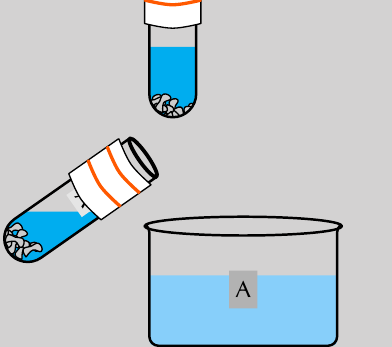
Esters can be prepared in the laboratory by heating a mixture of an alcohol and carboxylic acid with a small amount of concentrated acid catalyst (usually sulfuric acid). The reaction mixture is heated gently in a water bath, and the ester product can be identified by its characteristic smell.
The key steps in ester preparation are:
- Mix the alcohol and carboxylic acid in appropriate proportions
- Add a few drops of concentrated sulfuric acid as catalyst
- Heat the mixture gently in a water bath
- Cool the products and identify the ester by its distinctive odour
Summary
Key Points to Remember:
- Fossil fuels are non-renewable energy sources formed from decomposed organisms that contain high percentages of carbon
- Hydrocarbon cracking breaks long-chain hydrocarbons into shorter, more useful molecules through thermal or catalytic processes
- Fractional distillation separates crude oil components based on their different boiling points
- Complete combustion of alkanes produces carbon dioxide, water, and energy - always balance carbon first, then hydrogen, finally oxygen
- Esters are formed through acid-catalysed condensation between alcohols and carboxylic acids, with names ending in "-yl" (from alcohol) and "-oate" (from acid)