Isomers (Grade 12 NSC Matric Physical Sciences): Revision Notes
📚Revision Notes
Isomers
What are isomers?
Isomers are molecules that have the same molecular formula but different structural arrangements. This means they contain exactly the same number and types of atoms, but these atoms are connected or arranged differently in space.
Note
The key concept to understand is that while isomers share identical molecular formulas, their different structural arrangements give them distinct properties. This demonstrates that the way atoms are arranged in a molecule is just as important as which atoms are present.
For example, two compounds might both have the molecular formula C₄H₁₀, but if their carbon atoms are arranged differently, they are isomers with different physical and chemical properties.
Types of isomers
Structural isomers (positional isomers)
Structural isomers contain the same functional groups, but these groups are attached to different positions on the carbon chain. The functional groups themselves don't change - only their location changes.
Example 1: Butane isomers
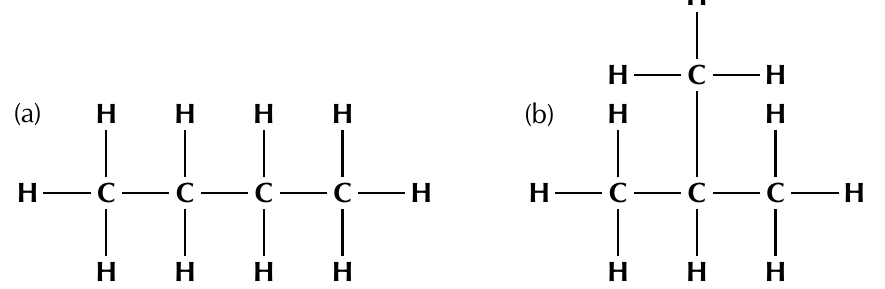
Both compounds have the molecular formula C₄H₁₀, but their structures differ:
- Butane has all four carbon atoms arranged in a straight chain
- 2-methylpropane (also called isobutane) has three carbon atoms in the main chain with a methyl group (-CH₃) branching off the second carbon
Note
These structural differences affect their properties. Both compounds are used in camping stoves and lighters, but they behave slightly differently due to their structural arrangements.
Example 2: Pentanol isomers
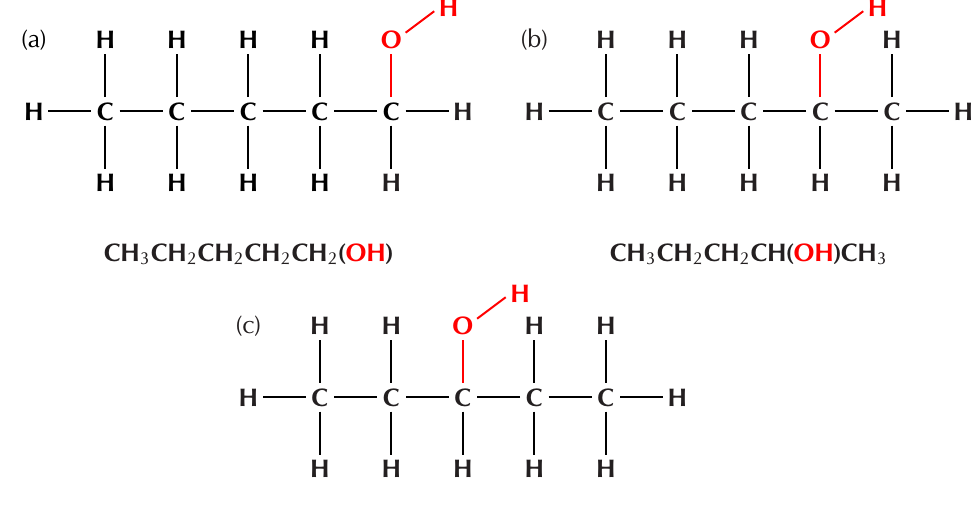
These three compounds all have the molecular formula C₅H₁₂O, but the hydroxyl group (-OH) appears in different positions:
- 1-pentanol: -OH group on the first carbon
- 2-pentanol: -OH group on the second carbon
- 3-pentanol: -OH group on the third carbon
Example 3: Ester isomers
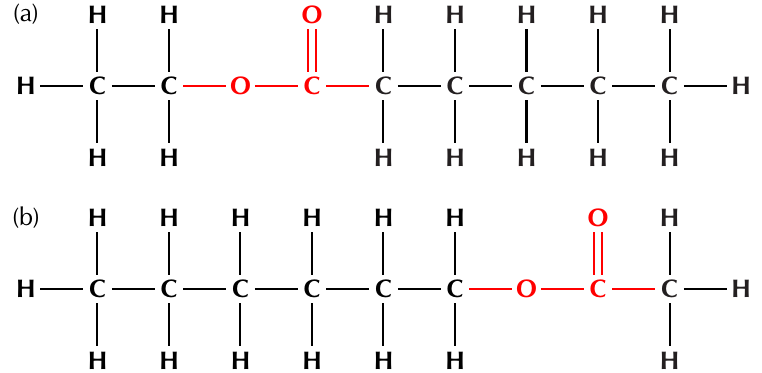
These ester molecules demonstrate how the same atoms can be rearranged to create different structural arrangements while maintaining the same molecular formula.
Functional group isomers
Functional group isomers have the same molecular formula but contain completely different functional groups. This type of isomerism often results in dramatically different properties because different functional groups behave very differently chemically.
Important
Functional group isomers can have vastly different chemical properties despite having identical molecular formulas. This is because different functional groups undergo completely different types of chemical reactions.
Example 1: Propanone vs propanal
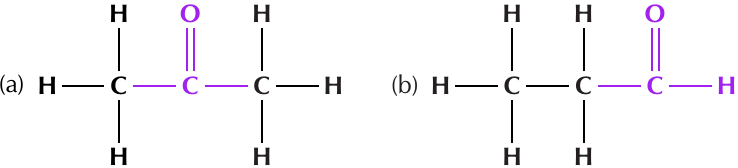
Both compounds have the molecular formula C₃H₆O, but they contain different functional groups:
- Propanone (acetone): Contains a ketone group (C=O) in the middle of the carbon chain
- Propanal: Contains an aldehyde group (C=O) at the end of the carbon chain

The table shows how these functional group differences lead to different properties. Even though they have identical molecular formulas, propanone and propanal have different melting points, boiling points, and reactivity levels.
Example 2: Carboxylic acid vs ester
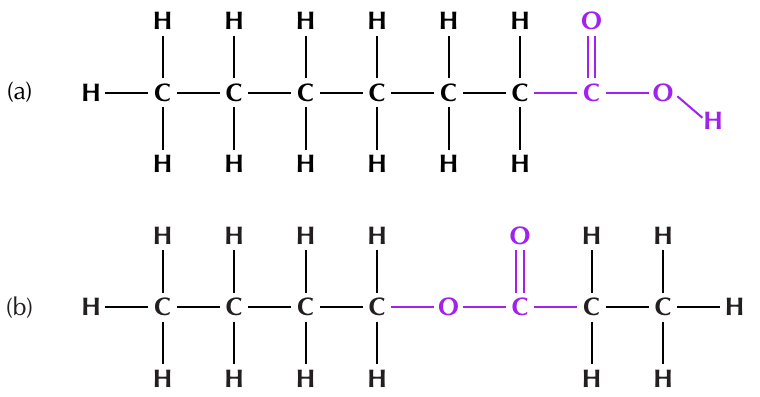
These molecules demonstrate another type of functional group isomerism, where the same atoms can form either a carboxylic acid or an ester functional group.
Properties of isomers
One of the most important facts about isomers is that they have different properties despite having identical molecular formulas. This occurs because molecular properties depend on molecular structure, not just the types and numbers of atoms present.
Physical property differences
Isomers often have different physical properties such as:
- Melting points: The temperature at which the solid becomes liquid
- Boiling points: The temperature at which the liquid becomes gas
- Solubility: How well the compound dissolves in various solvents

Note
This table compares heptanoic acid (a carboxylic acid) with butyl propanoate (an ester). Despite having the same molecular formula, they have significantly different melting points and boiling points.
Chemical property differences
Isomers also exhibit different chemical properties:
- Reactivity: Some isomers are more reactive than others
- Chemical behaviour: Different functional groups undergo different types of reactions
- Stability: Some structural arrangements are more stable than others
Important
For example, aldehydes are generally more reactive than ketones, even when they have the same molecular formula. This is why propanal is more reactive than propanone.
Worked examples
Example
Worked Example 1: Identifying structural isomers
Question: Are butane and 2-methylpropane isomers?
Solution:
- Check molecular formulas: Both have C₄H₁₀ ✓
- Check structural arrangements: Butane has a straight chain, 2-methylpropane has a branched chain ✓
- Answer: Yes, they are structural isomers
Example
Worked Example 2: Identifying functional group isomers
Question: Explain why propanone and propanal are functional group isomers.
Solution:
- Both have molecular formula C₃H₆O ✓
- Propanone has a ketone group (C=O in the middle)
- Propanal has an aldehyde group (C=O at the end)
- Answer: Same molecular formula but different functional groups makes them functional group isomers
Example
Worked Example 3: Predicting properties
Question: Would you expect 1-pentanol and 2-pentanol to have identical boiling points?
Solution:
- They are structural isomers (same molecular formula, different -OH positions)
- Isomers have different properties due to different structures
- Answer: No, they would have different boiling points because their structural differences affect intermolecular forces
Summary
Key Points to Remember:
- Isomers have the same molecular formula but different structural arrangements
- Structural isomers have the same functional groups in different positions
- Functional group isomers have completely different functional groups
- All isomers have different physical and chemical properties despite identical molecular formulas
- The arrangement of atoms is just as important as which atoms are present