Physical Properties and Functional Groups (Grade 12 NSC Matric Physical Sciences): Revision Notes
📚Revision Notes
Physical Properties and Functional Groups
Introduction to functional groups and their properties
Functional groups are specific arrangements of atoms that determine the chemical and physical properties of organic molecules. Different functional groups exhibit characteristic properties such as distinct smells, solubility patterns, and melting and boiling points. Understanding these patterns helps predict how organic compounds will behave under different conditions.
Overview of functional group characteristics
Different functional groups can be identified by their distinctive properties:
- Alkanes are generally odourless with low melting and boiling points
- Alkenes have a sweet or musky smell and remain gaseous at room temperature
- Alcohols have sharp odours and higher boiling points due to hydrogen bonding
- Carboxylic acids smell like vinegar or rancid butter and have the highest boiling points
- Esters typically have pleasant, fruity odours
- Aldehydes and ketones have pungent, sometimes fruity smells
Physical properties of alcohols
Solubility of alcohols
Solubility is a measure of the ability of a substance (solid, liquid or gas) to dissolve in another substance. The amount of the substance that can dissolve determines the measure of its solubility.
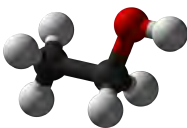
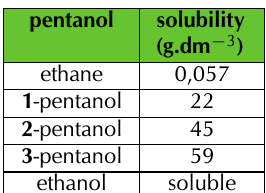
The hydroxyl group (-OH) significantly affects the solubility of alcohols. This group makes alcohol molecules polar and therefore more likely to be soluble in water. However, the carbon chain resists solubility, creating two opposing trends:
Important
Key Solubility Trends:
- Shorter carbon chains → higher water solubility
- Longer carbon chains → lower water solubility
This creates competing effects: the polar -OH group promotes solubility while the non-polar carbon chain reduces it.
Boiling points of alcohols
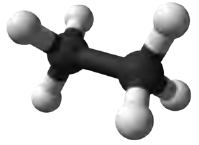
Alcohols have higher boiling points than corresponding hydrocarbons because of hydrogen bonding. The hydrogen atom in one hydroxyl group forms strong intermolecular forces with the oxygen atom of another hydroxyl group.
Note
This hydrogen bonding requires additional energy to break during boiling, resulting in elevated boiling points compared to similar molecules without hydroxyl groups.
Physical properties of haloalkanes
Volatility of haloalkanes
Volatility refers to the tendency of molecules at the surface of a compound to enter the gas phase. The more volatile a compound, the more likely it is to evaporate.
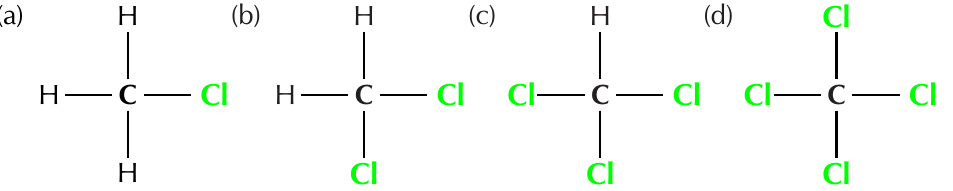

The series shows progressive chlorine substitution in methane. As more halogen atoms are substituted for hydrogen atoms, the haloalkane becomes less volatile. This trend can be observed through increasing melting and boiling points.

Trends in haloalkane properties
For every additional chlorine atom on the original methane molecule:
- Volatility decreases
- Melting point increases
- Boiling point increases
Note
This occurs because more halogen atoms create stronger intermolecular forces, requiring more energy to overcome during phase changes.
Properties of carbonyl compounds
Carboxylic acids as weak acids
Carboxylic acids are weak acids because they only dissociate partially in solution. The carboxyl group (-COOH) can release hydrogen ions, making these compounds acidic.
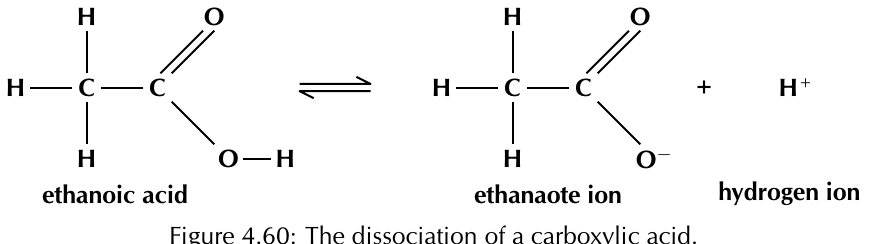
The dissociation shows how ethanoic acid releases a hydrogen ion to form an ethanoate ion, demonstrating the acidic nature of carboxylic acids.
Hydrogen bonding in carboxylic acids
Carboxylic acids form hydrogen bonding dimers through a process called dimerisation. Two carboxylic acid molecules can connect through hydrogen bonds between their carboxyl groups.
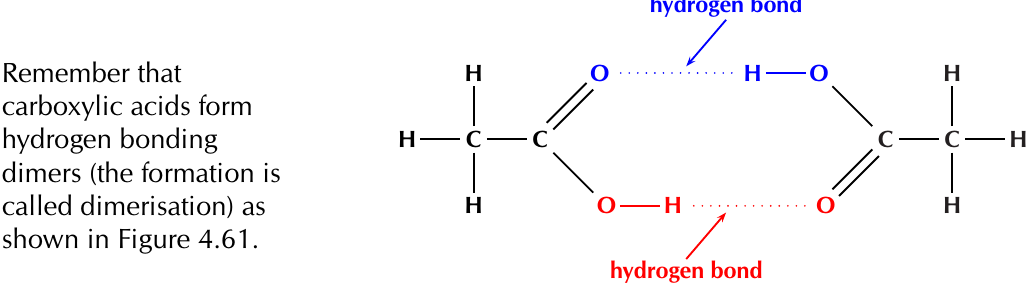
This dimerisation significantly affects physical properties:
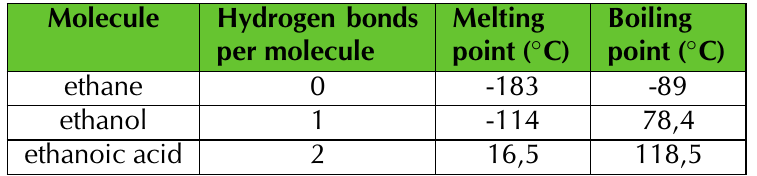
Important
Hydrogen Bonding and Physical Properties:
The table demonstrates how hydrogen bonding capability directly correlates with melting and boiling points:
- Ethane (0 hydrogen bonds): lowest melting and boiling points
- Ethanol (1 hydrogen bond): intermediate melting and boiling points
- Ethanoic acid (2 hydrogen bonds): highest melting and boiling points
Physical properties of ketones
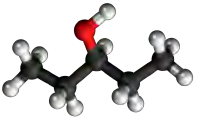
Ketones can form hydrogen bonds with water molecules, making them highly water-soluble. The oxygen atom in the carbonyl group (C=O) can accept hydrogen bonds from water.
Note
This hydrogen bonding ability explains why ketones like propanone (acetone) are highly soluble in water and useful as solvents.
Worked examples
Example
Worked Example 1: Predicting solubility trends
Question: Arrange these alcohols in order of increasing water solubility: pentanol, methanol, ethanol, propanol.
Solution:
- Remember: shorter carbon chains = higher solubility
- Count carbon atoms: methanol (1C), ethanol (2C), propanol (3C), pentanol (5C)
- Order of increasing solubility: pentanol < propanol < ethanol < methanol
Example
Worked Example 2: Explaining boiling point differences
Question: Explain why ethanoic acid has a higher boiling point than ethanol.
Solution:
- Both contain hydrogen bonding groups
- Ethanol forms 1 hydrogen bond per molecule
- Ethanoic acid forms 2 hydrogen bonds per molecule (dimerisation)
- More hydrogen bonds require more energy to break
- Therefore, ethanoic acid has a higher boiling point
Example
Worked Example 3: Haloalkane volatility prediction
Question: Which is more volatile: chloromethane or tetrachloromethane?
Solution:
- Chloromethane has 1 chlorine atom
- Tetrachloromethane has 4 chlorine atoms
- More chlorine atoms = stronger intermolecular forces
- Stronger forces = lower volatility
- Therefore, chloromethane is more volatile than tetrachloromethane
Summary
Exam Tips:
- Remember the trends: More hydrogen bonding = higher boiling point
- Solubility rule: "Like dissolves like" - polar substances dissolve in polar solvents
- Common mistake: Don't confuse volatility with boiling point - they are inversely related
- Functional group identification: Learn to recognise functional groups by their characteristic properties
- Numerical trends: Practice identifying patterns in data tables showing melting/boiling points
Summary
Key Points to Remember:
- Functional groups determine physical properties - each group has characteristic smells, solubility, and thermal properties
- Hydrogen bonding increases boiling points - alcohols, carboxylic acids, and other hydrogen-bonding compounds have higher boiling points than similar non-hydrogen-bonding molecules
- Solubility depends on polarity - polar functional groups (like -OH) increase water solubility, while long carbon chains decrease it
- More substitution affects properties - additional halogen atoms in haloalkanes decrease volatility and increase boiling points
- Carboxylic acids form dimers - they can form two hydrogen bonds per molecule, giving them exceptionally high boiling points for their molecular mass