Nutrients and Fertilisers (Grade 12 NSC Matric Physical Sciences): Revision Notes
📚Revision Notes
Nutrients and Fertilisers
Introduction
Plants require specific nutrients to grow and survive. As populations increase and farming demands grow, the soil often cannot naturally provide enough nutrients fast enough to support crop production. This is where fertilisers become essential - they help restore and supplement soil nutrients to maintain healthy crop yields.
Note
With the world's population continuing to grow, agricultural demands are increasing rapidly. This puts enormous pressure on soil systems to provide adequate nutrition for crops, making fertilisers increasingly important for food security.
What are nutrients?
Nutrients are chemical substances that organisms need for metabolism and proper functioning. Plants absorb these nutrients from their environment to support growth, reproduction, and survival.
Types of nutrients
There are two main categories of plant nutrients:
Non-mineral nutrients
These nutrients come from the air and water, not from the soil:
- Carbon (C): Obtained from carbon dioxide in the air
- Hydrogen (H): Obtained from water
- Oxygen (O): Obtained from water
All three function as components of organic molecules like carbohydrates, lipids, and proteins.
Mineral nutrients
These nutrients must be absorbed from the soil in dissolved form. They are divided into:
Macronutrients - needed in large quantities:
- Nitrogen (N): Found in nitrogen compounds in soil, essential for proteins and chlorophyll
- Phosphorus (P): Found in phosphate compounds, needed for photosynthesis and flowering
- Potassium (K): Found in potassium compounds, helps with cell building and disease resistance
Micronutrients - needed in small amounts, including iron (Fe), chlorine (Cl), copper (Cu), and zinc (Zn).
Important
The key difference is that macronutrients are required in large quantities whilst micronutrients are only needed in small amounts for plants to function properly. Understanding this distinction is crucial for proper fertiliser application.
What are fertilisers?
Fertilisers are chemical compounds given to plants to promote growth. They typically provide the three major plant nutrients: nitrogen, phosphorus, and potassium.
The fertiliser industry produces fertilisers from raw materials like nitric acid, phosphate rock, and sulphuric acid. These fertilisers supply nutrients that support life on earth.
Types of fertilisers
There are two main types:
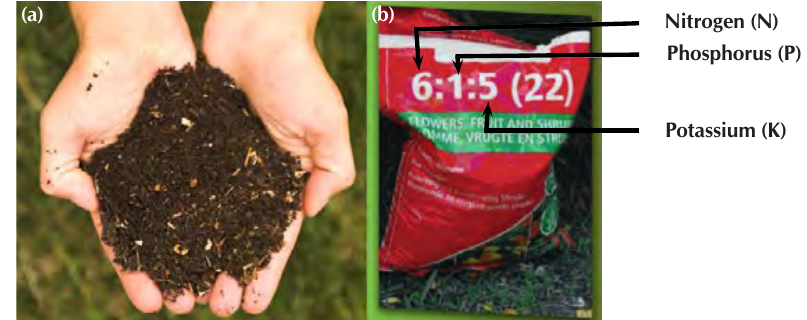
Organic fertilisers are made from natural products like manure, compost, bone meal, or seaweed. These materials started as part of living organisms.
Inorganic fertilisers refer to industrially produced compounds like ammonium nitrate or super phosphates. These have the advantage of being in a soluble form that plants can absorb immediately.
Why fertilisers are needed
Plants can only absorb nutrients when they are dissolved in water. For example, nitrogen gas () cannot be absorbed directly - it must be converted to ions like nitrate () or phosphate ().
Important
Critical Solubility Requirement: Plants can ONLY absorb nutrients when they are dissolved in water. Nitrogen gas () cannot be absorbed directly - it must be converted to ions like nitrate () or phosphate (). This is why fertilisers must be in a water-soluble form.
Natural processes like the nitrogen cycle do replace soil nutrients, but this takes a long time. Modern farming practices often don't allow enough time for natural nutrient replacement, so fertilisers play a crucial role in restoring soil nutrients quickly.
The NPK ratio
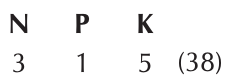
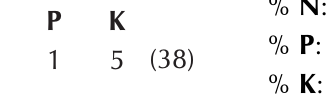
Fertiliser packaging shows a set of numbers called the NPK ratio. These numbers indicate the mass ratio of nitrogen (N), phosphorus (P), and potassium (K) in the fertiliser.
Example
Understanding NPK Ratios:
A fertiliser with NPK ratio 3:1:5 (38) means:
- The ratio of N:P is 3:1:5
- 38% of the total fertiliser mass consists of these nutrients
- The remaining 62% consists of fillers and other compounds
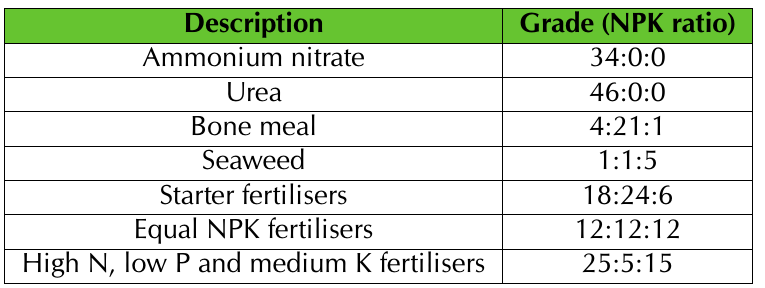
Understanding fertiliser grades
Different fertilisers have different NPK ratios suitable for various purposes:
Functions of N, P, and K
Each nutrient serves specific purposes:
- Nitrogen (N): Promotes leafy growth - best for lawns and leafy plants
- Phosphorus (P): Supports root development and flowering - ideal for flower beds
- Potassium (K): Enhances disease resistance and fruit development - excellent for fruit-bearing plants
Note
Choose your fertiliser based on what you want to achieve: high nitrogen for lush green growth, high phosphorus for strong roots and flowers, or high potassium for healthy, disease-resistant plants with good fruit production.
Calculating nutrients from NPK ratios
Worked example 1: Mass calculations
Example
Worked Example: Mass Calculations
Question: Calculate the mass of nitrogen (N), phosphorus (P), and potassium (K) in 500g of industrial fertiliser with NPK ratio 5:2:3 (40).
Solution:
Step 1: Determine the total nutrient mass 40% of 500g = contains nutrients
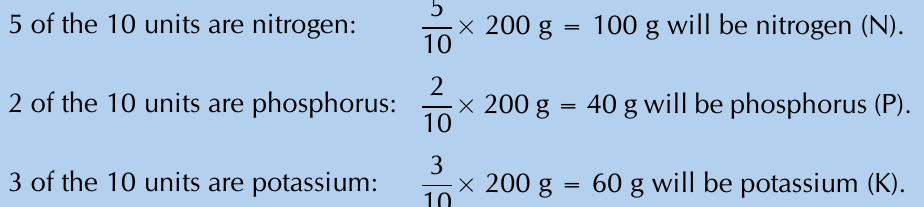
Step 2: Calculate individual masses using the ratio
- Total ratio parts = 5 + 2 + 3 = 10 parts
- Nitrogen:
- Phosphorus:
- Potassium:
Worked example 2: Mole ratio calculations
Example
Worked Example: Mole Ratio Calculations
Question: Calculate the mole ratio of an industrial fertiliser with NPK ratio 5:2:3 (40).
Solution:
Step 1: Use masses from previous example
- Mass of N = 100g
- Mass of P = 40g
- Mass of K = 60g
Step 2: Calculate moles for each element
- Moles of N =
- Moles of P =
- Moles of K =
Step 3: Determine the mole ratio N:P
mole ratio = 7.14 : 1.29 : 1.53Dividing by the smallest number (1.29): Mole ratio = 5.5 : 1 : 1.2 ≈ 55 : 10 : 12
Worked example 3: Compound ratios
Some countries express NPK ratios in compound form (N:P₂O₅:K₂O).
Example
Worked Example: Compound Ratios
Question: Calculate the moles of phosphorus (P) in 120g of fertiliser with N:P₂O₅:K₂O mass ratio of 4:3:8 (50).
Solution:
Step 1: Calculate nutrient mass 50% of 120g = 60g contains nutrients
Step 2: Calculate mass of P₂O₅ Total ratio parts = 4 + 3 + 8 = 15 Mass of P₂O₅ =
Step 3: Calculate moles of P₂O₅ Molar mass of P₂O₅ = Moles of P₂O₅ =
Step 4: Calculate moles of P Since each P₂O₅ contains 2 P atoms: Moles of P =
Summary
Key Points to Remember:
-
Nutrients are essential chemicals that plants need for growth - they include both mineral nutrients (from soil) and non-mineral nutrients (from air and water)
-
Fertilisers provide the three major nutrients - nitrogen (N) for leafy growth, phosphorus (P) for roots and flowers, and potassium (K) for disease resistance
-
NPK ratios show the mass proportion of nitrogen, phosphorus, and potassium in fertilisers, helping you choose the right fertiliser for specific plant needs
-
Organic fertilisers come from natural sources like compost, while inorganic fertilisers are industrially produced compounds that dissolve quickly
-
Always convert ratios to actual masses when calculating nutrient content - remember to account for the percentage purity and use molar masses for mole calculations