Accuracy in DNA Replication (HSC SSCE Biology): Revision Notes
📚Revision Notes
Accuracy in DNA Replication
Introduction
DNA replication must be incredibly precise because the sequence of bases forms the genetic code that defines every living organism. When DNA is copied, even tiny mistakes can have serious consequences for cells and future generations. The accuracy with which DNA is copied is known as replication fidelity.
While cells have sophisticated mechanisms to ensure accurate copying, DNA faces continuous threats from both internal errors and environmental damage. Understanding how cells maintain replication accuracy helps us appreciate why genetic information remains stable across generations.
Note
The concept of replication fidelity is fundamental to all life—it explains why children resemble their parents, why cells in your body function correctly, and why most organisms can pass on healthy genetic information across generations.
Why accuracy is critical
Precise DNA replication is essential for two fundamental biological processes:
Heredity
Genetic material must be transmitted accurately from cell to cell during mitosis and from generation to generation through gametes produced by meiosis. If errors occur during replication, these mistakes will be inherited by daughter cells and potentially passed to offspring. This means that replication errors don't just affect one cell—they can impact entire lineages of cells or even future generations of organisms.
Gene expression
Cells rely on the genetic instructions encoded in DNA to produce proteins that create their structure and control their functions. Proteins, particularly enzymes, regulate all the chemical reactions in cells (metabolism). If the DNA code contains errors, the proteins made from those instructions may not work properly, leading to cellular dysfunction or disease.
Note
Think of DNA as an instruction manual: if the manual contains errors, the final product won't work correctly. In cells, this "product" includes all the proteins needed for survival, growth, and reproduction.
Types of errors in replication
Despite sophisticated cellular machinery, errors can arise during DNA replication through two main mechanisms:
Spontaneous mutations
These are natural mistakes that occur randomly during DNA replication, even under normal conditions. They happen because the replication machinery, whilst highly accurate, is not perfect. Spontaneous mutations arise from the inherent chemical properties of DNA bases and occasional errors by DNA polymerase enzymes.
Mutagenic mutations
These errors result from exposure to environmental factors that damage DNA. Such factors include:
- Radiation (such as ultraviolet light or X-rays)
- Chemicals (including certain industrial compounds, tobacco smoke, and some food additives)
- Viruses (which can insert their genetic material into host DNA)
Environmental factors that change DNA are called mutagens. The risk of mutation increases with both the duration of exposure to mutagens and the intensity of that exposure.
Note
Understanding Mutagens
Mutagenic mutations differ from spontaneous mutations in their cause. While spontaneous mutations occur naturally as random events, mutagenic mutations result from specific environmental exposures. The longer and more intense the exposure to mutagens, the greater the risk of DNA damage.
DNA repair mechanisms
Cells contain specialized enzymes designed to detect and correct both spontaneous and mutagenic mutations. These repair systems act as quality control mechanisms during and after DNA replication.
DNA mismatch repair
During DNA replication, an incorrect base is sometimes inserted opposite the template strand. When this occurs, repair enzymes patrol the newly synthesized DNA, identifying incorrectly paired bases.
Important
The Three-Step Repair Process
DNA mismatch repair follows a precise sequence:
- Recognition: The repair enzyme identifies the mismatched base pair
- Excision: The enzyme removes the incorrect base from the new strand
- Replacement: The enzyme inserts the correct base
This process is called DNA mismatch repair, and it is primarily performed by the enzyme DNA polymerase I.
When repair mechanisms fail
Sometimes mismatched bases escape detection by repair enzymes. When this happens, the error becomes permanent during the next round of replication.
Example
Worked Example: How a Mismatch Becomes Permanent
Consider a replication error where a cytosine (C) nucleotide is accidentally paired with an adenine (A) nucleotide, instead of the correct guanine (G). If this mismatch is not repaired, the next time this DNA strand serves as a template, the A will pair with thymine (T), creating an AT base pair instead of the original GC pair.
The sequence changes as follows:
Original strand: AT, CG, GC, TA, AT
After error: AT, CG, AC, TA, AT
(Note the C-A mismatch in the third position)
After next replication: AT, CG, AT, TA, AT
(Now contains a permanent mutation)
This strand now contains a permanent mutation. The error won't be detected by DNA repair enzymes because AT is a valid base pair—the bases are correctly matched according to base-pairing rules. However, the sequence of bases now differs from the original strand, creating a mutation.
Consequences of permanent mutations
Uncorrected mutations will be replicated in all subsequent cell divisions. If the error occurs during meiosis (the production of gametes), it will be transmitted to subsequent generations of organisms.
The effects of mutations vary:
- Harmful effects: Many mutations disrupt normal protein function, potentially causing genetic diseases or cellular dysfunction
- Beneficial effects: Some mutations improve an organism's ability to survive or reproduce in its environment
- Neutral effects: Many mutations have no noticeable effect on the organism
Note
It's important to recognise that mutation serves as a mechanism for generating variation in organisms. This variation contributes to biodiversity and provides the raw material for evolution. Not all mutations are harmful—some drive adaptation and species improvement.
Gene expression and accurate replication
The link between DNA and proteins
Understanding DNA structure and replication naturally leads to the question: how does the genetic code actually work? The answer lies in protein production. The sequence of bases in DNA serves as instructions for making proteins, including enzymes that control the synthesis of cell materials and all biochemical reactions within cells and organisms.
Accurate replication in multicellular organisms
In multicellular organisms, different genes are activated in different cell types. For example, liver cells express different genes than nerve cells. Despite these differences, every cell in the body receives a complete and accurate copy of the entire genome during cell division.
This complete genetic code is essential because:
- Each cell type needs to activate specific genes appropriate for its function
- The genes must function correctly to produce the right proteins
- These proteins determine what type of cell it will become and how it will function
The activation of genes is itself regulated by other molecules, particularly enzymes (which are proteins). These regulatory molecules must also be accurately coded by DNA. Any errors in the genes controlling them create cascading problems.
Connection to cancer
Important
DNA Accuracy and Cancer Prevention
Errors in genes that control the cell cycle can lead to changes in how cells divide and die, potentially resulting in cancer. This connection highlights why accurate DNA replication and effective mismatch repair are critical for preventing disease.
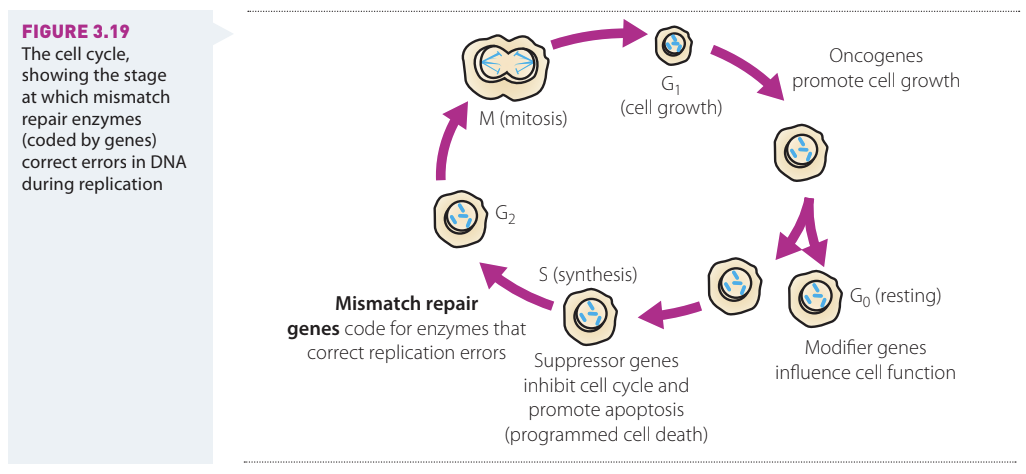
The cell cycle includes several phases where different genes are active:
- phase (cell growth): Cells grow and prepare for DNA replication
- S phase (synthesis): DNA replication occurs—this is where mismatch repair is particularly critical
- phase: Cells prepare for division
- M phase (mitosis): Cell division occurs
- phase (resting): Cells exit the cycle temporarily or permanently
During the S phase, mismatch repair genes code for enzymes that correct replication errors. If these genes themselves contain mutations, the repair mechanism fails, allowing more errors to accumulate.
Note
Why the S Phase is Critical
The S phase is when DNA replication occurs, making it the most vulnerable time for errors to arise. Active mismatch repair during this phase is the cell's primary defense against accumulating mutations. When repair genes are damaged, cells lose this crucial quality control mechanism.
This is particularly dangerous for:
- Cell cycle control genes: Errors here can cause uncontrolled cell division
- DNA repair enzyme genes: Mutations in these genes are directly linked to increased cancer risk
- Suppressor genes: These normally inhibit the cell cycle and promote programmed cell death (apoptosis) when needed
- Oncogenes: These promote cell growth and, when mutated, can drive cancer development
The mismatch repair of genes controlling the cell cycle is therefore particularly important for preventing cancer.
Different types of DNA damage and repair
Beyond mismatch repair, cells possess multiple types of repair enzymes that address different forms of DNA damage. Each type of damage requires specialized repair mechanisms to ensure accurate replication and normal cell functioning.
These include:
- Repair of breaks in the DNA backbone
- Correction of bases damaged by oxidation or radiation
- Removal of bulky chemical additions to DNA bases
Note
The existence of multiple, overlapping repair systems emphasises how critical DNA accuracy is for survival. Cells have evolved redundant mechanisms because the consequences of DNA errors can be severe—from cellular dysfunction to cancer to passing harmful mutations to offspring.
Remember!
Summary
Key Points to Remember:
-
Replication fidelity is crucial because DNA sequence determines genetic code—errors affect both heredity and gene expression
-
Two types of mutations occur during replication: spontaneous mutations (random errors) and mutagenic mutations (caused by environmental factors like radiation and chemicals)
-
DNA mismatch repair corrects errors through three steps: recognition of mismatched bases, excision of incorrect bases, and replacement with correct bases (primarily by DNA polymerase I)
-
Unrepaired mutations become permanent after the next replication cycle and can be passed to future generations if they occur in gametes
-
Accurate replication prevents cancer by ensuring proper function of cell cycle control genes and DNA repair enzyme genes