Preventing the Spread of Infectious Disease (HSC SSCE Biology): Revision Notes
📚Revision Notes
Preventing the Spread of Infectious Disease
Throughout human history, people have developed various methods to prevent disease transmission. Ancient civilisations including the Hebrews, Chinese, and Mesopotamians established early principles of good health over 3000 years ago. These principles included maintaining cleanliness in food and water, practising personal hygiene, properly disposing of waste, and isolating individuals with contagious diseases. Despite this historical knowledge, infectious diseases have continued to cause widespread illness and death, making disease prevention a critical focus of modern public health.
Hygiene practices
Hygiene practices represent one of the most fundamental approaches to preventing disease spread. These practices are organised into two main categories: personal hygiene and community hygiene.
Personal hygiene
Personal hygiene involves individual practices that reduce the risk of pathogens entering the body and being transmitted to others. By maintaining cleanliness, individuals prevent the build-up of micro-organisms on their bodies to levels that could cause disease.
Essential personal hygiene practices include:
Handwashing: Hands should always be washed thoroughly with soap and water before preparing or eating food and after using the toilet. This simple practice is one of the most effective ways to prevent the spread of pathogens that cause diseases with symptoms such as diarrhoea. Proper handwashing removes pathogens from the skin before they can be transferred to food, the mouth, or other people.
Note
Proper handwashing technique involves scrubbing all surfaces of the hands (including between fingers and under nails) with soap for at least 20 seconds, followed by thorough ringing and drying. This mechanical action, combined with soap's ability to break down pathogen membranes, effectively removes disease-causing micro-organisms from the skin.
Body and hair care: Regular washing of the body and hair prevents the accumulation of bacteria and other pathogens to numbers that could cause disease. For example, inadequate oral hygiene allows bacteria to multiply in the mouth, potentially leading to gingivitis—a condition characterised by swollen, bleeding gums and tooth loss.
Respiratory etiquette: When coughing or sneezing, individuals should cover their mouth and nose with a tissue or handkerchief. This prevents airborne droplets containing pathogens from spreading to others. It is important not to sneeze or cough into hands, as this transfers pathogens to whatever surfaces are touched next, facilitating disease transmission.
Community hygiene
Community hygiene encompasses public health infrastructure and practices that prevent pathogen build-up in the broader environment. When community hygiene systems fail, disease spreads rapidly through populations, as demonstrated by the 2005 South-East Asian tsunami aftermath.
Key community hygiene measures include:
Sewage and waste disposal: Proper sewage treatment and garbage disposal systems are essential for reducing pathogen numbers in the community. Modern sewage treatment plants may incorporate ultraviolet (UV) disinfection technology to manage pathogens in waste water before it is released back into the environment.
Sterilisation protocols: Hospitals, medical surgeries, dental clinics, and even hairdressing salons must follow strict sterilisation procedures for their equipment. These protocols reduce the risk of transmitting pathogens from one person to another through contaminated instruments.
Urban planning: City planning that reduces overcrowding plays a significant role in disease control. When populations are densely packed with inadequate infrastructure, disease transmission increases dramatically.

Note
High-density living conditions can strain water management systems and increase person-to-person contact, creating ideal conditions for pathogen transmission. Proper urban planning considers adequate housing space, water supply, and sanitation facilities to minimise disease risk.
Clean food and water
Many pathogens are transmitted through contaminated food and water. Implementing strict standards for food handling and water treatment is therefore essential for disease control.
Food safety
Diseases such as salmonellosis are caused by Salmonella bacteria transmitted through undercooked food, particularly animal products. To control disease transmission from food sources, Australia has established comprehensive food safety standards that all food handlers must follow.
These standards cover:
- Personal hygiene practices of food handlers
- Maintenance and cleaning of cooking utensils
- Proper storage of raw and cooked foodstuffs
- Correct processing methods, especially for meat
- Safe preparation and cooking techniques
When these guidelines are followed correctly, the spread of pathogens is prevented, reducing the incidence of food poisoning and other foodborne illnesses in the community.
Water quality
Water quality management is crucial for minimising pathogen multiplication and transmission through contaminated water supplies. In Australia, governments establish strict standards for domestic water quality, and water supplies are tested daily to ensure compliance.
Important
Waterborne pathogens of concern:
Contaminated water containing animal faeces may harbour dangerous pathogens such as the protozoans Cryptosporidium and Giardia. If consumed, these organisms cause symptoms including abdominal cramps, diarrhoea, nausea, and vomiting. Cholera, a potentially fatal disease, is transmitted through water contaminated with untreated sewage.
Water treatment processes destroy existing pathogens and prevent their multiplication, significantly reducing disease transmission. These treatments represent a critical component of successful disease control strategies.
Disease spread during natural disasters
Natural disasters provide a clear example of how multiple disease transmission factors interact simultaneously, leading to rapid disease spread. The 2010 Haitian earthquake demonstrates these principles.
When disasters occur in areas with high population density, their effects are often more severe. Disease management becomes complicated by economic, social, and cultural factors. Although many deaths result directly from disaster impacts (such as collapsed buildings), a significant proportion of deaths occur due to infectious disease spread following the disaster.
Example
Case Study: Haiti 2010 Earthquake and Disease Transmission
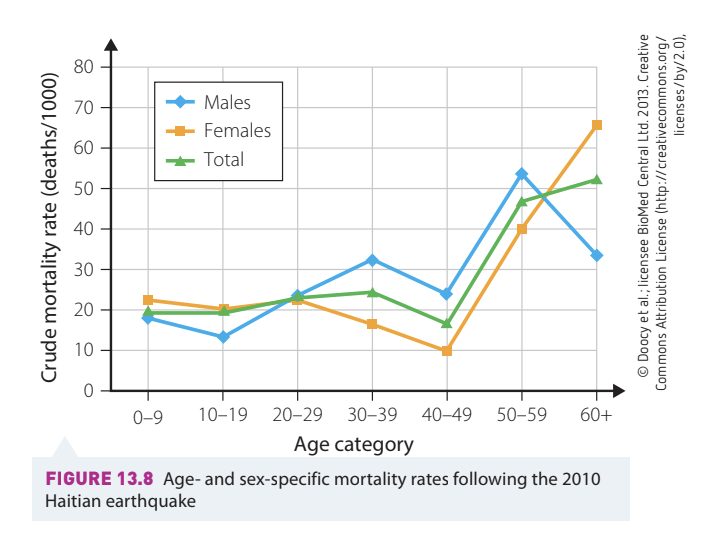
The graph above shows age- and sex-specific mortality rates following the 2010 Haiti earthquake. Several important patterns emerge:
- Mortality rates were relatively low in younger age groups ( years), ranging from approximately deaths per people
- Male mortality spiked dramatically in the age group (approximately deaths per )
- Female mortality peaked in the age category (approximately deaths per )
- Elderly populations showed the highest overall mortality rates
Factors affecting post-disaster disease spread
| Factor | Total Exposed | Total Deaths | Mortality Rate (%) |
|---|---|---|---|
| Overall | 6383 | 153 | 2.4 |
| Sex | |||
| Male | 3052 | 71 | 2.3 |
| Female | 3379 | 76 | 2.2 |
| Age category | |||
| 0-17 | 2299 | 37 | 1.6 |
| 18-49 | 3689 | 92 | 2.5 |
| 50+ | 548 | 24 | 4.4 |
| Education level | |||
| None | 289 | 11 | 3.8 |
| Primary | 1237 | 27 | 2.2 |
| Secondary | 3685 | 83 | 2.3 |
| Higher education | 1273 | 31 | 2.4 |
| Crowding | |||
| <2.0 | 1927 | 35 | 1.8 |
| 2.0-2.9 | 1566 | 37 | 2.4 |
| 3.0-3.9 | 949 | 23 | 2.4 |
| 4.0+ | 2094 | 58 | 2.8 |
| Current location | |||
| Neighbourhood | 3258 | 63 | 1.9 |
| Camp | 3278 | 90 | 2.7 |
| Multilevel building | |||
| 1 level | 3999 | 76 | 1.9 |
| >1 level | 2031 | 67 | 3.3 |
This data reveals that older populations, those living in crowded conditions, and camp residents experienced higher mortality rates. These patterns reflect the interaction of host factors (age, immune function), environmental factors (overcrowding, sanitation), and societal factors (access to healthcare, education) in disease transmission.
Note
During and after natural disasters, multiple factors compound to increase disease transmission:
- Malnutrition, exhaustion, and environmental exposure weaken immune systems
- Refugee camps often have questionable food and water hygiene
- Overcrowding increases host-to-host transmission
- Young children and elderly individuals are particularly vulnerable
- Breakdown of hygiene infrastructure accelerates pathogen spread
Quarantine
Australia maintains one of the strictest quarantine systems in the world, helping the country remain free from many serious pests and diseases. Originally protected by geographic isolation, Australia now requires sophisticated quarantine procedures as international travel and trade have increased.
The Department of Agriculture and Water Resources (DAWR) is responsible for maintaining Australia's disease-free status. This is essential for protecting:
- Unique native flora and fauna species
- Agricultural industries (worth approximately $30 billion annually in exports)
- The environment
- Public health
Important
The Purpose of Quarantine
Quarantine is designed to minimise the risk of exotic pests and diseases entering Australia, in order to protect our native flora and fauna, our agricultural industries, our environment and our health.
Australia's agricultural exports are highly valued internationally because of the country's reputation for being free from serious pests and diseases common elsewhere. If these pests and diseases entered Australia, they could devastate native animals, plants, and agricultural production.
Types of quarantine
Animal quarantine: All animals entering Australia must spend time at quarantine stations where they are regularly examined for signs of disease before being released. For example, pets being brought into Australia must remain in quarantine for several weeks to ensure they are disease-free.
Plant quarantine: All plants, plant parts, and plant products (including fruits, seeds, cuttings, bulbs, and wood) entering Australia are examined for pests or diseases. Many items are refused entry, while others are allowed only after treatment by quarantine officers to destroy potential pests or pathogens. Live plants must be kept at quarantine stations until any diseases have had time to develop and be detected.
Human quarantine: Captains of aircraft and ships must notify Australian Quarantine and Inspection Services (AQIS) if passengers or crew display symptoms of prohibited diseases such as rabies, yellow fever, malaria, SARS (severe acute respiratory syndrome), or avian influenza (bird flu). Aircraft are sprayed with insecticide to kill any pests that may have entered during the flight. All Australian international airports operate mosquito-trapping programs to quickly detect any mosquitoes entering the country that could act as disease vectors.
Northern Australia Quarantine Strategy (NAQS)
Northern Australia is particularly vulnerable to pest and disease invasions due to its proximity to South-East Asia and Pacific nations. The Northern Australia Quarantine Strategy (NAQS) serves as an early warning system for this susceptible region.
Note
NAQS uses sentinel animals—cattle and pigs that are regularly monitored for diseases such as Japanese encephalitis and blue tongue. These animals are called "sentinels" because they effectively "stand guard" or "watch out" for invading pathogens.
If they develop symptoms of a disease not yet established in Australia, it provides an early warning that allows strategies to be implemented quickly to halt pathogen spread. The program also includes insect traps that are regularly checked for pests such as screw-worm flies, Asian honeybees, and papaya fruit-flies.
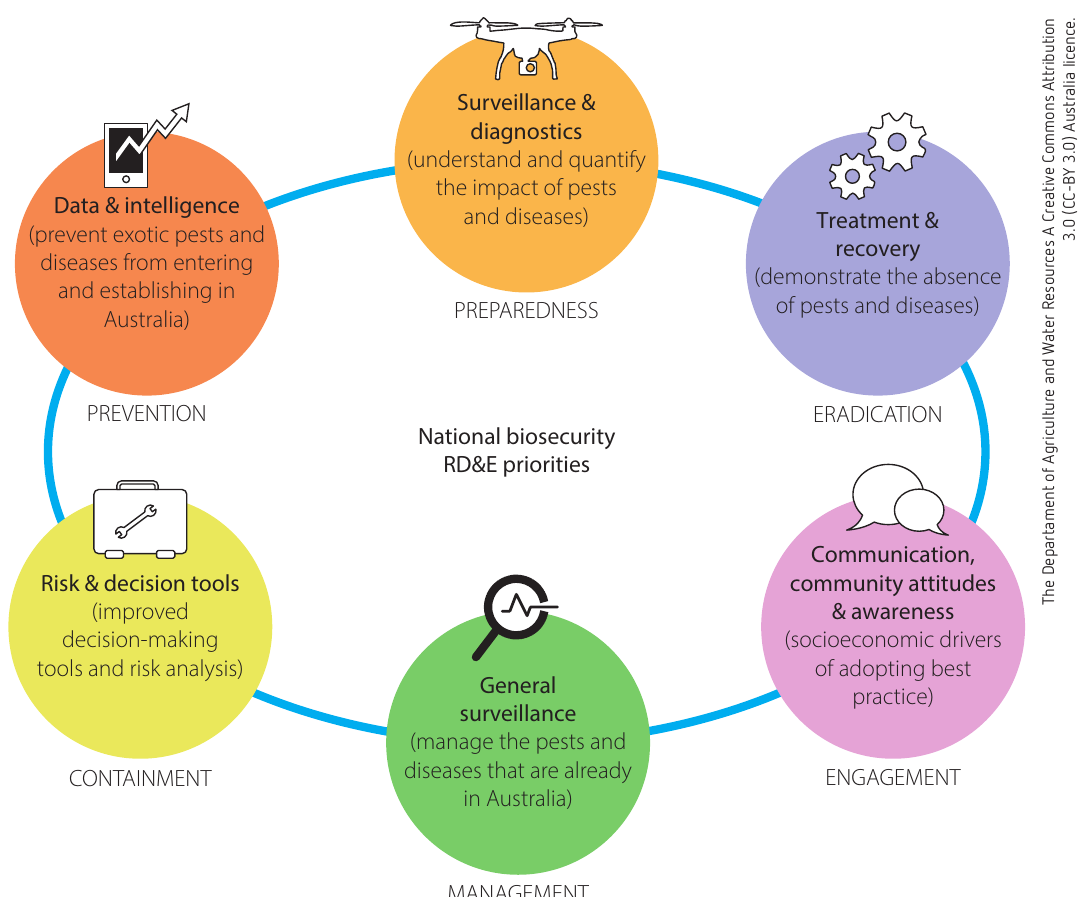
The DAWR biosecurity framework operates through six interconnected stages forming a comprehensive disease management cycle: Prevention, Preparedness, Eradication, Engagement, Management, and Containment. This cyclical approach ensures continuous vigilance and rapid response to biosecurity threats.
Vaccination
Vaccination is a powerful preventative strategy that prepares the immune system to combat pathogens before the body encounters them naturally. Understanding vaccination requires distinguishing between two related but different terms:
Important
Key Definitions:
Vaccination involves the introduction of a vaccine into the body—the physical act of administering the vaccine.
Immunisation is the process in which the body reacts to a vaccine by going through the immune response, producing memory cells that provide future protection.
Why vaccinate rather than allow natural immunity?
While the body can develop natural immunity by experiencing a disease, there are several important reasons why vaccination is preferable:
- Safety: Vaccines provide immunity without the person experiencing disease symptoms, which can be severe or fatal
- Prevention of complications: Many diseases cause serious complications or long-term health problems
- Community protection: Widespread vaccination prevents disease spread through populations
- Elimination potential: Diseases like smallpox have been eradicated through vaccination programs
Types of immunity
Note
Active Acquired Immunity
Active acquired immunity is when the immune response occurs and memory cells are produced. It can happen in two ways:
- Naturally induced: The body undergoes the immune response and suffers the symptoms of the disease
- Artificially induced: Through the use of vaccines, which cause the production of memory cells without the body experiencing the symptoms of the disease
Note
Passive Acquired Immunity
Passive acquired immunity involves the introduction of antibodies (immunoglobulins) into the body to prevent a disease from developing. These antibodies were produced by another organism that had the disease.
For example, someone exposed to hepatitis A may receive immunoglobulin injections to prevent infection. This immunity is temporary (lasting only a few months) because no memory cells are produced.
How vaccines work
Vaccines contain harmless forms of pathogens or their toxins that will not cause disease. They include the antigens that trigger the body's immune response and result in memory cell production for that specific antigen. If the body encounters that antigen in the future, the secondary immune response activates rapidly, destroying the pathogen before disease symptoms develop.
Types of vaccines:
- Attenuated (live, weakened) vaccines: Contain living but attenuated (weakened) and therefore harmless micro-organisms (examples: rabies, poliomyelitis, measles)
- Inactivated (dead) vaccines: Contain killed micro-organisms (examples: typhoid, whooping cough)
- Toxoid vaccines: Contain modified toxins (examples: tetanus, diphtheria)
Vaccines may be administered orally, by injection, or by scratching the skin surface.
Vaccine effectiveness
Each vaccine is specific for only one type of antigen and therefore provides immunity for only one disease. For maximum effectiveness, vaccines should be given as a series of doses over several years. Each vaccination produces a small immune response, but over the series, lymphocytes recognise the antigen more rapidly and sufficient memory cells accumulate to provide long-lasting immunity.
Important
Booster Shots and Memory Cells
Booster shots are sometimes necessary because memory cell numbers decrease over time. Booster injections increase circulating memory cell numbers to maintain immunity. For example, tetanus immunity requires periodic boosters to remain effective.
The immunity formed through vaccination is usually lifelong, though this varies depending on the specific disease and vaccine type.
Public health campaigns
The scale and complexity of infectious disease control can appear overwhelming, but like any large task, it can be broken down into manageable components. The approach to controlling infectious diseases follows the RICE framework:
The RICE framework
Note
The RICE Framework for Disease Control
R - Resolution: Governments and health organisations (such as the World Health Organization) commit to finding solutions to infectious disease problems
I - Information: Epidemiological studies and scientific research provide accurate data about pathogens and their transmission modes. This includes increased national funding for scientific research and training of scientists and medical personnel
C - Coordination: Efforts are coordinated at local, regional, and global scales to ensure resources are used efficiently and effectively
E - Education: Human populations at all levels (local, regional, and global) receive information about factors affecting infectious disease transmission, enabling informed decision-making
Government regulations and programs
Government regulations ensure standardised procedures for:
- Food handling, cooking, and storage
- Equipment sterilisation in hospitals, surgeries, and clinics
- Health worker hygiene when moving between patients
- Garbage disposal
- Drinking water treatment
- Sewage removal and treatment
When these procedures are followed correctly, pathogen spread is prevented, reducing disease occurrence in individuals and communities.
Notifiable diseases
Australian law requires certain diseases to be reported to authorities when detected. This enables early detection and implementation of appropriate control strategies. Examples of notifiable diseases include measles, botulism, cholera, meningococcal infection, pertussis (whooping cough), and malaria.
Mass immunisation programs
Public immunisation programs, such as childhood vaccination schedules, help prevent diseases including diphtheria, tetanus, whooping cough, measles, mumps, and rubella. Mass immunisation programs for human papilloma virus have also been introduced to help prevent cervical cancer.
Use of pesticides
Pesticides are chemicals used to kill the pests of plants and animals, including pathogens and the vectors that transmit pathogens between organisms. By eliminating pests and vectors, pesticide use reduces disease occurrence and controls disease spread through populations.
Categories of pesticides
- Insecticides: Kill insects that act as disease vectors
- Fungicides: Kill fungal pathogens
- Herbicides: Kill weeds
DDT and malaria control
One of the most well-known insecticides is DDT (dichlorodiphenyltrichloroethane). During World War II, DDT was used extensively to control typhus spread by killing the lice that transmitted the bacterial pathogen. DDT was also widely used to kill Anopheles mosquitoes, which carry the Plasmodium parasite causing malaria.
Example
DDT and Malaria Control
Initially, DDT effectively controlled malaria spread by preventing pathogen transmission through vector elimination.
However, mosquitoes developed resistance to DDT through natural selection, reducing its effectiveness. Many countries subsequently banned DDT use because of its harmful environmental effects.
Some malaria-infested countries continue using DDT despite reduced effectiveness, though alternative insecticides like pyrethrum are now also employed. These newer pesticides are less environmentally harmful and more effective at controlling mosquito populations.
Other applications
Insecticides also control aphids that carry the potato leaf-roll virus, which causes stunted growth and serious yield losses in potato plants. Australia uses pesticides to spray items brought into the country, killing any insects present and preventing the spread of associated diseases.
Challenges with pesticide use
Important
Major Concerns with Pesticide Use
Resistance development: Insect vectors and disease-causing organisms can develop resistance to pesticides, reducing their effectiveness and necessitating the development of stronger chemicals.
Environmental impact: Pesticide use is increasingly discouraged due to damaging environmental effects. Natural pesticides developed from sources like onions and garlic are gaining popularity. Companion planting—growing certain plants within crops that have insecticidal properties or attract beneficial insects—offers an alternative approach.
Genetic engineering
Genetic engineering involves altering an organism's genetic composition to make it resistant to diseases. This prevents disease occurrence in individual organisms and controls disease spread through populations.
Transgenic species are organisms with genes from other organisms inserted into their own genetic material. By using genetic engineering to produce disease-resistant plants and animals, it is possible to:
- Prevent disease occurrence in individual organisms
- Control disease spread through populations
- Reduce disease incidence
- Decrease reliance on costly vaccination programs
Concerns about genetic engineering
Important
Ethical and Practical Concerns about GMOs
The use of genetically modified organisms (GMOs) has not been universally accepted. Concerns include:
- Resistance development: Organisms may develop resistance to the insecticides produced by genetically altered organisms, making them ineffective
- Environmental effects: The long-term impact of GMOs on ecosystems and biodiversity remains uncertain
- Ethical issues: Questions exist about public labelling of GMO-derived products and the right to informed consumer choice
- Unknown risks: Long-term health and environmental consequences are not fully understood
Despite these concerns, genetic engineering represents a modern biotechnology approach that may reduce the need for chemical pesticides and intensive vaccination programs in the future.
Summary
Key Points to Remember:
- Hygiene practices (both personal and community-based) form the foundation of disease prevention by reducing pathogen transmission and build-up
- Clean food and water standards prevent the spread of many infectious diseases through contamination
- Quarantine systems protect Australia from exotic pests and diseases through strict border controls and monitoring programs like NAQS
- Vaccination provides immunity by training the immune system to recognise pathogens without experiencing disease symptoms, with effectiveness demonstrated by the near-eradication of diseases like polio
- Public health campaigns using the RICE framework (Resolution, Information, Coordination, Education) enable coordinated disease control efforts at multiple scales
- Multiple strategies working together—rather than any single approach—provide the most effective disease prevention and control