Overview of Homeostasis (HSC SSCE Biology): Revision Notes
📚Revision Notes
Overview of Homeostasis
Introduction to homeostasis
For your body to work at its best, all the chemical reactions inside your cells need to happen efficiently and be well coordinated. This optimal functioning is called metabolic efficiency, and it's essential for your overall health and wellbeing.
Your body maintains a relatively stable internal environment to ensure these reactions work properly. This maintenance of internal stability is called homeostasis. Think of it like a thermostat keeping a room at the perfect temperature—your body constantly adjusts conditions to stay within the ideal range.
Note
The Thermostat Analogy
Just as a thermostat detects temperature changes and activates heating or cooling to maintain a set temperature, your body constantly monitors internal conditions and makes adjustments to keep everything balanced. This automatic regulation happens without you having to think about it.
Living things regulate many internal conditions to maintain this balance, including:
- Blood pressure
- Temperature
- pH levels
- Water concentration
- Salt concentration
- Glucose levels
- Oxygen and carbon dioxide levels
- Metabolic waste products
What is homeostasis?
Homeostasis is the maintenance by an organism of a relatively stable internal state, regardless of external changes in the environment.
Note
Etymology of Homeostasis
The word comes from two Greek words:
- homoios meaning 'like' or 'the same'
- stasis meaning 'state'
In other words, homeostasis means keeping your internal conditions 'the same' even when the world around you changes.
This allows your body to function optimally despite changes in your external environment.
Why homeostasis matters
Your body is made of millions of cells that must function efficiently to keep you alive. All the chemical reactions in these cells are controlled by enzymes—special proteins that speed up reactions.
Important
Enzymes and Their Environment
Enzymes are extremely sensitive to their surroundings. Even small changes in temperature, pH, or the concentration of substances around them can significantly affect how well they work. This is why maintaining stable internal conditions is critical for survival.
To ensure optimal metabolic efficiency, your body must maintain internal conditions at levels that allow enzymes to function at their best. This includes carefully regulating:
- Temperature — enzymes work best at specific temperatures
- pH — enzymes need the right acid-base balance
- Substrate concentration — the amount of substances available for reactions
- Water and salt levels — these affect how enzymes are shaped and how they work
- Waste removal — substances like carbon dioxide and other metabolic wastes must be removed to prevent interference with enzyme activity
When these conditions are kept stable, your enzymes work efficiently, your cells function properly, and you stay healthy.
Set point and tolerance limits
Homeostasis doesn't mean your internal conditions never change at all. Instead, it means they stay within a narrow range around an ideal value.
Set point: This is the ideal or normal value for any internal condition. For example, normal human body temperature is around .
Tolerance limits: These are the upper and lower boundaries of the acceptable range. Your body works to keep values between these limits.
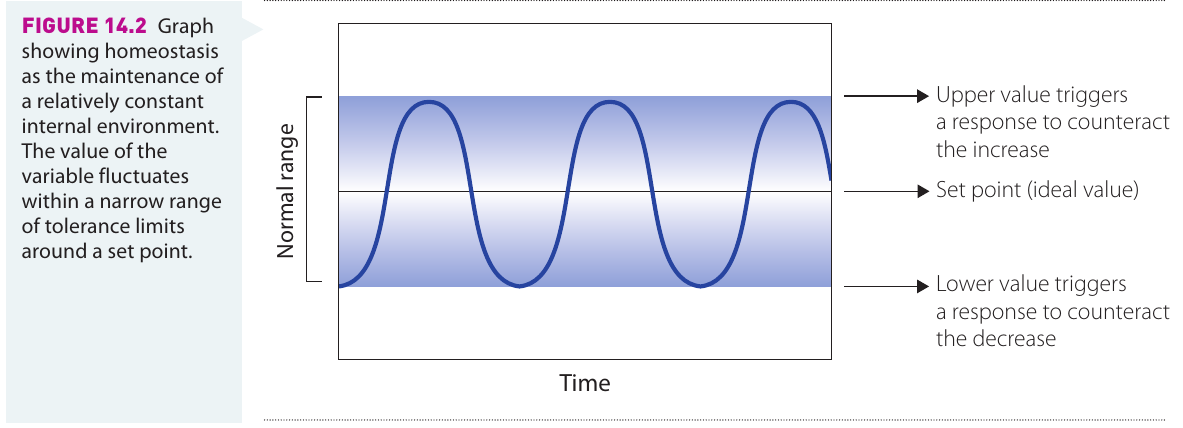
The graph above shows how a variable (like temperature or glucose concentration) fluctuates within the normal range:
- The variable oscillates (moves up and down) around the set point
- When it reaches the upper tolerance limit, your body triggers responses to decrease it
- When it drops to the lower tolerance limit, your body triggers responses to increase it
- This keeps the variable within safe, functional limits
Important
Exceeding Tolerance Limits
If fluctuations exceed the tolerance limits, homeostatic mechanisms activate to return the body to the normal range. Prolonged deviation from these limits can lead to serious health problems or even death.
How homeostasis is maintained
Maintaining homeostasis requires enormous coordination and control. In mammals like humans, two major body systems work together:
- The nervous system — sends messages as electrical nerve impulses throughout the body
- The endocrine system — sends messages using chemical messengers called hormones
The hypothalamus, a region in the lower central part of your brain, acts as a crucial control centre for homeostasis. It:
- Contains receptors that detect changes in certain factors (like body temperature)
- Links the nervous and endocrine systems
- Sends messages to effectors to carry out necessary responses
- Maintains many homeostatic conditions
Note
The Hypothalamus as Control Centre
The hypothalamus is unique because it serves as a bridge between your nervous system (which uses electrical signals) and your endocrine system (which uses chemical signals). This dual function makes it essential for coordinating complex homeostatic responses.
The negative feedback system
Homeostasis works through a self-regulating process called a negative feedback mechanism. This system automatically corrects changes in your internal environment.
Two stages of homeostasis
The homeostatic process occurs in two main stages:
Stage 1: Detecting change
- Sensory cells called receptors detect a change in a particular component of the internal environment
- This change is called a stimulus
- Examples: receptors might detect that body temperature has increased or blood pH has decreased
Stage 2: Counteracting the change
- A response occurs that reverses or counteracts the change
- This response is carried out by effector organs (such as muscles or glands)
- The response restores the body to its relatively stable internal state
The role of the control centre
The link between these two stages is the control centre. Here's how it works:
- The control centre receives information from receptors about a change in a condition
- It determines if the change is too far above or below the set point
- It decides on an appropriate response
- It sends a message to the effectors to carry out activities that will counteract the stimulus
- Once receptors detect that acceptable levels have been achieved, this information is fed back to the control centre
- The control centre then directs the effectors to stop their actions
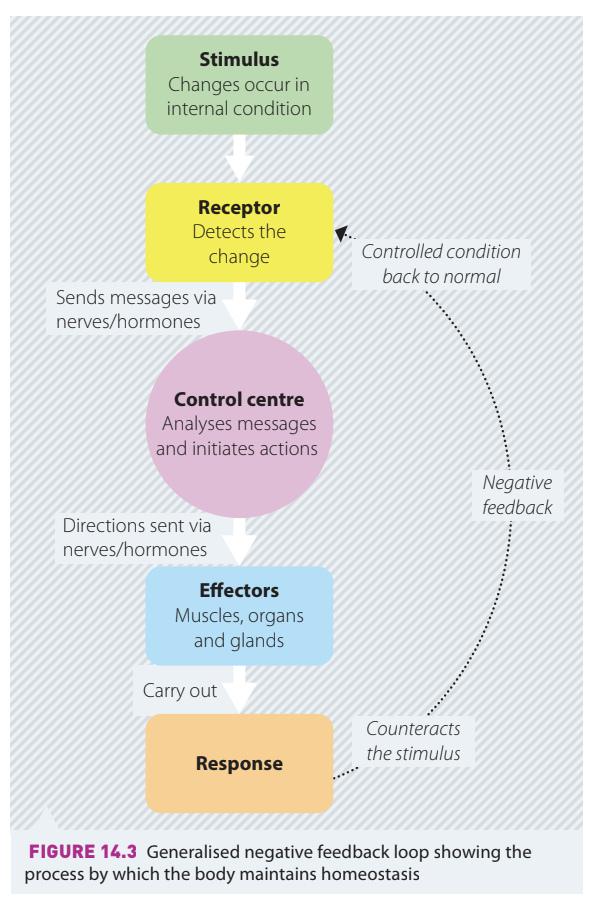
Why it's called 'negative' feedback
Important
Understanding 'Negative' Feedback
The term "negative" doesn't mean bad—it means the feedback opposes or counteracts the original change.
For example:
- If your body temperature rises (stimulus), the response is to cool down (counteracts the rise)
- If blood glucose drops (stimulus), the response is to increase it (counteracts the drop)
The response always works in the opposite direction to the stimulus, bringing conditions back to the set point. This is what makes it "negative" feedback.
Components of the negative feedback loop
Every negative feedback mechanism involves these key components:
Note
Key Components of Negative Feedback
- Stimulus — the change that occurs in an internal condition
- Receptor — detects the change
- Control centre — analyses messages from receptors and initiates actions
- Effectors — muscles, organs, and glands that carry out the response
- Response — the action that counteracts the stimulus
- Feedback — information sent back to the control centre about the current status
The process creates a continuous loop that constantly monitors and adjusts your internal environment.
Coordination of homeostatic mechanisms
Depending on which internal condition needs regulating, homeostatic mechanisms can be coordinated by:
- The nervous system alone
- The endocrine system alone
- A combination of both systems working together
Messages are transmitted in different ways:
- The nervous system relays information as nerve impulses (fast, electrical signals)
- The endocrine system releases chemical messengers called hormones into the bloodstream (slower, but longer-lasting effects)
The hypothalamus plays a particularly important role because it:
- Contains receptors for certain factors like body temperature
- Acts as a bridge between the nervous and endocrine systems
- Coordinates responses from multiple effectors
Remember!
Summary
Key Points to Remember:
-
Homeostasis is the maintenance of a relatively stable internal environment, essential for optimal metabolic efficiency and enzyme function.
-
Internal conditions have a set point (ideal value) and are maintained within tolerance limits (narrow acceptable range).
-
Homeostasis occurs in two stages: detecting change (via receptors) and counteracting change (via effectors).
-
The process works through negative feedback mechanisms—responses that counteract or oppose the original stimulus.
-
The control centre (often the hypothalamus) receives information from receptors and directs effectors to respond appropriately.
-
Both the nervous system (nerve impulses) and endocrine system (hormones) coordinate homeostatic mechanisms to maintain balance.