Stakeholders in the Human Resource Management Process (HSC SSCE Business Studies): Revision Notes
📚Revision Notes
Stakeholders in the Human Resource Management Process
Introduction to stakeholders
A stakeholder is any individual or group that has a common interest in or is affected by the actions of an organisation. In human resource management, stakeholders share a common interest in the survival and success of the business. However, their specific interests often differ, which can lead to conflict between stakeholder groups.
The main stakeholders in the human resource management process include:
- Employers
- Employees
- Employer associations
- Trade unions
- Governments and government organisations
- Society
Each stakeholder group has different objectives that can either align with or compete against the objectives of other groups. Understanding these stakeholders and their interests is essential for effective human resource management.
Note
While all stakeholders share an interest in the business's survival, their specific objectives often conflict. For example, employers may seek to minimise costs while employees seek higher wages, creating natural tension in the HRM process.
Employers
An employer is one who exercises control over employees, has responsibility for the payment of wages and/or salaries, and has the power to dismiss employees.
Employer responsibilities and challenges
Employers handle human resource management issues on a daily basis. Many employers spend over half their working day dealing with HRM matters, including developing programs to improve business performance. Their responsibilities have increased significantly in recent years as legislation encourages them to negotiate agreements and resolve disputes at the workplace level.
Key employer objectives:
- Increase profit and business growth
- Increase workplace flexibility
- Minimise costs to remain competitive
- Expand the business
- Develop new products
- Maximise customer service
Management capability concerns
Despite their central role in HRM, employers have been widely criticised for failing to manage employees effectively. Research involving more than people found that 'people management' was the most serious failing of business leaders in Australia—cited times more frequently than any other management failing. This highlights the importance of improving management training in Australia.
Important
Critical Management Gap
Research shows that 'people management' is cited times more frequently than any other management failing among Australian business leaders. This represents a significant capability gap that directly impacts business performance and employee satisfaction.
Employees
An employee is a worker under the control of an employer. This control includes the workplace location, the way that work is to be performed, and the extent to which supervision will be exercised.
Changing nature of employees
Modern employees differ significantly from workers of previous generations:
- They are more highly educated on average
- They become bored quickly and demand more challenging, interesting work
- They want involvement in decision-making processes
- They seek greater autonomy in their workplace
- Many build careers through a succession of jobs in different organisations
Employee objectives
Employees seek:
- Better wages
- Improved working conditions
- Meaningful jobs
- Job security
- Participation in workplace decisions
Employment trends
Following extensive downsizing in recent years, employees no longer trust a single business to meet their needs. This has led to 'churning'—the practice of moving frequently from one job to another in different organisations, particularly in service industries.
Note
The Churning Phenomenon
Modern employees increasingly practice 'churning'—moving between different organisations rather than building long-term careers with a single employer. This trend reflects reduced trust in single employers and a desire for diverse experiences and opportunities.
To retain and motivate skilled staff, businesses must invest in:
- Career and training plans
- Reward systems
- Opportunities for employee involvement
- Work-life balance initiatives
Workforce composition changes
The structure of work has changed significantly:
- Many older workers, women and younger inexperienced people struggle to obtain full-time jobs
- These groups form Australia's 'flexible', casual workforce
- The number of Australians aged years and over is projected to double by
- Their participation rates are expected to increase from to
- Women's participation rates are expected to grow by over the next years
Trade unions have responded to these concerns by prioritising job security and limitations on casual employment in their negotiations. However, many employees appreciate the flexibility of job sharing, part-time and casual work to manage family commitments.
Note
Australia's workforce is undergoing significant demographic shifts. With the population aged expected to double by and participation rates rising from to , businesses must adapt their HRM strategies to accommodate an aging and more diverse workforce.
Employer associations
An employer association is an organisation that represents and assists employer groups. They usually act as respondents to awards covering the employees of their members and represent employers in the same or related industry.
History and original purpose
Employer associations were originally created as a counter-party to unions to represent employers in the making of awards through the conciliation and arbitration system established in . They helped employers formulate policies and process logs of claims (lists of demands made by workers through their unions regarding wages and conditions).
Current role and functions
Today, employer associations primarily act on behalf of employers (especially small businesses) in collective bargaining sessions and before industrial tribunals, courts, commissions and committees.
Key functions:
- Provide advice (especially to small businesses) on awards, unfair dismissals and discrimination issues
- Make submissions to safety net wage cases
- Negotiate agreements
- Lobby governments and other organisations with employers' views and interests
- Represent employers, industries and trade on broader issues
Unlike unions, employer associations represent employers on a broader range of issues beyond human resource and industrial relations matters. They may function as professional bodies (e.g. Australian Medical Association), marketing bodies (e.g. dairy cooperatives) or associations with industrial relations functions (e.g. Australian Chamber of Commerce and Industry, Australian Industry Group).
Example
Case Study: Australian Industry Group (Ai Group)
The Australian Industry Group (Ai Group) is Australia's peak industry association, representing more than businesses across manufacturing, engineering, transport, IT, telecommunications and construction sectors.
The Ai Group focuses on ensuring business views are represented to all levels of government on matters including work health and safety, workplace relations, human resource management and workers' compensation. This demonstrates how employer associations serve as a vital link between business and government on HRM issues.
Trade unions
A trade union is an organisation formed by employees in an industry, trade or occupation to represent them in efforts to improve wages and working conditions of their members.
Development of trade unions in Australia
Trade unions have played a significant role in Australian industrial relations since the s:
Key historical developments:
- s: Union concept brought from Great Britain
- : Stonemasons won first -hour working day
- Late s: Unions organised on broader scale (waterfront, mining, manufacturing, shearing)
- s: Major strikes occurred; unions defeated by combined power of governments, employers, military and non-union workers
- : Unions formed the Labor Party to gain political representation
- : Conciliation and Arbitration Act established, enshrining union power
- : Famous Harvester case established principle of basic wage for a family
- : of workforce unionised; ACTU established in
- : Equal pay for equal work established
- s: White collar unions grew significantly through 'closed shop' arrangements (compulsory union membership)
- s onwards: Union membership declined rapidly—a global pattern in high-income countries
Current union landscape
Peak body: The Australian Council of Trade Unions (ACTU)
Major unions include:
- Australian Services Union (ASU)
- Australian Workers' Union (AWU)
- Australian Manufacturing Workers' Union (AMWU)
- Construction, Forestry, Maritime, Mining And Energy Union (CFMMEU)
- Finance Sector Union (FSU)
- Maritime Union of Australia (MUA)
- Transport Workers' Union of Australia (TWU)
- Textile, Clothing and Footwear Union of Australia (TCFUA)
Declining union membership
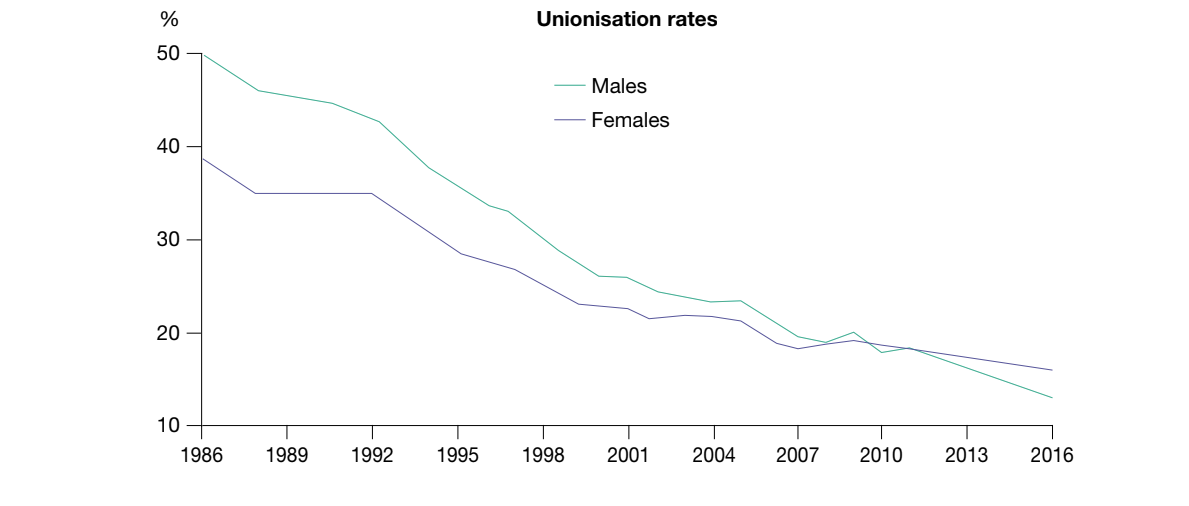
Union membership peaked at in , falling to by . It has fallen dramatically since, reaching the current level of of the workforce, where it has remained steady for recent years.
Current statistics:
- of full-time and of part-time employees belong to a trade union
- of government workers compared with of private industry workers are union members
- Highest levels: education and training sector ()
- Lowest levels: real estate services and professional, scientific and technical services ()
- of workers have never belonged to a trade union
Important
Dramatic Decline in Union Membership
Union membership has declined from a peak of in to just today. Perhaps most striking is that of workers have never belonged to a trade union, indicating a fundamental shift in the Australian industrial relations landscape.
Reasons for declining union membership
Economic changes and workforce composition:
- Decline in manufacturing employment (traditionally heavily unionised) due to technological and structural change
- Growth of service industries (poorly unionised—workers don't see need to unionise)
- Growth of casual/part-time sector and contract labour (hard to unionise)
- Feminisation of workforce (women less likely to unionise)
- Decline in workplace size (lower levels of unionisation more common)
- Privatisation of public businesses
- Globalisation pressures
Legislative and institutional changes:
- Legislative changes reducing union power and role (e.g. banning of 'closed shops')
- Collapse of the centralised wage-fixing system
- Unions became too dependent on tribunal system; lost contact at grass-roots level
Social and cultural factors:
- Poor image of unions in media
- Community attitudes favouring individual rather than collective approaches
- Changing workforce expectations
Union response and services
In response to declining membership, unions have expanded their range of services and become more active in recruiting. Beyond representation in disputes, unions now offer members:
- Free or discounted legal services
- Superannuation schemes
- Cheap home loans
- Training programs through TAFE
- Insurance
- Cheap holiday accommodation
- Income protection against illness or accident
- Work health and safety (WHS) advice
Note
To counter declining membership, unions have evolved from focusing solely on industrial representation to providing a comprehensive suite of member services. These include financial services (home loans, superannuation), insurance, legal assistance, and training programs—transforming unions into multi-service organisations.
Governments and government organisations
Governments are important stakeholders in the human resource management process. They have significantly affected the industrial relations system through their key roles.
Five key government roles
1. Legislator
Elected representatives pass laws in parliaments (state and federal) that provide the legal framework for industrial relations. Legislation has led to the growth of the judicial system and the institutions and processes used by employers and employees to conduct bargaining and resolve disputes.
2. Employer
Federal and state governments employ almost one-third of Australian workers, including teachers, nurses, clerks, police officers, postal workers and transport workers. Governments are often regarded as pacesetters in responsible industrial relations policies, having introduced practices such as maternity leave, flexitime and affirmative action for women that were eventually adopted in the private sector.
3. Responsible economic manager
Governments operating at the macro level aim to ensure non-inflationary, stable economic growth and a high standard of living for all Australians. Sometimes there is conflict between governments' economic goals and industrial relations outcomes. For example, cutting public service jobs to reduce a budget deficit may conflict with maintaining employment levels.
4. Administrator of government policies
Through established departments and agencies, governments implement the legislation they enact. This is achieved by publishing information and guidelines, providing advice to government and the public, and investigating breaches of legislation.
5. Representative of Australia internationally
Australia is a foundation member of the International Labour Organization and has been represented on its governing body. Government implements legislation based on treaties and conventions signed with international organisations. Social justice legislation relating to discrimination and human rights originated in these international agreements.
Note
Government as Employer and Pacesetter
Governments employ almost one-third of Australian workers and often lead the way in introducing progressive workplace practices. Initiatives like maternity leave, flexitime, and affirmative action were pioneered in the public sector before being adopted in private industry.
Statutes and industrial relations framework
Statutes are laws made by federal and state parliaments relating to employment conditions. Until recently, Australia operated a dual system of industrial relations since federation, but most states (except Western Australia) have now referred their industrial relations powers to the Commonwealth.
Key framework elements:
- Legislative power: Legislation passed by parliament (e.g. Industrial Relations Act)
- Executive power: Regulations made by governor/governor-general on advice of government departments
- Judicial power: Cases brought before tribunals/courts for breaches of award conditions
Fair Work Act 2009
The Fair Work Act established a national framework for industrial relations covering most private employees. It applies to all employees of constitutional corporations (foreign corporations and trading or financial corporations formed within the Commonwealth) in all states.
Key elements:
- National framework covering most private employees (except Western Australia)
- Ten National Employment Standards (NES) providing basic employee protections
- Collective bargaining and good faith bargaining required by all parties
- modern awards for specific industries and occupations (industry or occupation-based awards covering all private sector employers and employees performing work within their scope)
- Enterprise bargaining continues
- Annual National Wage Case sets minimum wage
- Protection from unfair dismissal
- Fair Work Commission administers the Act
- Fair Work Ombudsman promotes compliance with Fair Work laws
Important
Fair Work Act 2009: A National Framework
The Fair Work Act represents a fundamental shift in Australian industrial relations by establishing a unified national system. Key features include:
- Ten National Employment Standards (NES) as baseline protections
- modern awards replacing thousands of previous awards
- Mandatory good faith bargaining
- Unified administration through the Fair Work Commission
This framework applies to most private employees across Australia, with Western Australia remaining the exception.
Modern awards replaced thousands of previous state and federal awards. Together with the NES and the national minimum wage order, they form a safety net for employees covered by the national workplace relations system.
Award simplification is the process of reducing the number of matters in each award and eliminating inefficient work practices.
Industrial tribunals and courts
Fair Work Commission
The Fair Work Commission ensures that the bargaining process and any associated industrial action occur according to law. It replaced the Australian Industrial Relations Commission (AIRC).
Primary functions:
- Settling disputes through conciliation
- Supervising the making of agreements or awards and award simplification
- Hearing appeals and unfair dismissal cases
- Assisting in resolving disputes involving employers, employees, unions and employer associations
A full panel (bench) of at least three Fair Work members, including a Deputy President, is needed to:
- Hear matters of significant national interest
- Certify multiple business agreements
- Hear appeals against orders, or cancel and suspend awards and orders
- Arbitrate after a bargaining period is terminated
The Expert Panel (seven senior members) is responsible for hearing annual wage cases and setting minimum wages.
Penalties: Breaches of Fair Work Commission orders can lead to fines of up to $12,600 for individual workers or $63,000 for a corporate entity.
Federal Court
The Federal Court has judicial power (the power of courts to interpret and apply laws). Its industrial relations division:
- Enforces industrial relations legislation
- Handles cases relating to industrial action and breaches of industrial laws
- Interprets industrial legislation
- Imposes penalties for breaches of awards or orders
- Handles discrimination or victimisation cases under industrial and human rights legislation
- Approves disamalgamation (splitting up) of unions
- Declares unauthorised action during disputes
- Hears cases under the Corporations Act
Other government agencies
Australian Human Rights Commission (AHRC), Workplace Gender Equality Agency (WGEA) and state organisations like Anti-Discrimination NSW implement specific areas of government legislation.
Safe Work Australia began operating as an independent statutory agency in . Its primary responsibility is to improve work health and safety and workers' compensation arrangements across Australia. It has developed a national framework for occupational health and safety in collaboration with state governments, the Australian Chamber of Commerce and Industry (ACCI), and the ACTU.
Note
Multiple government agencies work together to implement different aspects of workplace legislation. While the Fair Work Commission handles industrial relations, agencies like the AHRC, WGEA, and Safe Work Australia focus on human rights, gender equality, and workplace safety respectively.
Society
Society is a crucial stakeholder in human resource management. In , the General Assembly of the United Nations passed the Universal Declaration of Human Rights, recognising the importance of work to people's lives and the need for fair and just conditions and rights at work.
UN Declaration of Human Rights (Articles 23 and 24)
Key rights relating to work:
- The right to work
- The right to freely choose employment
- Fair conditions of work
- Equal pay for equal work
- Just and fair remuneration
- The right to form and join a trade union
- The right to leisure and rest (limits on working hours and holidays)
Note
Foundation of Modern Work Rights
The UN Declaration of Human Rights (1948) established fundamental principles that underpin modern employment legislation worldwide. These include the right to work, fair conditions, equal pay, and the freedom to join unions—concepts that now form the basis of workplace protections in Australia and other developed nations.
Community expectations and pressures
Employment is one of the most significant issues for voters. If there are threats to employment or working conditions—whether from planned legislation, economic conditions, global competition or adverse social impacts—voters make their views clearly known. The relationship between employers and employees has often been a battleground, reflected in frequent disputes and legislative changes in Australia.
Global competition and community concerns
As global competition increases, businesses face pressure to become leaner and more efficient. Multinational corporations increasingly use contractors to supply or manufacture components or services, creating opportunities globally for suppliers with the most cost-effective operations.
Social impacts:
- Relocating production offshore or shifting to lower-cost locations leads to dislocation and structural unemployment in communities left behind
- Other communities face constant pressure to 'do more with less', work longer hours and accept difficult conditions to retain jobs
Community demands have increased for:
- Safety and wellbeing at work
- Elimination of discrimination against female, Indigenous and disabled workers
- Work-life balance
- Fair and just working conditions
Important
Balancing Competitiveness and Community Wellbeing
For businesses, this creates ongoing tension between the need to reduce labour costs (their biggest expense) due to global competition and the needs of employees, particularly those with dependent families. This represents one of the most challenging aspects of modern HRM—balancing business survival with community expectations for fair treatment and job security.
For businesses, this creates ongoing tension between the need to reduce labour costs (their biggest expense) due to global competition and the needs of employees, particularly those with dependent families.
Summary
Key Points to Remember:
-
Stakeholders are individuals or groups with a common interest in or affected by an organisation's actions. The six main HRM stakeholders are employers, employees, employer associations, trade unions, governments and society.
-
Employers control employees, pay wages/salaries and have power to dismiss. They face increasing responsibilities under legislation and criticism for poor people management.
-
Employees are more educated than in the past, seek meaningful work and involvement in decisions, and increasingly move between organisations ('churning'). Workforce is aging and becoming more diverse.
-
Employer associations represent employers in bargaining sessions and tribunals, provide advice especially to small businesses, and lobby governments on behalf of industries.
-
Trade unions represent employees to improve wages and conditions. Membership has declined from in to currently due to economic changes, legislative changes and social factors. Unions have expanded services to attract members.
-
Governments play five key roles: legislator, employer, economic manager, administrator and international representative. The Fair Work Act established a national framework with ten National Employment Standards, modern awards, and emphasis on collective bargaining.
-
Society influences HRM through community expectations based on UN human rights principles, demands for safety and anti-discrimination measures, and concerns about balancing business competitiveness with employee wellbeing.
Key terms: stakeholder, employer, employee, employer association, trade union, log of claims, statutes, constitutional corporation, modern award, award simplification, judicial power, Fair Work Commission