Dissociation Constants for Bases (HSC SSCE Chemistry): Revision Notes
📚Revision Notes
Dissociation Constants for Bases
What are base dissociation constants?
When a weak base dissolves in water, only a fraction of its molecules split apart to form ions. This creates an equilibrium between the intact base molecules and the ions they produce. We use a special value called the base dissociation constant (represented as ) to measure how much splitting occurs.
The general equation showing a base reacting with water is:
where B represents any base molecule.
The equilibrium expression for is:
Note
Square brackets indicate the concentration of each species at equilibrium, measured in . This notation is standard in all equilibrium expressions.
Example: ammonia in water
Ammonia () is a common weak base. When it reacts with water:
The expression becomes:
This tells us that at equilibrium, ammonia produces a relatively small concentration of ions compared to the amount that remains as molecules.
How Kb relates to base strength
The size of directly indicates how strong a base is. Here's what the value tells you:
- Larger = Stronger base = More dissociation occurs
- Smaller = Weaker base = Less dissociation occurs
This works because a larger means the numerator (product concentrations) is bigger compared to the denominator (reactant concentration). In practical terms, more hydroxide ions () are produced.
Note
Memory Aid: "Bigger Kb = Bigger Base strength" - remember the three B's!
Strong bases vs weak bases
Strong bases, such as sodium hydroxide (), dissociate almost completely in water:
Nearly 100% of the base splits apart, so the for strong bases is extremely large. For weak bases like ammonia, only a small percentage dissociates, giving much smaller values.
Common weak bases and their Kb values
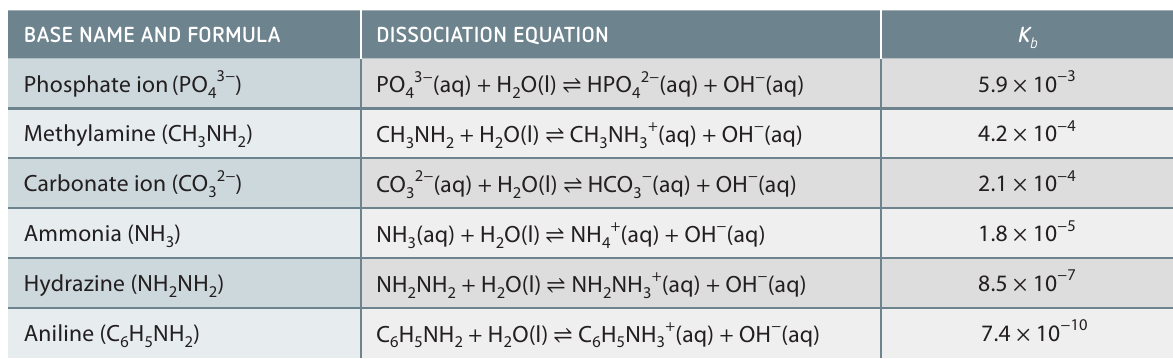
The table below shows values for several weak bases at 25°C. Notice how the values range over several orders of magnitude, indicating very different base strengths:
Important
Phosphate ion has the largest in this table (), making it the strongest base shown. Aniline has the smallest (), making it the weakest base in the table.
Determining base concentration from pOH
The method you use to find base concentration depends on whether you're working with a strong or weak base.
Strong bases
For strong bases, dissociation is effectively 100% complete. This means:
- The final concentration of the intact base is negligible (essentially zero)
- The pOH directly tells you the original base concentration
- You can calculate directly from pOH using:
Weak bases
For weak bases, the situation is more complex:
- Significant amounts of the base remain un-dissociated at equilibrium
- The pOH does NOT directly give you the base concentration
- You must use and the hydroxide ion concentration together to calculate the base concentration
Important
Critical Distinction: For strong bases, pOH directly gives you the concentration. For weak bases, you must perform calculations using . Understanding this difference is crucial for solving problems correctly.
The relationship between Ka and Kb
For any conjugate acid-base pair, there's a simple mathematical relationship connecting their equilibrium constants:
where is the ion product of water ( at 25°C).
Note
Memory Aid: "Ka times Kb equals Kw" - notice the alphabetical progression!
Example: the NH₄⁺/NH₃ conjugate pair
Consider the ammonium ion () and ammonia (), which form a conjugate acid-base pair.
For the weak acid :
For the corresponding weak base :
Multiplying these values:
Note
Practical use: If you know either or for a conjugate pair, you can calculate the other using this relationship. This saves you from having to look up both values!
Determining Kb experimentally
You can find the of a weak base by measuring the pH or pOH of a solution with known concentration, then using this data to calculate the hydroxide ion concentration.
The method
Starting with a base B that forms conjugate acid :
The equilibrium expression is:
Because each base molecule that dissociates produces exactly one ion and one ion, we know that:
This allows us to simplify the expression to:
Important assumptions
Note
When performing these calculations, we make two key assumptions that simplify our work:
Assumption 1: The base concentration at equilibrium equals the initial concentration.
This is valid because weak bases only dissociate to a small extent, so the amount that splits apart is negligible compared to the starting amount. We can write .
Assumption 2: Hydroxide ions from water's self-ionisation are negligible.
Pure water produces a tiny amount of ions (), but this is so small compared to what the base produces that we can ignore it.
These assumptions simplify calculations considerably and introduce minimal error for typical weak base problems.
Required formulas
To convert between pH, pOH, and hydroxide concentration:
Worked examples
Example
Worked Example 1: Calculating from pOH
Step 1: Write the dissociation equation
Step 2: Write the expression for
Step 3: Calculate the hydroxide ion concentration
Given:
Step 4: Substitute values into the formula
Assume:
Since:
Final Answer
Example
Worked Example 2: Calculating pH from
Step 1: Write the expression
For ammonia:
Step 2: Rearrange to find
Since:
Rearranging:
Step 3: Substitute values
Given:
Step 4: Calculate pOH
Step 5: Calculate pH
Final Answer
Practical investigation: determining Kb for ammonia
Investigation 6.5 provides a hands-on method to experimentally determine the value for ammonia solution. The investigation uses dilution and pH measurements to gather data.
The dilution approach
Different concentrations of ammonia are prepared using serial dilution:
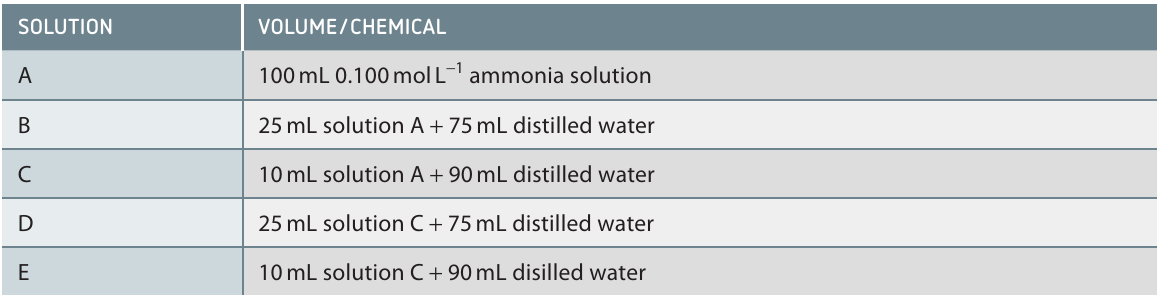
By measuring the pH of each solution and plotting pH against initial ammonia concentration, you can determine equilibrium concentrations of all species. This data then allows you to calculate using the equilibrium expression.
Note
The investigation follows the same methodology as calculations with weak acids, but applied to bases. Students measure pH, convert to , and use equilibrium expressions to find . The theoretical value for ammonia at 25°C is .
Understanding how to set up serial dilutions and use pH data to calculate equilibrium constants is an important practical skill for chemistry students.
Remember!
Summary
Key Points to Remember:
-
The base dissociation constant () measures how much a weak base splits apart in water:
-
Larger values indicate stronger bases because more ions are produced at equilibrium compared to un-dissociated base molecules.
-
For conjugate acid-base pairs: at 25°C. This relationship lets you calculate one constant if you know the other.
-
When calculating with weak bases, you can use the simplified formula because at equilibrium.
-
Two important assumptions:
- The base concentration barely changes from initial to equilibrium
- Hydroxide ions from water self-ionisation are negligible compared to those from the base