Self-Ionisation of Water (HSC SSCE Chemistry): Revision Notes
📚Revision Notes
Self-Ionisation of Water
Water is not just a simple solvent - it has some fascinating chemical properties! One of the most important is its ability to react with itself through a process called self-ionisation (also known as autoionization). Understanding this concept is crucial for working with acids, bases, and pH calculations.
Water's amphiprotic nature
In earlier sections, you learned that water is amphiprotic, meaning it can act as both an acid and a base. This special property allows water molecules to react with each other in an equilibrium reaction that produces ions. Even in pure water, a small number of water molecules are constantly participating in this reaction:
In this reaction, one water molecule donates a proton (acting as an acid) while another water molecule accepts that proton (acting as a base). The result is the formation of a hydronium ion () and a hydroxide ion ().
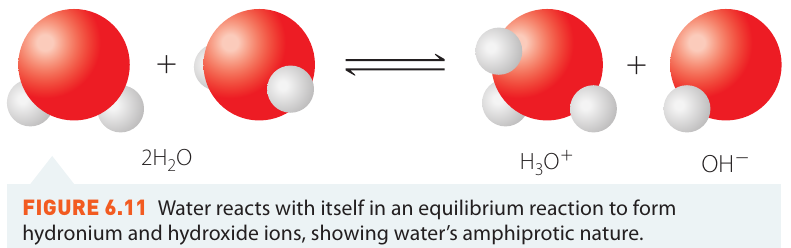
This equilibrium is present in all aqueous solutions, not just pure water. However, only a tiny fraction of water molecules actually undergo this ionisation - the equilibrium lies far to the left, favouring the undissociated water molecules.
Note
The equilibrium position lies so far to the left that only about 2 out of every billion water molecules are ionised at any given moment! This is why pure water is such a poor conductor of electricity despite containing ions.
The self-ionisation constant ()
Since the self-ionisation of water is an equilibrium reaction, it has an equilibrium constant. However, this constant has a special name and symbol: the self-ionisation constant or ionic product constant for water, represented as .
The expression for is:
At (which is , standard room temperature):
Note
Why isn't water included in the expression?
You might wonder why doesn't appear in the expression. This is because the concentration of water is extremely large (approximately ) and remains essentially constant during the reaction. Since only a minuscule amount of water molecules actually ionise, the change in water concentration is negligible. For this reason, the water concentration is incorporated into the constant itself, giving us the simplified expression.
Important
The value of is only valid at (). Like all equilibrium constants, changes with temperature. Using this value at other temperatures will lead to incorrect results!
Ion concentrations in pure water
In pure water at , something special happens: the concentration of hydroxide ions exactly equals the concentration of hydronium ions. This makes sense when you look at the equation - for every ion formed, exactly one ion is also formed.
Therefore, in pure water:
We can use the expression to calculate these concentrations:
Since the two concentrations are equal:
Taking the square root:
Therefore, at , pure water has:
This is why pH 7 is considered neutral - but remember, this is only true at !
Defining acidic, alkaline and neutral solutions
The relationship between hydronium and hydroxide ion concentrations allows us to classify any aqueous solution as acidic, alkaline, or neutral. The key is comparing the concentrations of these two ions:
Acidic solution:
- At :
Alkaline (basic) solution:
- At :
Neutral solution:
- At : both concentrations
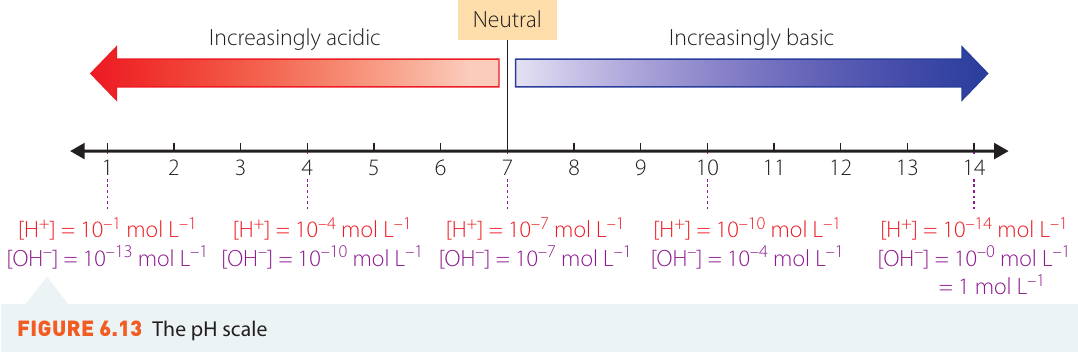
The pH scale shown below illustrates these relationships visually:
Note
Notice how the exponents of the hydronium and hydroxide ion concentrations always add up to . This is a direct consequence of . For example, if , then must be , and .
Calculating pH using
One of the most powerful applications of is that it allows you to calculate the pH of any solution, even alkaline solutions where you only know the hydroxide ion concentration.
The calculation pathway:
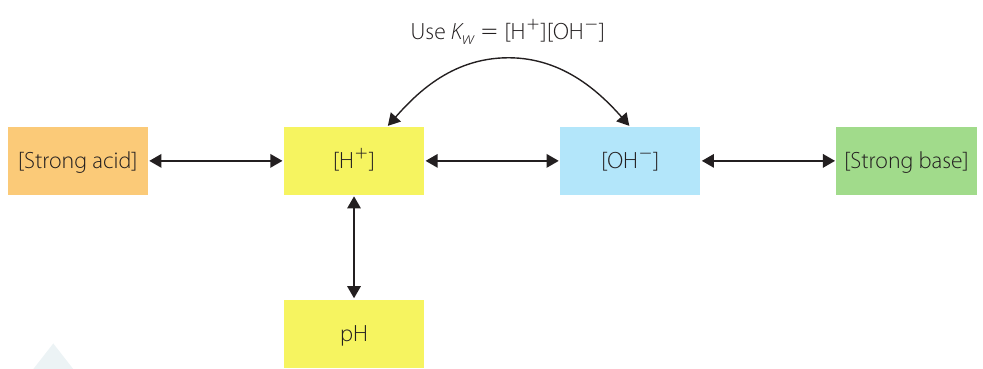
When you're given information about either acids or bases, you can use to find the missing ion concentration, and then calculate pH. Here's a helpful diagram showing the relationships:
Note
Key steps for pH calculations:
-
If you know , use to find :
-
If you know , calculate pH:
-
For strong acids and bases, remember they dissociate completely, so:
- For a strong acid:
- For a strong base with one :
Important
Exam tip: Always check whether you're given the concentration of an acid or a base, and whether you need to find , , or pH. Draw a simple pathway diagram if needed!
Worked examples
Example
Worked Example 1: Finding pH of a strong base
Problem: Find the pH of a solution of sodium hydroxide.
Step-by-step solution:
Step 1: Identify the species
Sodium hydroxide () is a strong base that dissociates completely in water:
Step 2: Determine
Since dissociates completely:
Step 3: Use to find
Step 4: Calculate pH
Answer: The pH is 12.3, which confirms this is an alkaline solution.
Example
Worked Example 2: Finding concentration from hydroxide ion concentration
Problem: If in a solution of , calculate the concentration of the solution.
Step-by-step solution:
Step 1: Use to calculate
Step 2: Identify the species
Nitric acid () is a strong acid that dissociates completely:
Step 3: Determine stoichiometric relationship
From the equation, one mole of produces one mole of :
Step 4: Final answer
Answer: The concentration of the nitric acid solution is 2.51 × 10⁻⁴ mol L⁻¹.
Important
Exam tip: When dealing with strong acids and bases, always remember they dissociate 100% in solution. This means the concentration of ions equals the original concentration of the acid or base. This is NOT true for weak acids and bases!
Summary
Key Points to Remember:
- Water undergoes self-ionisation to produce equal concentrations of and ions in pure water
- The self-ionisation constant at ()
- In pure water at : and
- A solution is acidic when , alkaline when , and neutral when
- You can use to convert between hydroxide and hydronium ion concentrations, enabling pH calculations for both acidic and alkaline solutions
- Always check the temperature - values are temperature-dependent!