The pH Scale (HSC SSCE Chemistry): Revision Notes
📚Revision Notes
The pH Scale
Introduction to the pH scale
Scientists need a precise way to measure how acidic or alkaline a solution is. The pH scale provides this quantitative measurement. The term 'pH' stands for 'hydrogen power' or 'power of hydrogen', reflecting the fact that the scale is based on the concentration of hydrogen ions in a solution.
Danish biochemist Soren Sorensen developed this scale to make expressing hydrogen ion concentrations more manageable. Remember that in aqueous solutions, hydrogen ions () attach to water molecules to form hydronium ions (). Therefore, the pH scale measures the concentration of hydronium ions in solution.
Note
While we often use and interchangeably when discussing pH, they represent the same concept in aqueous solutions. The pH scale measures both the hydrogen ions that have been donated and the resulting hydronium ions formed.
The pH scale directly relates to the Brønsted-Lowry definition of acids as proton donors. This is because pH measures the number of hydronium ions present - in other words, the number of ions that the acid has donated to water. For example:
Understanding the pH scale
The pH scale typically ranges from to , although values outside this range are possible. The scale works as follows:
- Lower pH values = more acidic solution
- Higher pH values = more basic (alkaline) solution
- pH = 7 = neutral solution (at )
Therefore:
- Acids have pH
- Bases have pH
- Neutral substances have pH
Relationship between pH and hydrogen ion concentration
The table below shows how pH values relate to hydrogen ion concentration:
| pH | |||||||||||||||
|---|---|---|---|---|---|---|---|---|---|---|---|---|---|---|---|
| or (mol L) |
Notice the relationship between the pH value and the exponent (ignoring the negative sign) in the hydrogen ion concentration - they are the same number. This is because pH is mathematically defined as:
Important
An increase of 1 unit on the pH scale corresponds to a 10-fold decrease in hydrogen ion concentration. For example, moving from pH to pH represents a change in from to mol L. This logarithmic relationship is crucial for understanding how dramatically pH values represent changes in acidity.
The relationship between hydrogen and hydroxide ions
While the pH scale is based on hydrogen ion concentration, it can also tell us about hydroxide ion () concentration. At pH (neutral), both and equal mol L.
| pH | |||||||||||||||
|---|---|---|---|---|---|---|---|---|---|---|---|---|---|---|---|
| (mol L) | |||||||||||||||
| (mol L) |
Key observations from this table:
- As decreases, increases by the corresponding amount
- Adding the exponents (ignoring the negative signs) of and always equals 14
Note
This inverse relationship between hydrogen and hydroxide ion concentrations reflects the constant product in aqueous solutions at . This is known as the ion product constant for water.
Measuring pH
There are several methods for measuring pH, ranging from simple indicators to sophisticated electronic instruments.
Indicators
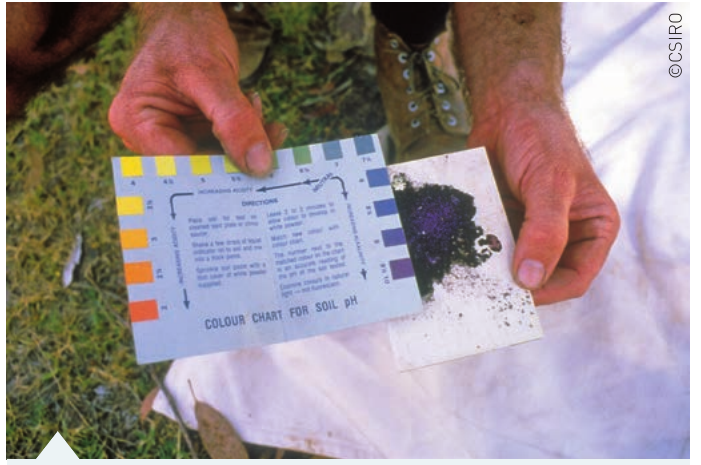
Indicators are substances that change colour depending on the pH of a solution. There are two main types:
Natural indicators: These were covered in earlier chapters and include substances like red cabbage juice.
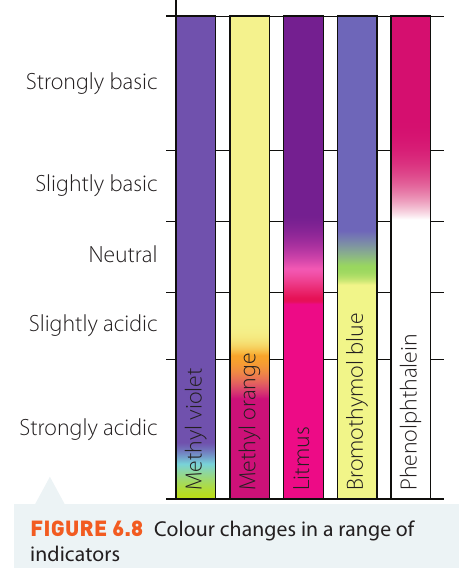
Synthetic indicators: These provide more precise information about the degree of acidity. Common synthetic indicators include:
- Methyl violet
- Methyl orange
- Litmus
- Bromothymol blue
- Phenolphthalein
Note
Each indicator changes colour over a specific pH range, not at a single pH value. This means different indicators are useful for detecting different ranges of acidity or alkalinity. The colour change typically occurs over a range of about 2 pH units.
Each indicator changes colour over a specific pH range:
Universal indicator
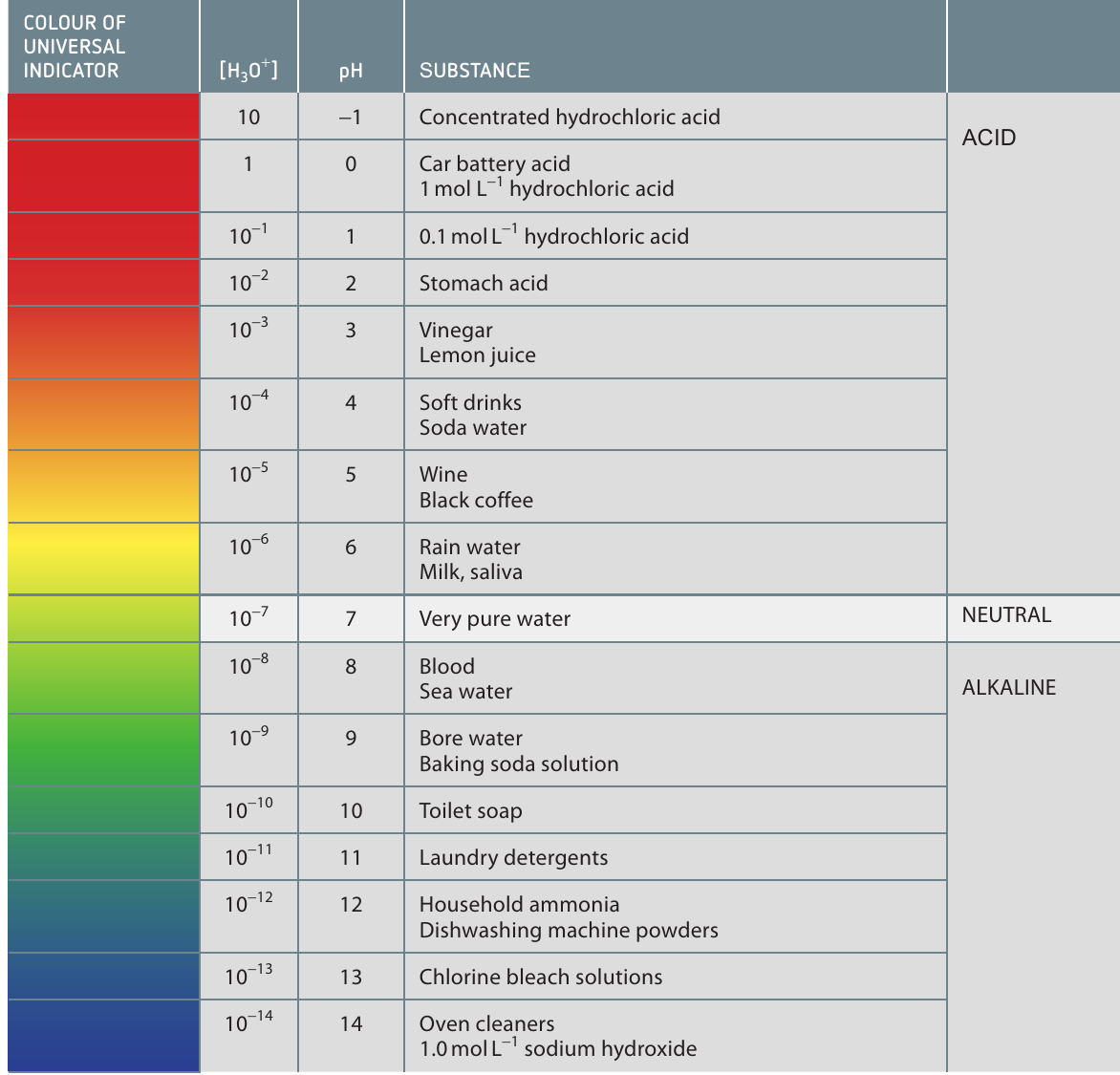
Universal indicator is a mixture of several indicators that produces multiple colour changes across the entire pH range. This makes it very useful for getting an approximate pH value.
pH meters and pH probes
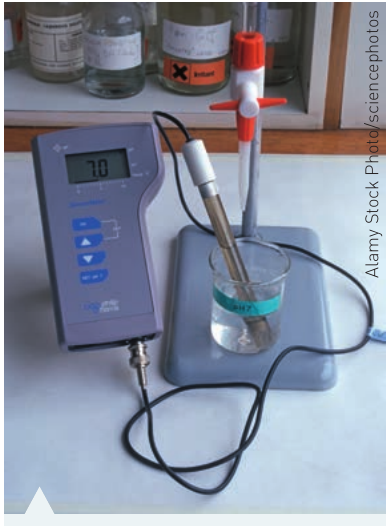
For more accurate measurements, scientists use pH meters with pH probes. These instruments provide a digital readout of the pH value.
Advantages of pH meters:
- Don't require adding additional substances to the solution
- Provide greater accuracy (when properly calibrated)
- Give a numerical readout rather than requiring colour comparison
Common substances and their pH
The table below shows the pH values of everyday substances, demonstrating the practical applications of the pH scale:
| pH | Substance | Type | |
|---|---|---|---|
| Concentrated hydrochloric acid | ACID | ||
| Car battery acid, mol L HCl | |||
| mol L hydrochloric acid | |||
| Stomach acid | |||
| Vinegar, lemon juice | |||
| Soft drinks, soda water | |||
| Wine, black coffee | |||
| Rain water, milk, saliva | |||
| Very pure water | NEUTRAL | ||
| Blood, sea water | ALKALINE | ||
| Bore water, baking soda solution | |||
| Toilet soap | |||
| Laundry detergents | |||
| Household ammonia, dishwashing machine powders | |||
| Chlorine bleach solutions | |||
| Oven cleaners, mol L NaOH |
Note
Notice that many common household substances are either quite acidic (cleaning products, foods) or quite alkaline (soaps, detergents). This table demonstrates why understanding pH is important for everyday life, from understanding food preservation to safe handling of cleaning products.
Calculating pH
The pH formula
The pH of a solution is mathematically defined as:
Where the square brackets represent the molar concentration of hydrogen ions in mol L.
Calculating pH from concentration
For simple concentrations that are powers of , the calculation is straightforward:
- If M (or ), then pH
- If M (or ), then pH
- If M (or ), then pH
For more complex concentrations, use a calculator.
Calculating concentration from pH
To find the hydrogen ion concentration from pH, use:
Worked examples
Example
Worked Example 1: Calculate pH from hydrogen ion concentration
Given: M
Step 1: Write the pH formula
Step 2: Substitute the given concentration
Step 3: Calculate using a calculator
Therefore, a solution with hydrogen ion concentration of M has a pH of 4.70.
Example
Worked Example 2: Calculate hydrogen ion concentration from pH
Given: pH
Step 1: Write the inverse pH formula
Step 2: Substitute the given pH value
Step 3: Calculate using a calculator
Therefore, a solution with pH of has a hydrogen ion concentration of M.
Important note on significant figures
Important
When working with pH values, only the digits after the decimal point (called the mantissa) are significant figures. The number before the decimal point (called the characteristic) is a 'place holder'. For example, a pH of has only two significant figures, not three. This is a common source of error in pH calculations!
Remember!
Summary
Key Points to Remember:
- The pH scale provides a quantitative measure of acidity and alkalinity based on hydrogen ion concentration
- pH ranges from to : acids have pH , bases have pH , and neutral substances have pH
- The pH formula is: and
- An increase of pH unit represents a 10-fold decrease in hydrogen ion concentration
- Universal indicator produces multiple colour changes across the pH range, making it useful for estimating pH values
- When reporting pH values, only digits after the decimal point are significant figures