Production (HSC SSCE Chemistry): Revision Notes
📚Revision Notes
Production
Alcohols can be made in several different ways, depending on their intended use. For alcohols in beverages and biofuels, fermentation of carbohydrates is the primary method. Industrial alcohol production typically uses either hydration of alkenes or substitution of haloalkanes. Increasingly, biofuel plants are also producing industrial alcohol, which can be further purified through distillation to achieve 99.9% purity.
Production from alkenes
When water is added to an alkene with sulfuric acid as a catalyst, the double bond breaks and a hydroxyl group () attaches to the molecule. This process is called hydration.
Example
Worked Example: Production of 2-butanol from 1-butene
When 1-butene undergoes hydration with sulfuric acid catalyst:
The sulfuric acid acts as both a catalyst and a source of ions to facilitate the reaction.
Note
This method is commonly used in industrial settings because it can produce alcohols quickly and efficiently from readily available alkene starting materials.
Production from halogenated organic compounds
When water is added to a haloalkane (an organic compound containing a halogen atom), a substitution reaction occurs. The halogen atom is replaced by a hydroxyl group to form an alcohol.
Example
Worked Example: Substitution Reaction
2-bromobutane reacts with water to form 2-butanol:
The bromine atom is replaced by a hydroxyl group.
Why haloalkanes react more easily
Haloalkanes undergo substitution reactions much more readily than regular alkanes. This is because the carbon-halogen bond is easier to break than carbon-carbon or carbon-hydrogen bonds.
The ease of breaking a bond depends on its bond energy, which is the energy required to break a chemical bond. For a substitution reaction to occur, the bond (where is a halogen) must break so the hydroxyl group can substitute in.
Bond energies for important bonds in haloalkanes:
| Bond | Bond energy () |
|---|---|
Note
All the carbon-halogen bond energies are lower than the C-C and C-H bonds, which explains why haloalkanes are more reactive.
Important
Exam tip: The bond energies also reveal why iodoalkanes are more reactive than bromoalkanes or chloroalkanes. As the bond energy decreases, the bond becomes easier to break, making the molecule more reactive.
Important exception: The bond has a bond energy of , which is substantially higher than both and bonds. This means fluoroalkanes will not react with water to produce alcohols.
Classification of haloalkanes
Like alcohols, haloalkanes can be classified as primary, secondary, or tertiary based on the number of carbon atoms bonded to the carbon carrying the halogen:
- A primary haloalkane has one carbon bonded to the carbon atom carrying the halogen
- A secondary haloalkane has two carbons bonded to the carbon atom carrying the halogen
- A tertiary haloalkane has three carbons bonded to the carbon atom carrying the halogen
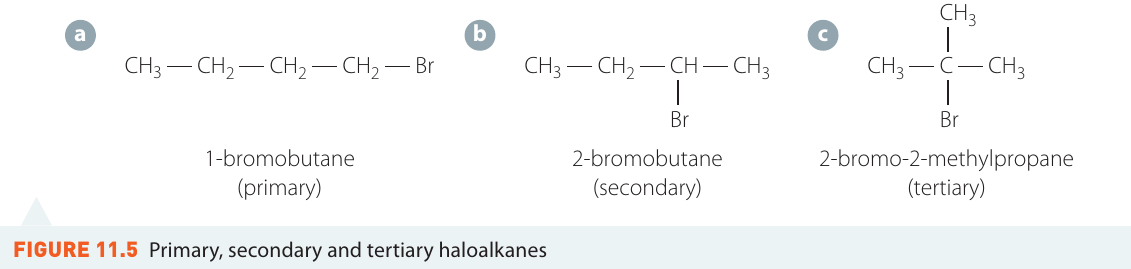
Reactivity of different haloalkanes
In substitution reactions with water, tertiary haloalkanes are the most reactive, followed by secondary haloalkanes. Primary haloalkanes do react, but only very slowly as they are the least reactive.
Important
Memory aid: Remember the reactivity order as "TSP": Tertiary > Secondary > Primary
This order exists because tertiary carbons form more stable carbocation intermediates during the substitution reaction.
Production from fermentation
Fermentation is the process of converting simple sugars like glucose into ethanol in an anaerobic (oxygen-free) environment. This is the traditional method for producing alcohol for beverages and is increasingly important for biofuel production.
The overall equation for fermentation is:
The role of yeast
Yeast carries out fermentation when oxygen is absent. Glucose molecules pass through the yeast cell wall, where the organism uses them to produce energy through its normal metabolic pathways. Under oxygen-free conditions, yeast produces ethanol as a by-product of these processes, which it then excretes along with carbon dioxide.
Note
While yeast can be found naturally on fruits like grapes, most alcohol producers add cultured yeast. This allows for better control of the fermentation rate and produces a more consistent, predictable product.
Types of sugars
Yeast requires simple sugars to produce ethanol effectively. Understanding the different types of sugars is important for successful fermentation.
Monosaccharides
Monosaccharides are simple sugars with a single ring structure containing four, five, or six carbon atoms. They also contain multiple hydroxyl groups (). Common examples include:
- Glucose ()
- Fructose ()
Glucose and fructose are isomers of each other (they have the same molecular formula but different structures). Many fruits, including grapes, contain these simple monosaccharides.
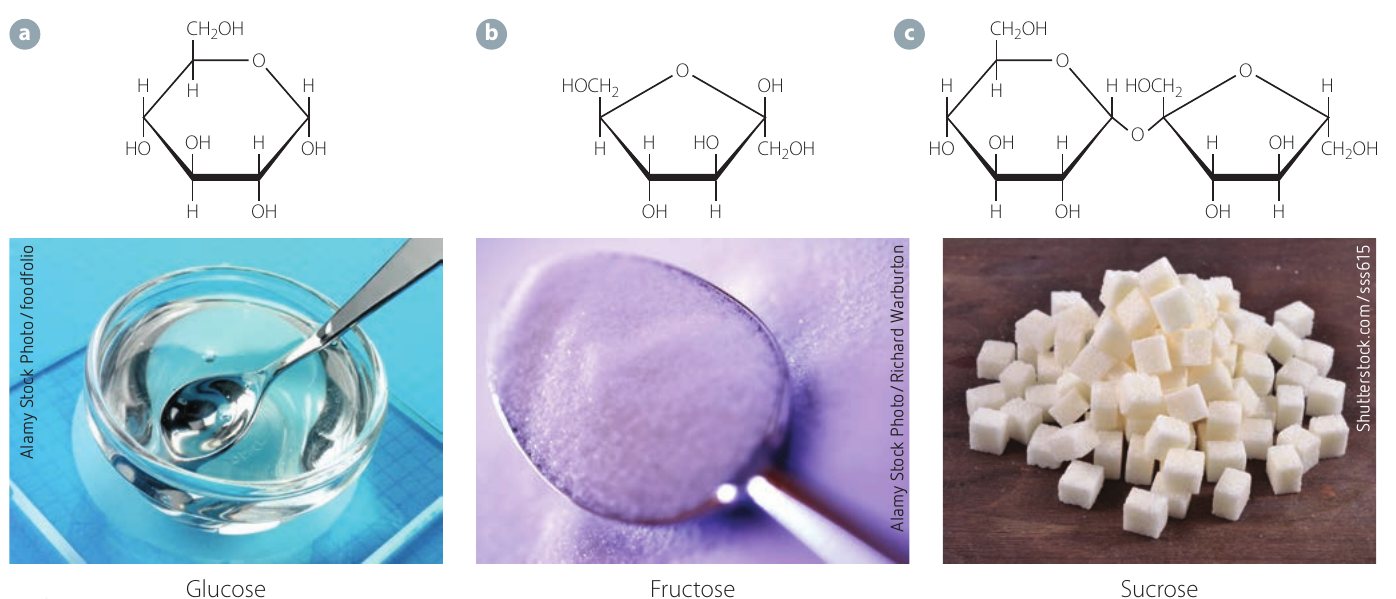
Disaccharides
A disaccharide consists of two carbon rings joined together. Two monosaccharides join in a condensation reaction to produce disaccharides. The most common example is:
- Sucrose (table sugar):
Note
Most fruits used to produce alcohol contain a mixture of glucose, fructose, and sucrose, plus other mono- and disaccharides like galactose and maltose.
Polysaccharides
Many grains and vegetables used to produce ethanol contain polysaccharides (also called carbohydrates). These are large molecules formed when multiple monosaccharides and disaccharides join together. Important examples include:
- Cellulose: found in plant cell walls
- Starch: found in grains and vegetables
Both have the general formula , where indicates multiple units are present in the polymer chain.
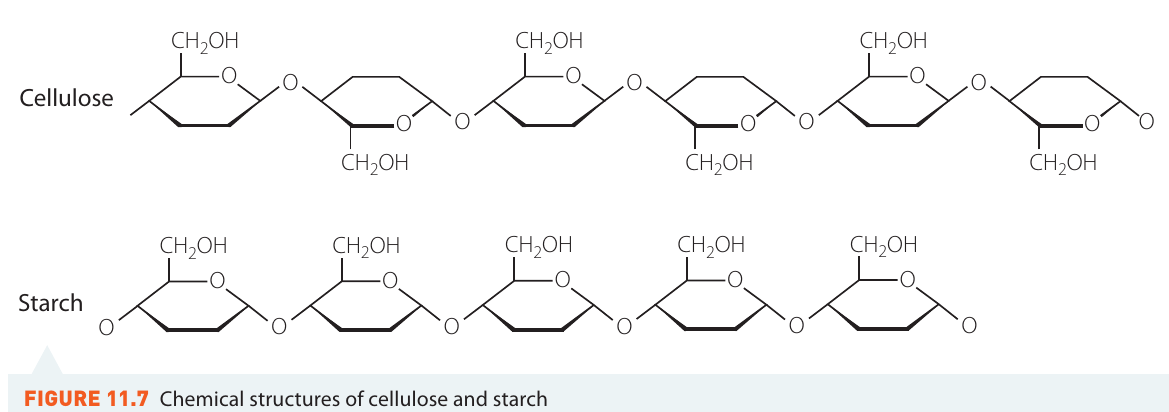
Breaking down complex sugars
Yeast is most efficient at breaking down simple monosaccharide sugars. Most types of yeast cannot break down polysaccharides at all, and can only break down sucrose in a limited way. Therefore, more complex sugars must be broken down before fermentation can occur.
Enzymes present in the fermentation mixture break down complex sugars into glucose through hydrolysis reactions:
Hydrolysis of polysaccharides to monosaccharides:
Hydrolysis of disaccharides to monosaccharides:
Once glucose has formed, it can be converted to ethanol by the yeast in the fermentation mixture.
Conditions for fermentation
Very specific conditions are required for successful fermentation. Without these conditions, it is nearly impossible to produce drinkable wine or spirits, or efficient biofuel production.
Temperature control
The temperature of the fermentation mixture must be kept within a narrow range:
- Red wine production: maximum
- White wine production: maximum
Important
The yeast and enzymes involved in fermentation are extremely temperature sensitive and will denature (stop working) if temperatures are above or below the optimal range.
pH control
Enzymes and yeast are also very sensitive to pH. The ideal range for fermentation is pH 6.1-6.8 (slightly acidic). Enzymes will denature outside this range and fermentation will stop.
Anaerobic conditions
Fermentation must occur under anaerobic conditions, meaning no oxygen must be present. If oxygen is present, it will oxidise the ethanol to produce ethanal and ethanoic acid, giving an unpleasant vinegar taste.
Note
This is what happens to wine that has been open for too long - oxygen enters the bottle and oxidises the alcohol to acetic acid (vinegar).
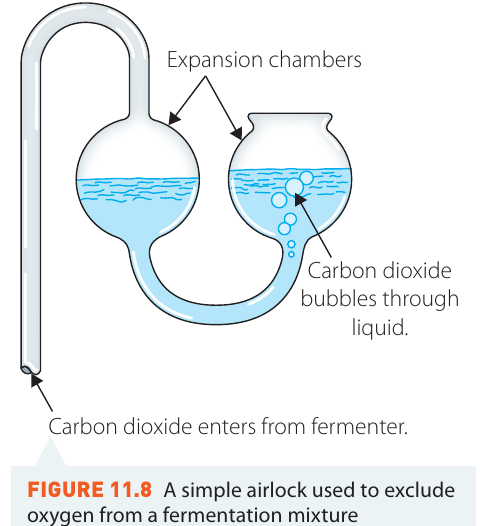
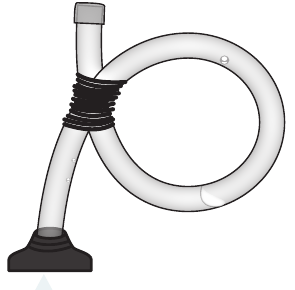
A simple airlock is used to keep oxygen out of the fermentation mixture. The liquid in the airlock (usually water) allows the carbon dioxide produced during fermentation to escape, preventing pressure buildup inside the reaction vessel. At the same time, the water prevents oxygen from entering the mixture.
Dilution requirements
The mixture must be kept dilute, usually by periodically adding water. The ethanol produced by yeast will poison the yeast cells if the concentration becomes too high.
Important
Critical limit: Yeast will be killed when the ethanol content reaches approximately 14% v/v.
This is why wines produced through fermentation alone cannot exceed about 14% alcohol content. Stronger beverages require distillation.
Keeping the mixture dilute is not a problem for the final product, as the ethanol can be distilled off and concentrated at the end of the process.
Investigation 11.3: Measuring the rate of fermentation
Aim
To create a fermentation mixture and measure the rate of reaction.
Materials
- of sodium dichromate solution ()
- of sulfuric acid ()
- conical flask
- yeast (dried packet yeast for bread-making)
- glucose (sucrose or table sugar will also work)
- warm water ()
- Spatula
- Electronic balance
- Controlled environment (incubator) set at approximately
- Plastic hose
- One-hole rubber stopper
- Limewater (calcium hydroxide)
- Test tube
- Thermometer
- measuring cylinder
- Disposable pipettes
Risk assessment
Important
Safety Considerations:
| What are the risks in doing this investigation? | How can you manage these risks to stay safe? |
|---|---|
| Concentrated sulfuric acid is corrosive and emits harmful vapours | Teacher may dispense acid as required. Avoid contact with skin by using appropriate personal protective equipment. Avoid inhalation of vapours by using chemicals in a fume cupboard |
| Production of carbon dioxide gas could build up pressure | Ensure gas leaves through airlock |
| Ethanol is flammable | Keep mixture clear of flame and hot equipment |
Method
- Place of yeast in the conical flask
- Add glucose and warm water to the flask. Swirl to mix contents
- Stopper the conical flask and attach a simple airlock created by making a circle of a length of plastic tube and filling with water
- Measure the mass of the set-up and record
- Measure the mass of the fermentation set-up over the next days, recording against the number of hours since set-up. If possible, store the mixture in a temperature-controlled environment at approximately . Generally a classroom window will be sufficient to see results
- During one mass measurement, unwind the plastic tubing and bubble the gas produced through a solution of limewater, recording any observations
- After completion of mass measurements, extract approximately of the fermentation mixture and add acidified dichromate solution. Record any observations
Results
Record the mass of the fermentation mixture against the number of hours of fermentation in a suitable table. Record observations of limewater and acidified dichromate ion tests.
Discussion
- Explain, using an equation, why there was a decrease in mass over time. Explain how this can be used to measure rate of fermentation
- Construct a graph of mass lost against hours of fermentation. Describe and explain any trends seen
- Explain the purpose of the limewater test. Use a balanced equation in your answer
- Explain the purpose of the acidified dichromate ion test. Use a balanced equation in your answer
Note
Explanation: The mass decreases because carbon dioxide gas () is produced during fermentation and escapes through the airlock. The rate of mass loss indicates the rate of fermentation. The limewater test confirms the presence of CO₂ (limewater turns cloudy), whilst the acidified dichromate test confirms the presence of ethanol (orange dichromate turns green).
Conclusion
Write a conclusion summarising any trends found in this investigation. You should observe that mass decreases over time as fermentation progresses, with the rate of mass loss potentially slowing as fermentation approaches completion or as conditions become less favourable for the yeast.
Summary
Key Points to Remember:
-
Three main production methods exist for alcohols: hydration of alkenes (with acid catalyst), substitution of haloalkanes (halogen replaced by group), and fermentation (yeast converts sugars to ethanol)
-
Bond energy determines reactivity in haloalkanes: carbon-halogen bonds are weaker than C-C and C-H bonds, making them easier to break. Reactivity order: tertiary > secondary > primary haloalkanes, and iodoalkanes > bromoalkanes > chloroalkanes
-
Fermentation requires specific conditions: regulated temperature ( depending on product), slightly acidic pH (), strictly anaerobic environment (no oxygen), and dilute mixture (to prevent yeast poisoning above 14% ethanol)
-
Complex sugars must be broken down first: yeast can only ferment monosaccharides efficiently. Enzymes hydrolyse polysaccharides and disaccharides into glucose before fermentation begins
-
Industrial applications vary: beverage and biofuel production primarily uses fermentation, whilst industrial alcohol is often produced from alkenes or haloalkanes, then purified through distillation to achieve high purity levels