Aldehydes and Ketones (HSC SSCE Chemistry): Revision Notes
📚Revision Notes
Aldehydes and Ketones
Introduction to carbonyl compounds
Carbonyl compounds are organic molecules that feature a carbon atom connected to an oxygen atom through a double bond. This special arrangement, known as the carbonyl group (), gives these compounds unique properties and behaviours.
Note
Both aldehydes and ketones belong to the family of carbonyl compounds, but they differ in where the carbonyl group is positioned within the molecule. This positional difference is the key distinguishing feature between these two types of compounds.
What are aldehydes?
Aldehydes are organic molecules characterized by having their carbon-oxygen double bond positioned at the end of the carbon chain. This terminal placement is what distinguishes aldehydes from other carbonyl compounds.
The general molecular formula for aldehydes can be written as:
where represents any alkyl group (a chain of carbon and hydrogen atoms).
Important
Common notation mistake to avoid:
When writing the condensed formula , do not confuse it with the alcohol group . In alcohols, the carbon connects to oxygen, which then connects to hydrogen (). In aldehydes, both the oxygen and hydrogen attach directly to the same carbon atom ().
Common examples of aldehydes
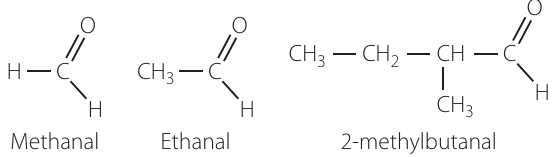
- Methanal (): Also called formaldehyde, this is the simplest aldehyde. It is manufactured in large quantities and used extensively in making plastics. The first synthetic plastic, bakelite, was created using phenol and formaldehyde.
- Ethanal (): A two-carbon aldehyde commonly used in industrial processes.
- 2-methylbutanal: A branched aldehyde with a methyl side group, demonstrating how aldehydes can have more complex structures.
What are ketones?
Ketones differ from aldehydes in a key way: the carbonyl group () can be located on any carbon atom except those at the ends of the hydrocarbon chain. This means the carbonyl group sits within the carbon chain, rather than at its terminus.
The general molecular formula for ketones is:
where and represent alkyl groups that can be the same or different.
Common examples of ketones

- Propanone (): Commonly known as acetone, this is the simplest ketone. It is widely used as a solvent in laboratories and industry, including in nail polish remover.
- Butanone (): A four-carbon ketone used as an industrial solvent.
- 3-pentanone (): A five-carbon ketone where the carbonyl group is positioned at carbon 3.
Naming aldehydes and ketones
Understanding how to name these compounds correctly is essential for communicating clearly in chemistry. The naming system follows specific rules that help identify the structure from the name alone.
How to name aldehydes
The suffix '-al' is used for aldehydes, replacing the '-e' from the parent alkane name.
Step-by-step process:
- Identify the longest carbon chain that includes the group
- Remove the 'e' from the parent alkane name and add 'al' (for example, ethane → ethanal)
- Number the carbon atoms starting from the aldehyde group. Since the aldehyde functional group is always at position 1, you don't need to include this number in the name
- Name any side branches (alkyl groups) using the same rules as for branched alkanes, with their position numbers
How to name ketones
The suffix '-one' is used for ketones, replacing the '-e' from the parent alkane name.
Step-by-step process:
- Identify the longest carbon chain that includes the group
- Remove the 'e' from the parent alkane name and add 'one' (for example, propane → propanone)
- Number the carbon atoms from the end that gives the smallest number to the group
- Add a number before the name to show the position of the carbonyl group (for example, 2-pentanone)
- Name any side branches (alkyl groups) using the same rules as for branched alkanes, with their position numbers
Functional group isomers
Aldehydes and ketones with the same number of carbon and hydrogen atoms are called functional group isomers. They share the same molecular formula but have different functional groups, which means they have different structural formulae and different properties.
Note
For example, propanal (an aldehyde) and propanone (a ketone) both have the molecular formula , but their structures and properties differ significantly due to the different positions of their carbonyl groups.
Worked example: identifying and naming carbonyl compounds
Let's practice identifying whether molecules are aldehydes or ketones and naming them correctly.
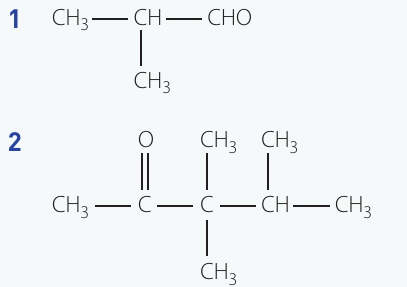
Example
Worked Example: Naming Carbonyl Compounds
Molecule 1 has the carbonyl group at the end of the chain, making it an aldehyde. The parent chain contains four carbon atoms (butane), and there is a methyl branch on carbon 2. Therefore, the name is 2-methylbutanal.
Molecule 2 has the carbonyl group in the middle of the chain, making it a ketone. The parent chain contains seven carbon atoms (heptane), the ketone group is on carbon 3, and there is an ethyl branch on carbon 5. The name is 5-ethyl-3-heptanone.
Important
Exam tip: Always check whether the carbonyl group is at the end (aldehyde) or in the middle (ketone) of the chain first. This determines which suffix to use and how to approach the numbering system.
When approaching these structures, identify the longest carbon chain, locate the carbonyl group, number from the appropriate end, and then name any branches systematically.
Properties of aldehydes and ketones
The carbonyl group gives aldehydes and ketones distinctive physical and chemical properties that set them apart from other organic compounds.
Polarity of the carbonyl group
Oxygen is more electronegative than carbon, meaning it has a stronger pull on shared electrons in the carbon-oxygen bond. This creates a highly polar bond, with oxygen carrying a partial negative charge () and carbon carrying a partial positive charge ().
Note
This polarity allows dipole-dipole forces to form between aldehyde and ketone molecules. These are stronger intermolecular forces than the dispersion forces found in hydrocarbons, but weaker than the hydrogen bonds found in alcohols.
Boiling points
The strength of intermolecular forces directly affects boiling points:
Aldehydes and ketones vs hydrocarbons: Aldehydes and ketones have higher boiling points than hydrocarbons of similar molecular mass. Hydrocarbons only experience weak dispersion forces, which require less energy to overcome than the dipole-dipole forces between carbonyl compound molecules.
Aldehydes and ketones vs alcohols: However, aldehydes and ketones have lower boiling points than alcohols of similar size. Alcohols form hydrogen bonds between molecules due to their hydroxyl group (). Hydrogen bonds are stronger than dipole-dipole forces and require more energy to break.
Note
Order of boiling points:
Alcohols > Aldehydes/Ketones > Hydrocarbons
This order reflects the relative strength of intermolecular forces: hydrogen bonds > dipole-dipole forces > dispersion forces
Solubility in water
The highly polar carbonyl group forms attractions with polar water molecules, making aldehydes and ketones more soluble than hydrocarbons but less soluble than alcohols.
Effect of chain length: Small aldehydes and ketones are soluble in water because the polar carbonyl group dominates the molecule's behaviour. However, as the carbon chain length increases, solubility in water decreases. This happens because the longer non-polar hydrocarbon portion of the molecule begins to outweigh the effect of the polar carbonyl group.
Note
Order of water solubility:
Alcohols > Aldehydes/Ketones > Hydrocarbons
This pattern occurs because the polar functional groups (hydroxyl in alcohols, carbonyl in aldehydes/ketones) interact favourably with water, while the non-polar hydrocarbon chains do not.
Important
Exam tip: Remember that the balance between the polar functional group and the non-polar hydrocarbon chain determines physical properties like solubility and boiling point. As chain length increases, the non-polar portion dominates, reducing water solubility.
Remember!
Summary
Key Points to Remember:
-
Carbonyl compounds contain a carbon-oxygen double bond (), with aldehydes having this group at the end of the chain and ketones having it in the middle.
-
The general formula for aldehydes is , and for ketones is . The position of the carbonyl group is critical for identification.
-
Aldehydes are named with the suffix '-al', while ketones use '-one' with a number indicating the carbonyl position. The numbering system ensures the functional group has the smallest possible number.
-
The carbonyl group is highly polar due to oxygen's greater electronegativity, creating dipole-dipole forces between molecules that affect physical properties.
-
Boiling points and water solubility follow the order: alcohols > aldehydes/ketones > hydrocarbons, based on intermolecular force strength (hydrogen bonds > dipole-dipole forces > dispersion forces).