Amines and Amides (HSC SSCE Chemistry): Revision Notes
📚Revision Notes
Amines and Amides
Introduction
Amines and amides are essential families of organic compounds with numerous practical applications. Amines work as catalysts, solvents, and raw materials in manufacturing dyes, medicines, and polymers. They also occur naturally as amino acids, which serve as the building blocks of proteins.
Amides form when an amine reacts with a carboxylic acid. These compounds are particularly important in synthetic plastics called polyamides.
Note
The versatility of amines and amides makes them fundamental to both biological systems and industrial chemistry. Understanding their structure and properties is crucial for comprehending how many natural and synthetic materials function.
Historical significance
Urea (also called carbamide, ) was the first organic compound synthesised from inorganic starting materials. This breakthrough showed that organic compounds could be produced outside living organisms, demonstrating they were part of the broader chemical system. Urea contains two groups attached to a carbonyl () group.
Amines
What are amines?
Amines are organic compounds formed when one or more hydrogen atoms in ammonia () are replaced by carbon-containing groups, such as alkyl groups. The defining feature of amines is the amino functional group: .
General formula: Alkyl amines are represented as , where R represents an alkyl group.
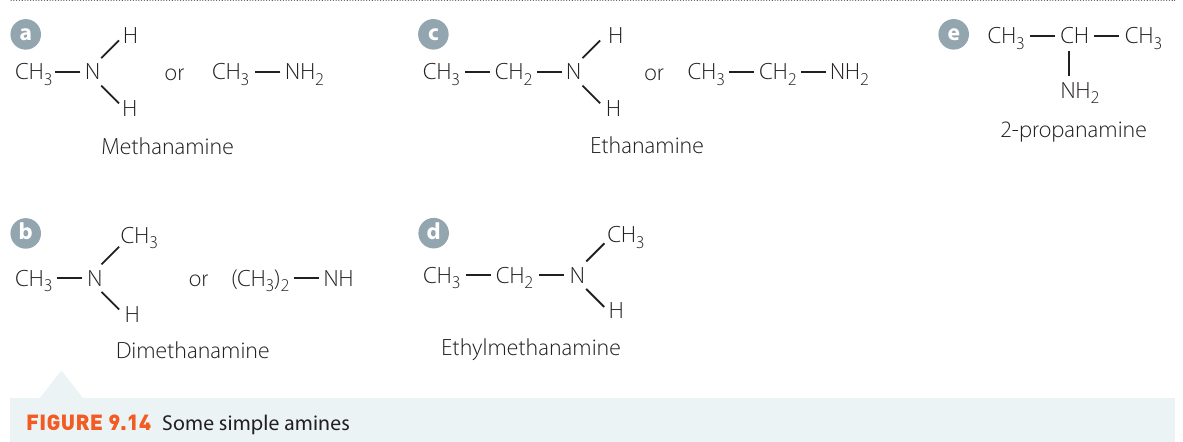
Classification of amines
Amines are classified as primary, secondary, or tertiary based on the number of alkyl groups attached to the nitrogen atom:
- Primary amine: One alkyl group attached to nitrogen (e.g., methanamine, ethanamine)
- Secondary amine: Two alkyl groups attached to nitrogen (e.g., dimethanamine)
- Tertiary amine: Three alkyl groups attached to nitrogen (e.g., )
This classification system helps chemists understand the structure and predict the properties of different amines.
Important
Remember the Classification Pattern:
The classification (primary, secondary, tertiary) is based on counting the alkyl groups attached to nitrogen, not the total number of atoms. This same classification system applies to both amines and amides, making it a fundamental concept to master.
Naming amines
The IUPAC system for naming amines follows these steps:
Step 1: Identify all carbon chains attached to the nitrogen atom and arrange them in alphabetical order (using the alkyl name, except for the final group). Write them with no spaces between.
Step 2: For the last alkane name in alphabetical order, delete the 'e' from the end and add 'amine'. For example, ethane becomes ethanamine.
Step 3: Add the prefixes 'di-' or 'tri-' when two or three of the alkyl groups are identical (e.g., dimethanamine means two methyl groups).
Step 4: Number the carbons on the main chain starting from the end nearest the amine group. If the amine group is not at the end of the chain, indicate its position by stating the number of the carbon to which it is attached at the beginning of the name (e.g., 2-propanamine).
Step 5: Name any alkyl groups attached to the main carbon chain following standard alkane naming conventions.
Example
Worked Example: Naming amines
- Dimethanamine: This amine has two methyl groups attached to nitrogen. The name indicates 'di-' (two) + 'methan' (methyl groups) + 'amine'.
- Ethylmethanamine: This amine has both an ethyl and a methyl group attached to nitrogen. The groups are arranged alphabetically (ethyl before methyl). Since methyl is last alphabetically, it becomes 'methanamine', with 'ethyl' placed in front as an alkyl group name.
Drawing amines
To draw the structure of an amine from its name:
If the amine group is NOT at the end of the chain:
- Draw the main carbon chain
- Number the carbons
- Position the amine and any other alkyl groups as substituents on the appropriate carbon
If the amine group is AT the end of the chain:
- Start by drawing the nitrogen atom
- Identify the alkyl groups from the molecule name (e.g., ethylmethanamine has an ethyl and a methyl group)
- Add the alkyl groups to the nitrogen atom
- Add hydrogen atoms to the nitrogen until it has three bonds total
Example
Worked Example: Drawing methylpropanamine
Step 1: Draw the central nitrogen atom.
Step 2: Identify the alkyl groups from the name: methyl and propyl groups.
Step 3: Add these alkyl groups to the nitrogen atom.
Step 4: Add hydrogen atoms to the nitrogen atom until it has three bonds.
The final structure shows the nitrogen bonded to a methyl group (), a propyl group (), and one hydrogen atom.
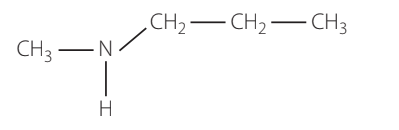
Note
Key Drawing Principle:
Nitrogen always forms three bonds in amines. When drawing structures, ensure the nitrogen atom is bonded to exactly three atoms (any combination of alkyl groups and hydrogen atoms).
Properties of amines
The properties of amines are largely determined by the amino functional group and the electronegativity of nitrogen.
Polarity and electronegativity
Nitrogen is the third most electronegative element (after fluorine and oxygen), which makes the functional group highly polar. This polarity significantly influences amine behaviour.
Hydrogen bonding
Primary and secondary amines can form hydrogen bonds because they contain N-H bonds within the molecule. However, since nitrogen is less electronegative than oxygen, the hydrogen bonds formed by amines are weaker than those formed by alcohols. This results in amines having lower boiling points than alcohols of similar size.
Tertiary amines cannot form hydrogen bonds because they lack N-H bonds (the nitrogen is bonded to three alkyl groups). Consequently, tertiary amines have lower boiling points than primary and secondary amines and are generally insoluble in water.
Important
Critical Property Difference:
Tertiary amines cannot form hydrogen bonds because they have no N-H bonds - all three bonding positions on nitrogen are occupied by alkyl groups. This fundamental structural difference leads to significantly different physical properties compared to primary and secondary amines.
Solubility
The hydrogen bonding capability of smaller amines means they are soluble in water. As the carbon chain length increases, the non-polar hydrocarbon portion becomes more significant, and solubility decreases.
Boiling and melting points
The presence of hydrogen bonding elevates the boiling and melting points of amines compared to non-polar molecules of similar size. As the molecular size increases, both melting and boiling points increase due to stronger London dispersion forces.
Amides
What are amides?
Amides are derivatives of carboxylic acids, formed when the hydroxyl () group of a carboxylic acid is replaced by an amine group ( or ). The resulting molecule is a stable covalent compound with neither acidic nor basic properties.
The characteristic structural unit of amides is the amide linkage:
This amide linkage is crucial in biological systems, appearing in proteins, and in synthetic materials, such as polyamides (nylons).
Note
The amide linkage is one of the most important functional groups in biochemistry. It forms the "peptide bond" that connects amino acids together in proteins, making it essential for life as we know it.
Classification of amides
Like amines, amides are classified as primary, secondary, or tertiary depending on the number of alkyl chains attached to the nitrogen atom:
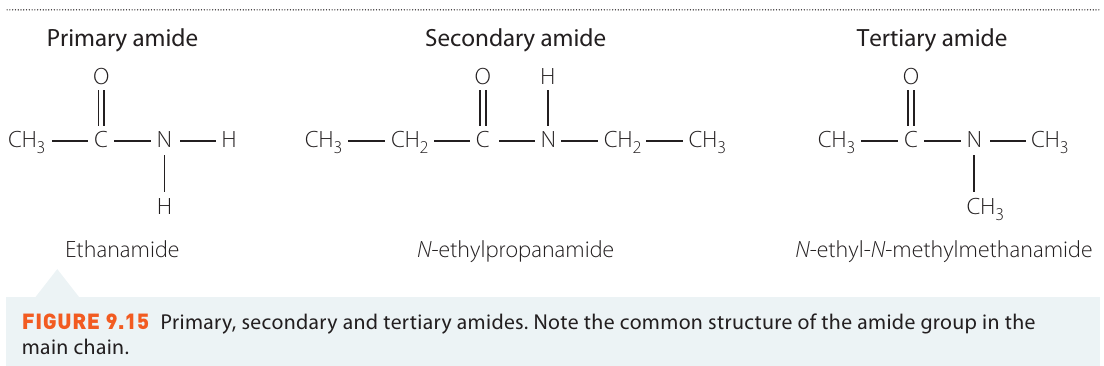
- Primary amide: Nitrogen bonded to two hydrogens and the carbonyl carbon (e.g., ethanamide)
- Secondary amide: Nitrogen bonded to one hydrogen, one alkyl group, and the carbonyl carbon (e.g., N-ethylpropanamide)
- Tertiary amide: Nitrogen bonded to two alkyl groups and the carbonyl carbon (e.g., N-ethyl-N-methylmethanamide)
Naming amides
The systematic naming of amides follows these rules:
Rule 1: Start with the name of the parent carboxylic acid. Change the ending from '-oic acid' to 'amide'. For example, ethanoic acid becomes ethanamide.
Rule 2: Name any alkyl groups bonded to the nitrogen atom using the prefix 'N-alkyl' before the amide name. The 'N-' designation indicates that the alkyl group is directly attached to the nitrogen atom. For example, if an ethyl group is attached to the nitrogen, use 'N-ethyl'.
Rule 3: For tertiary amides with three alkyl groups:
- An amide with two methyl groups and an ethyl group would be N-ethyl-N-methylmethanamide
- An amide with three methyl groups would be N,N-dimethylmethanamide
The naming system ensures that the structure can be accurately determined from the name alone.
Important
The "N-" Prefix Rule:
Whenever you see "N-" in an amide name (such as N-ethyl or N,N-dimethyl), it means the alkyl group is bonded to the nitrogen atom, not to the carbon chain. This distinction is crucial for correctly drawing and interpreting amide structures.
Properties of amides
Amides exhibit distinctive physical and chemical properties due to their functional group structure.
Polar bonds and structure
Primary and secondary amides contain two highly polar bonds:
- The N-H bond
- The C=O bond (carbonyl)
Tertiary amides contain only the C=O bond because the nitrogen is attached to three alkyl groups, with no N-H bond present.
Hydrogen bonding
Primary and secondary amides can form extensive hydrogen bond networks between molecules. They can also form dimers, where hydrogen bonds form between the N-H group on one molecule and the C=O group on a different molecule.
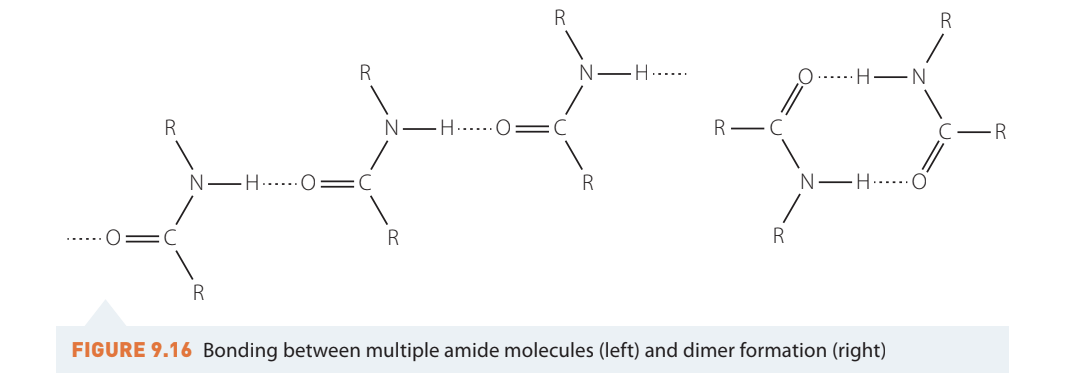
The diagram shows how multiple amide molecules can hydrogen bond together, creating strong intermolecular forces. This bonding pattern is similar to what occurs in proteins.
Note
The ability of amides to form strong hydrogen bonds in multiple directions creates complex three-dimensional networks. This is why amide-containing proteins can fold into specific shapes - the hydrogen bonding pattern determines the protein's structure and function.
Melting and boiling points
The hydrogen bonds between amide molecules give them significantly higher melting and boiling points than would be expected based on molecular size alone. Many amides are solid at room temperature due to these strong intermolecular forces.
Solubility
Small amides are soluble in water because the amide group can form hydrogen bonds with water molecules. However, as the carbon chain length increases, solubility decreases. This occurs because the non-polar hydrocarbon chain begins to dominate, outweighing the effect of the polar amide group.
Summary
Key Points to Remember:
-
Amines contain the amino functional group () and form when hydrogen atoms in ammonia are replaced by alkyl groups. General formula:
-
Classification matters: Both amines and amides are classified as primary, secondary, or tertiary based on the number of alkyl groups attached to nitrogen (1, 2, or 3 respectively)
-
Naming amines: List alkyl groups alphabetically, use 'di-' or 'tri-' for identical groups, end with 'amine', and number from the end nearest the amino group
-
Hydrogen bonding determines properties: Primary and secondary amines and amides can form hydrogen bonds, giving them higher boiling points and water solubility. Tertiary amines cannot hydrogen bond due to the absence of N-H bonds
-
Amides contain the amide linkage () and are derivatives of carboxylic acids. They have exceptionally high melting and boiling points due to strong hydrogen bonding, with many being solid at room temperature