Unsaturated Hydrocarbon Reactions (HSC SSCE Chemistry): Revision Notes
📚Revision Notes
Unsaturated Hydrocarbon Reactions
Introduction to unsaturated hydrocarbons
Unsaturated hydrocarbons include alkenes (containing carbon-carbon double bonds) and alkynes (containing carbon-carbon triple bonds). These compounds are significantly more reactive than their saturated counterparts, alkanes.
Important
The increased reactivity occurs because double and triple bonds have a different structure compared to single C—C bonds. Multiple bonds are weaker and easier to break, which makes molecules containing these bonds more likely to participate in chemical reactions.
Combustion reactions
Combustion reactions occur when substances burn in the presence of oxygen, releasing large amounts of energy. This energy has practical applications including:
- Powering internal combustion engines
- Industrial furnaces
- Domestic heating and cooking
Both alkenes and alkynes undergo combustion. When sufficient oxygen is available, complete combustion occurs, producing carbon dioxide and water as the only products.
Example
Worked Example: Complete Combustion of 1-Pentene
The complete combustion of 1-pentene follows this equation:
Notice that complete combustion always produces only and as products.
Note
When oxygen supply is limited, incomplete combustion can occur, which will be discussed later in this chapter.
Addition reactions
An addition reaction is a type of chemical reaction where atoms are added to an unsaturated compound by breaking the double or triple bond.
Important
Key Characteristic of Addition Reactions
All atoms from the added molecule become part of the product structure—no atoms are left over in an addition reaction.
Unsaturated hydrocarbons undergo addition reactions with:
- Hydrogen ()
- Halogens ( such as or )
- Hydrogen halides ( such as or )
- Water ()
Addition of hydrogen (hydrogenation)
Hydrogenation is the process of adding hydrogen to an unsaturated hydrocarbon. This is one of the most important addition reactions both industrially and in organic synthesis.
When an alkene undergoes hydrogenation, it converts to an alkane. For example, ethene forms ethane:
The role of catalysts
Hydrogenation reactions are quite slow without assistance, so a metal catalyst is necessary. Common catalysts include nickel (Ni), platinum (Pt), palladium (Pd), or rhodium (Rh). The catalyst works through a three-step mechanism:
- The hydrogen molecule reacts with the metal catalyst, breaking the H—H bond and forming two weak metal–hydrogen bonds
- The alkene molecule reacts with the metal catalyst, breaking one bond in the double bond and forming weak carbon–metal bonds
- The metal catalyst brings the hydrogen atoms and carbon atoms together, creating the final alkane molecule
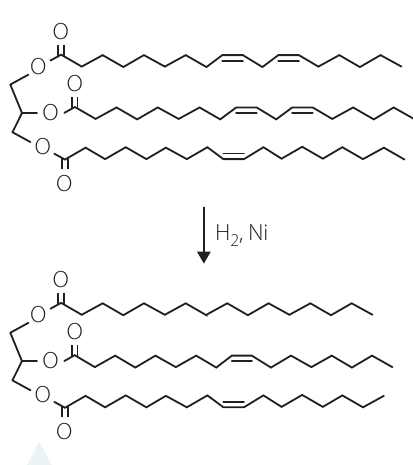
Industrial application: Margarine production
Note
Real-World Application: From Liquid Oil to Solid Margarine
Hydrogenation is used commercially to convert liquid vegetable oils into solid fats like margarine. Oils and fats are both natural esters (compounds discussed in Chapter 12) containing long hydrocarbon chains:
- Fats contain primarily saturated hydrocarbon chains (single bonds only)
- Oils contain unsaturated chains with one or multiple double bonds
The terms "saturated fats" and "polyunsaturated oils" refer to whether the hydrocarbon chains contain double bonds.
To make margarine, liquid oils with double bonds react with hydrogen gas in the presence of heat and a nickel catalyst. Enough hydrogen is added to make the oil solid at room temperature, but not enough to completely saturate all double bonds in the molecule.
Converting alkynes to alkenes
Alkynes can also be hydrogenated. With careful control, an alkyne converts to an alkene rather than continuing to an alkane.
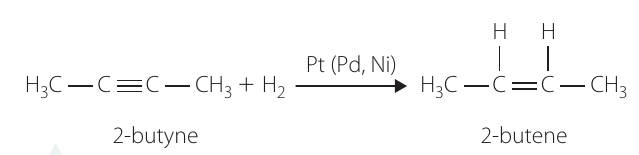
In this reaction, 2-butyne converts to 2-butene. To prevent the alkene from reacting further to form an alkane, a special Lindlar catalyst is used. This heterogeneous catalyst consists of palladium deposited on calcium carbonate. The catalyst acts as an inhibitor, stopping the reaction at the alkene stage.
Addition of halogens (halogenation)
Halogenation involves adding halogen molecules (such as chlorine or bromine) across a double or triple bond. The mechanism is similar to hydrogenation, but the high reactivity of halogens means no catalyst is needed.
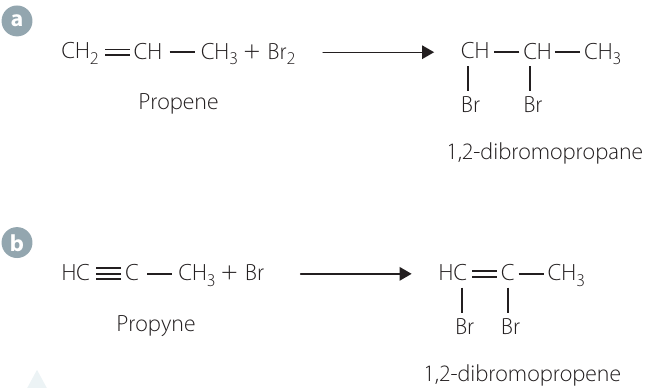
Figure (a) shows propene reacting with bromine to form 1,2-dibromopropane. Both bromine atoms add to the carbons that were originally part of the double bond.
Figure (b) shows propyne reacting with bromine to form 1,2-dibromopropene. This product still contains a double bond. If more bromine is available, the double bond can react again, breaking to form 1,1,2,2-tetrabromopropane (a fully saturated compound).
Note
Exam Tip: Testing for Unsaturation
Halogenation reactions are useful for testing whether a compound is saturated or unsaturated. Unsaturated compounds will decolourise bromine water, whilst saturated compounds will not react.
Addition of hydrogen halides
Hydrogen halides are molecules containing one hydrogen atom bonded to one halogen atom. Common examples include hydrogen chloride (HCl) and hydrogen bromide (HBr).
When a hydrogen halide adds to an unsaturated hydrocarbon, the hydrogen atom attaches to one carbon from the multiple bond, whilst the halogen attaches to the other carbon.
Example
Worked Example: Stepwise Addition to Ethyne
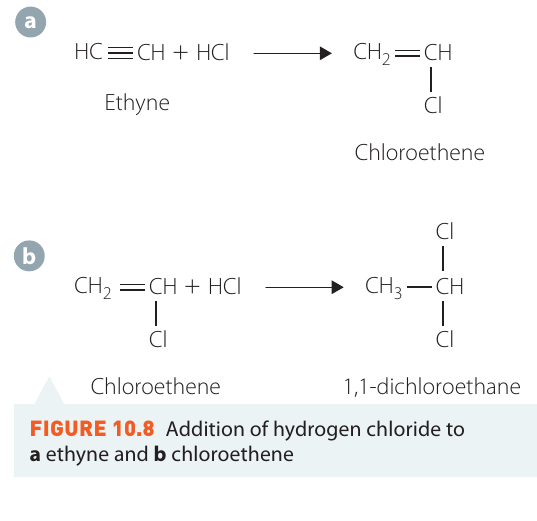
Figure (a) shows ethyne (an alkyne) reacting with HCl to form chloroethene (an alkene). The hydrogen adds to one carbon and chlorine to the other, breaking one bond of the triple bond.
Figure (b) shows chloroethene reacting with another molecule of HCl to form 1,1-dichloroethane. This demonstrates that the addition can continue in steps, first converting an alkyne to an alkene, then an alkene to a saturated compound.
Addition of water (hydration)
Adding water across a double bond requires a dilute sulfuric acid () catalyst. When water adds to an alkene, one hydrogen from water attaches to one carbon, whilst the —OH group attaches to the other carbon.
Hydration of alkenes
The hydration of alkenes produces alcohols. For example, ethene reacts with water to form ethanol:
Industrial importance of ethanol production
Note
Industrial Significance
This reaction has significant industrial importance. Whilst ethanol for alcoholic beverages is produced almost exclusively through fermentation, industrial quantities cannot be met by fermentation alone.
Ethanol has numerous industrial uses:
- As a solvent
- As an antiseptic and disinfectant
- In synthesising organic products and polymers (Chapter 13)
- As a biofuel (Chapter 12)
Hydration of alkynes
The hydration of alkynes requires different catalysts: mercury(II) compounds combined with sulfuric acid. Addition of water to an alkyne produces a ketone rather than an alcohol.
Important
The exception is ethyne, which produces ethanal (an aldehyde) rather than a ketone, because a ketone cannot form with only two carbons in the chain.
General notes on addition reactions
Understanding the following patterns will help you predict products of addition reactions:
Symmetrical reagents
When a symmetrical reagent (such as or ) adds to an alkene, the same group adds to each carbon. This produces only one possible product.
Asymmetrical reagents with symmetrical alkenes
When an asymmetrical reagent (such as or HBr) adds to a symmetrical alkene (like ethene), there is only one possible product because the molecule is symmetrical.
Asymmetrical reagents with asymmetrical alkenes
When an asymmetrical reagent adds to an asymmetrical alkene (like propene), two different products are theoretically possible. However, one product predominates over the other.
Markovnikov's rule
Important
Markovnikov's Rule
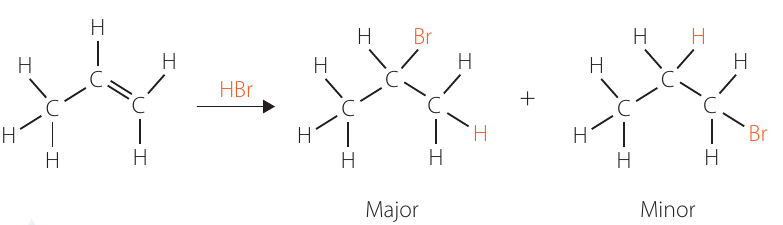
Russian chemist Vladimir Markovnikov observed that in addition reactions, the hydrogen atom predominantly adds to the carbon that already has the greater number of hydrogen atoms attached. This creates a major product and a minor product.
Example
Worked Example: Applying Markovnikov's Rule
In this example, propene reacts with HBr. The double bond is asymmetrical (the end carbon has two hydrogens, the middle carbon has one).
According to Markovnikov's rule, the hydrogen from HBr adds to the end carbon (which already has more hydrogens), making bromine add to the middle carbon. This forms the major product.
The minor product forms when the opposite occurs, but this happens much less frequently.
Note
Memory Aid: "The Rich Get Richer"
Think "the rich get richer"—the carbon that's already rich in hydrogen atoms gets the additional hydrogen.
Polymerisation
Alkenes and alkynes are extensively used in addition polymerisation reactions, where multiple small molecules (monomers) join together to form long chain molecules called polymers. You will learn more about polymerisation reactions in Chapter 13.
Investigation 10.2: Modelling reactions of unsaturated hydrocarbons
Aim: To model the reactions of alkenes and alkynes using molecular model kits.
Materials:
- Organic model kits (alternatively, use modelling clay in various colours for different atoms and toothpicks for bonds)
- Digital camera
Risk assessment:
| What are the risks? | How can you manage these risks? |
|---|---|
| Possible risk of slipping on model kit components if they are on the floor | Keep all components within containers when not being used |
Method:
Part A: Modelling hydrogenation
- Build models of ethene and hydrogen molecules
- Take photos of the reactants
- Combine the models to make the product
- Take photos of the product
- Repeat for two other simple alkenes
Part B: Modelling addition of hydrogen halides, halogens and water
- Repeat the above process to model the addition of hydrogen halides, halogens, and water
- Use at least two simple alkenes for each type of reaction
- Take photos of reactants and products
Discussion questions:
Part A:
- Write equations for each reaction you modelled, naming all reactants and products
- Identify a benefit of using modelling to improve your understanding
- Identify a specific limitation of modelling reactions (What doesn't it show properly?)
- Explain what you would do differently to model addition of hydrogen to an alkyne
Part B:
- Identify two addition reactions you modelled and use your photos to explain what is meant by an addition reaction
- Using a model of propene reacting with water, explain why two different products are possible from some addition reactions
Summary
Summary
Key Points to Remember:
-
Unsaturated hydrocarbons (alkenes and alkynes) are highly reactive because double and triple bonds are weaker and easier to break than single bonds
-
Complete combustion of alkenes and alkynes produces carbon dioxide and water, releasing energy
-
Addition reactions involve breaking double or triple bonds to add atoms—all atoms from the added molecule become part of the product
-
Hydrogenation requires a metal catalyst (Ni, Pt, Pd, or Rh) and converts alkenes to alkanes, or alkynes to alkenes; this process is used industrially to make margarine
-
Halogenation needs no catalyst due to the high reactivity of halogens
-
Markovnikov's rule: when an asymmetrical reagent adds to an asymmetrical alkene, hydrogen adds to the carbon that already has more hydrogen atoms, forming a major product
-
Symmetrical reagents produce one product; asymmetrical reagents on asymmetrical alkenes produce major and minor products