Organic Acids and Bases (HSC SSCE Chemistry): Revision Notes
📚Revision Notes
Organic Acids and Bases
What are organic acids?
Carboxylic acids represent the main category of organic acids that you need to understand for this course. While other types of organic acids exist, this course focuses specifically on carboxylic acids and their properties.
Organic acids can be relatively simple molecules, such as methanoic acid and ethanoic acid, which have straight carbon chains. However, they can also be much more complex structures. Common examples of complex organic acids include:
- Citric acid: Found naturally in citrus fruits
- Fumaric acid: Used as a food additive
- Malic acid: Present in fruits and also used as a food additive
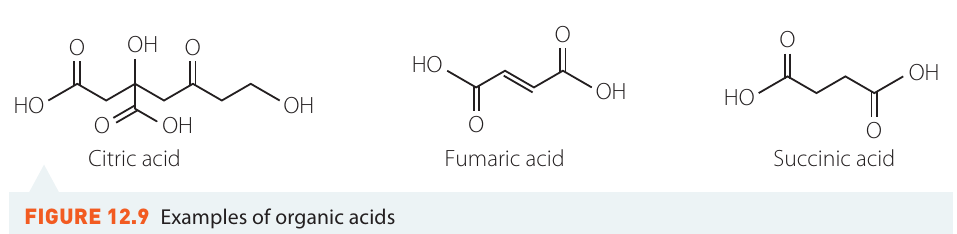
Note
All carboxylic acids contain the carboxyl functional group (), which is responsible for their acidic properties. This functional group is what gives these molecules their characteristic behaviour in chemical reactions.
What are organic bases?
Most organic bases contain nitrogen as their key structural element. In this course, you have studied amines, which are common examples of organic bases.
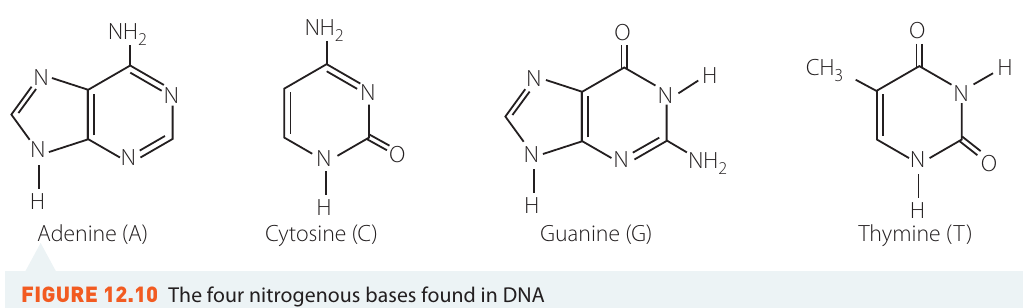
Many important organic bases occur naturally. Some of the most significant are the four nitrogenous bases found in DNA:
- Adenine (A)
- Cytosine (C)
- Guanine (G)
- Thymine (T)
These molecules play a crucial role in storing genetic information in living organisms.
Note
Mnemonic for DNA bases: Remember "All Cows Go To market" (Adenine, Cytosine, Guanine, Thymine) to help recall the four DNA bases.
Amino acids: molecules with both properties
Amino acids are remarkable natural molecules because they contain both an organic acid group and an organic base group within the same molecule. This dual nature makes them particularly interesting from a chemical perspective.
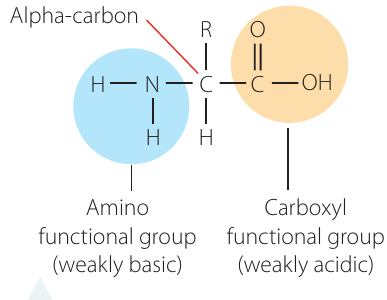
The general structure of an amino acid includes:
- An amino functional group (): This is weakly basic
- A carboxyl functional group (): This is weakly acidic
- An alpha-carbon: The central carbon atom connecting these groups
- An R group: A variable side chain that differs between amino acids
Note
There are 20 naturally occurring amino acids, and they differ only in the structure of their R group. Amino acids join together through chemical bonds to form polypeptides, which eventually fold and combine to create proteins essential for life.
Acid-base properties and reactions
Weak acid behaviour
Organic acids and bases share similar physical properties (such as boiling point and solubility) with other organic compounds. More importantly, they react in fundamentally the same way as inorganic acids and bases like sulfuric acid or sodium hydroxide.
Important
However, there is one critical difference: organic acids typically behave as weak acids when dissolved in water. This means they only partially ionise in solution, unlike strong acids which completely dissociate. As a result, organic acid solutions generally don't have very low pH values, even at moderate concentrations.
Variation in acidity
Different organic acids ionise to different extents in solution. This means that solutions of different organic acids at the same concentration will have different pH values. The table below demonstrates this variation:
| Name | pH |
|---|---|
| Oxalic acid | |
| Pyruvic acid | |
| Salicylic acid (aspirin) | |
| Fumaric acid | |
| Citric acid | |
| Malic acid | |
| Methanoic acid | |
| Ethanoic acid |
Important
Notice that while all these acids have pH values between approximately 1.3 and 2.9 at the same concentration, there is still significant variation. Oxalic acid, with the lowest pH, ionises most extensively, while ethanoic acid ionises least.
This variation occurs because different organic acids have different degrees of ionisation - they are all weak acids, but some are "weaker" than others!
Reactions with active metals
Like inorganic acids, carboxylic acids react with active metals to produce a salt and hydrogen gas. For example, when ethanoic acid reacts with magnesium metal:
Example
Worked Example: Reaction with Metal
When magnesium metal is added to ethanoic acid:
Products formed:
- Magnesium ions ()
- Ethanoate ions () - the conjugate base of ethanoic acid
- Hydrogen gas () - observed as bubbling
Reactions with bases
Carboxylic acids undergo neutralisation reactions with bases to produce a salt and water. When ethanoic acid reacts with sodium hydroxide:
Example
Worked Example: Neutralisation Reaction
When sodium hydroxide is added to ethanoic acid:
Products formed:
- Sodium ions ()
- Ethanoate ions ()
- Water ()
This is a typical acid-base neutralisation reaction.
Reactions with carbonates
When organic acids react with carbonates, they produce a salt, carbon dioxide gas, and water. For example, the reaction between ethanoic acid and sodium carbonate:
Example
Worked Example: Reaction with Carbonate
When sodium carbonate is added to ethanoic acid:
Products formed:
- Sodium ions ()
- Ethanoate ions ()
- Carbon dioxide gas () - observed as effervescence (fizzing)
- Water ()
Note
This reaction produces effervescence (fizzing) as carbon dioxide gas is released. This test is particularly useful for identifying carboxylic acids in the laboratory.
Remember "MBC": Organic acids react with Metals, Bases, and Carbonates - all producing salts plus different additional products!
Organic base reactions
Organic bases react with acids following Brønsted-Lowry acid-base theory. When an amine reacts with an acid, a salt and water are produced. For example, when methanamine reacts with hydrochloric acid:
Example
Worked Example: Amine Reaction with Acid
When hydrochloric acid is added to methanamine:
Product formed:
- Methylammonium chloride () - an ionic salt
Protonated amines
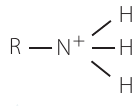
When an acid is added to an amine, a compound called a protonated amine forms. This is essentially the conjugate acid of the original amine.
Important
The protonated amine has substantially different properties compared to the original amine molecule. The presence of the positive charge significantly affects:
- Solubility: Charged molecules generally dissolve better in water
- Boiling point: Ionic compounds typically have higher boiling points
- Chemical reactivity: The charged species reacts differently from the neutral amine
Understanding these property changes is crucial for predicting the behaviour of amines in different chemical environments.
Investigation 12.2: properties of organic acids and bases
Aim
To investigate and compare the properties of various organic acids and bases through experimental observation.
Materials
- solutions of ethanoic acid, methanoic acid, citric acid, and hydrochloric acid
- sodium carbonate solution
- sodium hydroxide solution
- solution of 1-2 organic bases (such as diethylamine, diethanolamine bisulfite, or diethanolamine)
- Test tubes and test-tube rack
- pH probe
- Universal indicator and colour charts
- Organic waste container
Risk assessment
Important
Safety Considerations
| What are the risks in doing this investigation? | How can you manage these risks to stay safe? |
|---|---|
| Organic compounds can release toxic vapours | Keep containers stoppered when not in use. Perform in a well-ventilated area or in a fume cupboard if available |
| Acids and bases are corrosive | Wear personal protective equipment and wash hands after experiment has been completed |
Method
- Use the equipment provided to conduct tests that distinguish between the acids and bases provided
- Measure the pH of each acid solution and record the values (note: all acids must be at the same concentration for valid comparison)
- React all solutions with:
- Sodium carbonate solution, recording all observations
- Sodium hydroxide (after adding 2-3 drops of universal indicator), recording all observations
Note
Record all results in a well-organised table for comparison and analysis. Pay particular attention to any differences in reactivity between organic and inorganic acids.
Summary
Key Points to Remember:
-
Carboxylic acids are the most common type of organic acid, while amines are the most common organic bases. Both contain characteristic functional groups that determine their behaviour.
-
Organic acids are weak acids that only partially ionise in water. This results in higher pH values (typically 1.3-2.9) compared to strong acids at the same concentration. Different organic acids ionise to different degrees.
-
Organic acids react similarly to inorganic acids: they react with active metals (producing salt + hydrogen gas), bases (producing salt + water), and carbonates (producing salt + carbon dioxide + water).
-
When amines (organic bases) react with acids, they form protonated amines (conjugate acids). These charged species have very different properties from the original amine, particularly regarding solubility and boiling point.
-
Amino acids are unique molecules containing both acidic (carboxyl) and basic (amino) functional groups in the same structure. They are the building blocks of proteins in living organisms.