Soaps and Detergents (HSC SSCE Chemistry): Revision Notes
📚Revision Notes
Soaps and Detergents
Introduction
Soaps and detergents are powerful cleaning agents that we use every day. Their cleaning ability comes from their unique molecular structure, which allows them to remove dirt, oil, and stains from various surfaces. Understanding how these molecules work helps us appreciate why they are so effective at keeping things clean.
Surfactants and surface tension
When you dissolve soap or detergent in water, something interesting happens at the molecular level. The soap molecules act as surfactants - substances that change how water behaves at surfaces. Water molecules normally stick together strongly through hydrogen bonds, creating surface tension. This is why water forms droplets on surfaces rather than spreading out.
Note
What happens to hydrogen bonds?
Surfactants break these hydrogen bonds between water molecules. When this happens, the water can spread across a surface instead of beading up. This spreading action is called wetting, and it's crucial for cleaning because water needs to reach all areas of a dirty surface to clean it effectively.
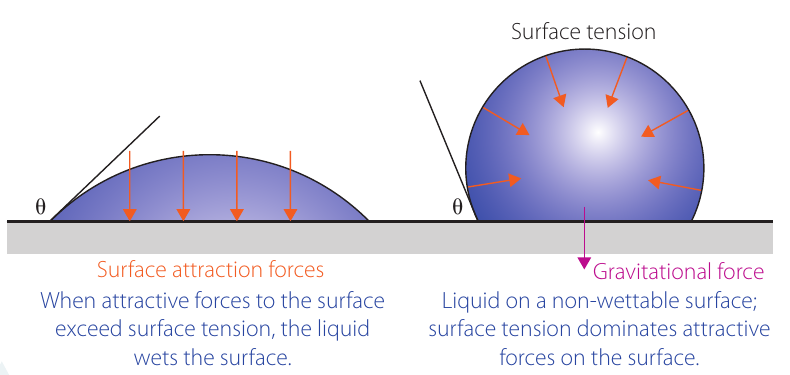
The diagram above shows how a liquid's ability to wet a surface depends on the balance of forces. If the attractive forces between the liquid and surface are stronger than the forces within the liquid itself, the liquid will spread and wet the surface. The contact angle () measures this wettability - a smaller angle means better wetting.
Structure of soaps and detergents
Soap molecules
Soaps are salts of fatty acids - they form when fatty acids react with bases like sodium hydroxide or potassium hydroxide. Every soap molecule has two distinct parts that give it special properties:

The structure shows a long chain of carbon and hydrogen atoms (the hydrocarbon tail) connected to a carboxylate ion () at one end (the head). A sodium () or potassium ion sits near the carboxylate group, making the soap a sodium or potassium salt.
The hydrophobic tail: The long hydrocarbon chain is non-polar, meaning it doesn't interact well with water molecules. We call this hydrophobic or "water-fearing". Instead, this tail bonds strongly to other non-polar substances like oils and grease through dispersion forces (weak intermolecular attractions between non-polar molecules).
The hydrophilic head: The carboxylate ion at the other end is polar because it carries a negative charge. This charged head forms strong ion-dipole bonds with water molecules, so we call it hydrophilic or "water-loving".
Important
The Key to Cleaning Power: Amphiphilic Nature
This dual nature - one end that likes oil and one end that likes water - makes soap molecules amphiphilic. This property is the key to their cleaning power. The molecule acts as a bridge between water and grease, allowing them to interact when they normally wouldn't.
Detergent molecules
Detergents have a similar structure to soaps, with a long hydrocarbon tail, but they differ in their polar head region. Scientists developed detergents to overcome some of soap's limitations, particularly its poor performance in hard water.
There are three main types of detergents:
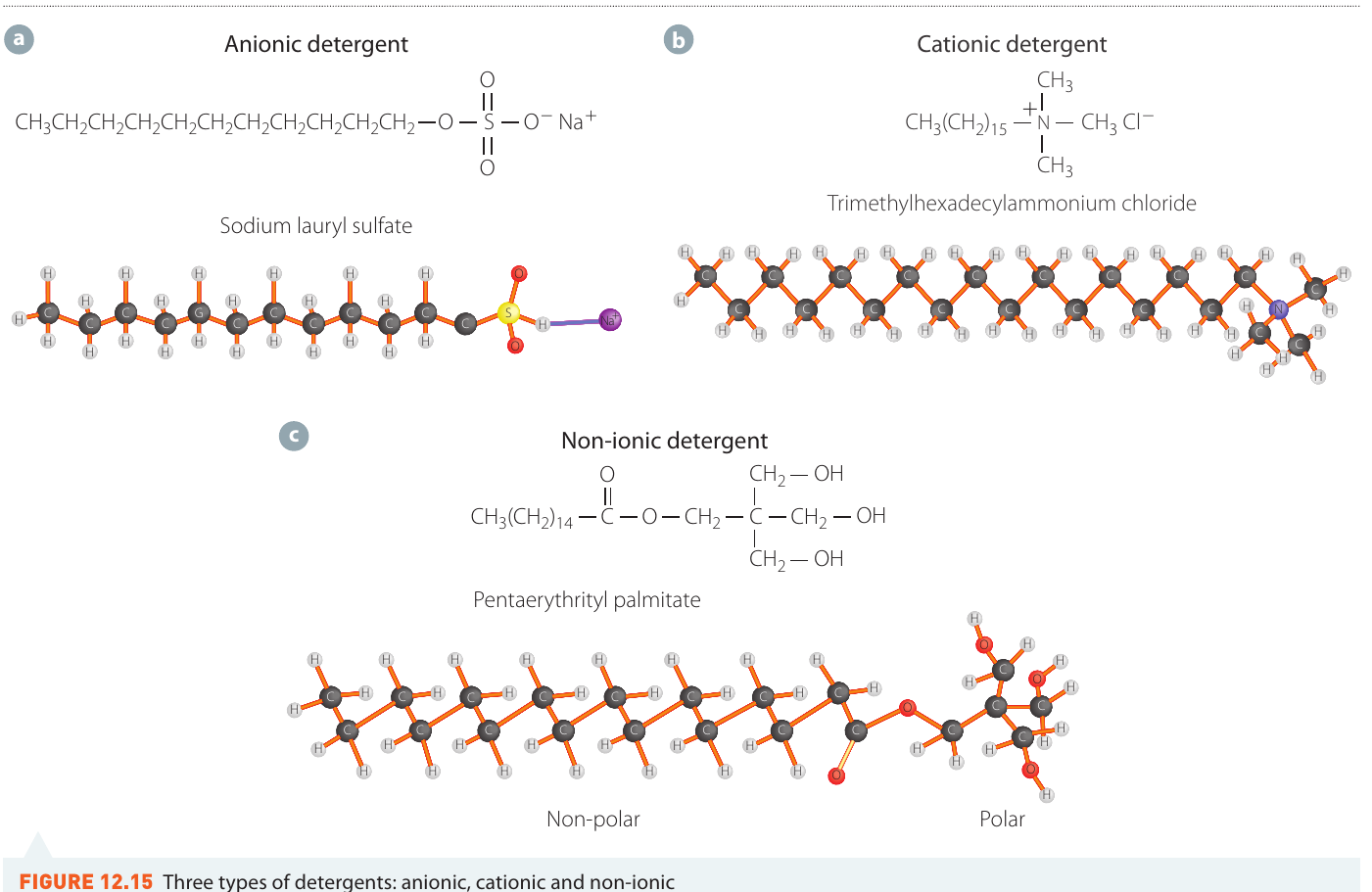
Anionic detergents have a negatively charged head group, similar to soaps. An example is sodium lauryl sulfate, which has a sulfate ion () as the head. These detergents create lots of foam and work well for general cleaning.
Cationic detergents have a positively charged head group, such as a quaternary ammonium ion (). Trimethylhexadecylammonium chloride is a common example. The positive charge helps these detergents stick to negatively charged surfaces like fabrics and hair, making them useful as fabric softeners and conditioners. They also kill bacteria, so they're used in disinfectants.
Non-ionic detergents have no electrical charge, but they still have a polar head group, such as hydroxyl groups (). Pentaerythrityl palmitate is an example. These detergents produce less foam than anionic types, making them ideal for dishwashers where excess foam would be a problem.
Properties and uses of different detergent types
| Type of detergent | Uses | Characteristics |
|---|---|---|
| Anionic | • Laundry detergents • Dishwashing detergents • Household cleaners | • Create good lather • Have a negative charge • Harsh action (not suitable for personal cleaners) • Inexpensive |
| Cationic | • Fabric softeners • Hair conditioners • Disinfectants • Sanitisers (e.g., mouthwash) | • Bond strongly to negatively charged surfaces (reducing static and tangling) • Biocidal (kill bacteria) • Expensive |
| Non-ionic | • Dishwasher detergents • Glass cleaners | • Low lather formation (prevents foam build-up) • Expensive |
Emulsifying action
Another important property of soaps and detergents is their ability to act as emulsifiers. Normally, oil and water don't mix because they have different polarities - they're immiscible. However, when you add a detergent, it can make these two liquids mix together, creating an emulsion. This happens because the detergent molecules position themselves at the boundary between oil and water, with their hydrophobic tails in the oil and hydrophilic heads in the water.
Production of soaps
Saponification reaction
Soaps are made through a process called saponification - the hydrolysis (breaking down with water) of fats. The starting materials are triglycerides, which are fat molecules consisting of three long hydrocarbon chains (fatty acids) attached to a three-carbon backbone (glycerol) through ester bonds.
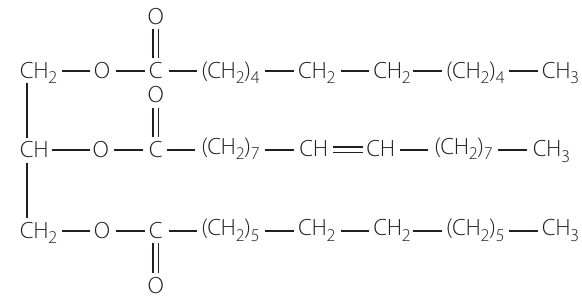
A typical triglyceride has three fatty acid chains, each containing 10-20 carbon atoms. The chains may be saturated (all single bonds) or unsaturated (containing some double bonds).
Note
Products of Saponification
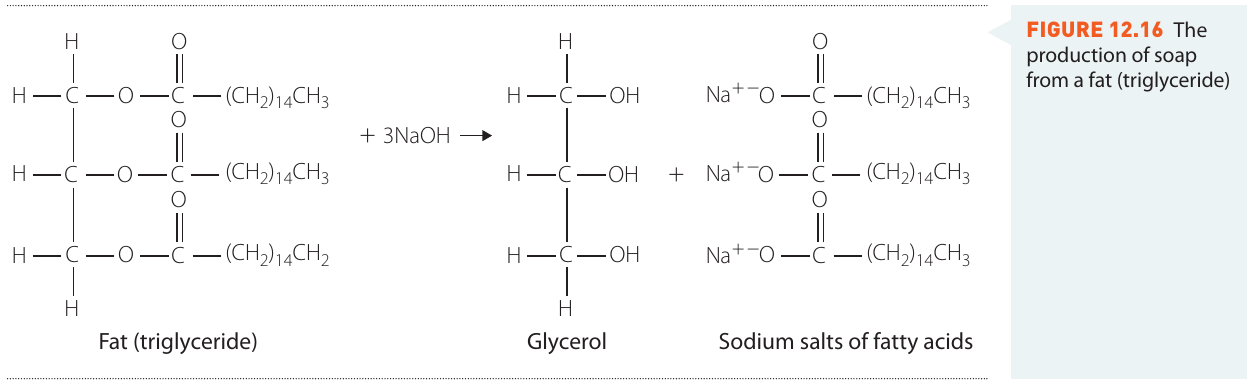
When a triglyceride reacts with sodium hydroxide () or potassium hydroxide (), the ester bonds break. This produces two types of products:
- Glycerol () - also called 1,2,3-propanetriol
- Three molecules of sodium carboxylate - these are the soap molecules
Example
Worked Example: The Saponification Reaction
The general equation for saponification is:
Or written with structural formulas showing the fatty acid chains:
where represents the hydrocarbon chain (typically 12-18 carbons long).
Production process
In practice, soap is made by:
- Heating fat or oil with sodium hydroxide solution
- Boiling the mixture - the soap forms and rises to the surface
- "Salting out" - adding concentrated sodium chloride solution to precipitate the soap and separate it from the glycerol solution
- Drying the solid soap
This process can be done in a laboratory using vegetable oil, producing a basic soap that demonstrates the same principles as commercial soap production.
How soaps and detergents work
The cleaning action of soaps and detergents relies on their amphiphilic structure - having both hydrophobic and hydrophilic regions.
The cleaning mechanism
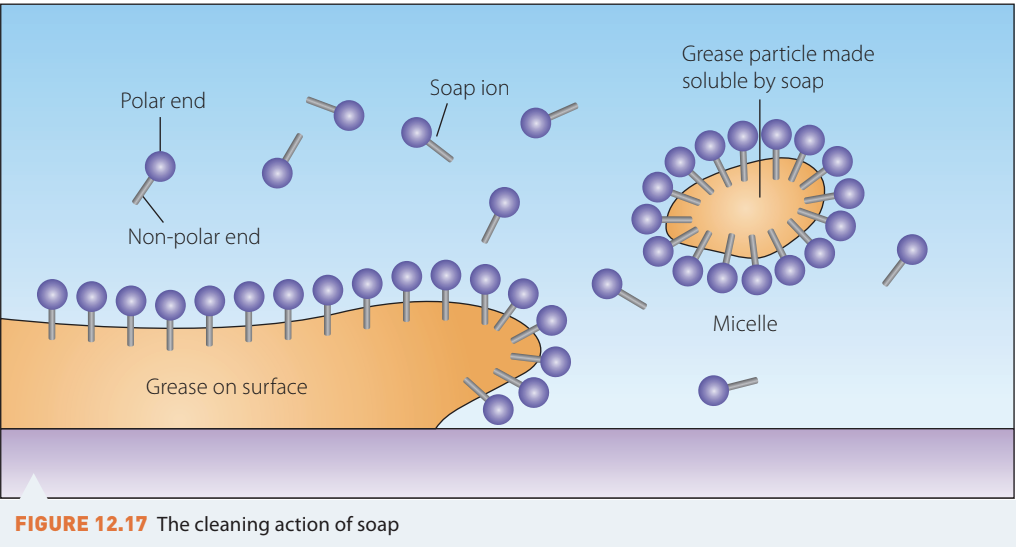
When soap molecules encounter grease or dirt on a surface, they arrange themselves in a specific way:
- Initial contact: The hydrophobic tails of soap molecules penetrate into the grease or oil through dispersion forces. Meanwhile, the hydrophilic heads remain in the water, forming ion-dipole bonds with water molecules.
- Agitation: When you scrub or shake the water, the water molecules pull on the soap molecules through their strong ion-dipole bonds. This pulling force is stronger than the bond between grease and the surface.
- Lifting: The soap molecules lift the grease away from the surface as more soap molecules attach around the grease droplet.
- Micelle formation: Eventually, soap molecules completely surround the grease droplet, forming a spherical structure called a micelle. In a micelle, all the hydrophobic tails point inward (embedded in the grease), while all the hydrophilic heads point outward (into the water).
Note
Why Micelles Stay Suspended
Each micelle has a negatively charged surface (from all the carboxylate heads pointing outward). Like charges repel, so micelles push each other apart and don't clump together. They're also very small, so they remain suspended in the water rather than settling out. When you drain the wash water, the micelles wash away, carrying the grease and dirt with them.
Important
The Importance of Agitation
This is why agitation (scrubbing, shaking, or machine washing) is important - it provides the energy needed to lift dirt off surfaces and form micelles. Without agitation, soap molecules might attach to grease but won't successfully remove it from the surface.
Soaps and detergents in hard water
What is hard water?
Hard water contains high concentrations of dissolved calcium () and magnesium () ions. Water is classified as:
- Slightly hard: more than 20 ppm (parts per million) of calcium and magnesium ions
- Very hard: up to 180 ppm of these ions
These ions dissolve from rocks and minerals as water flows through the ground.
The problem with soap in hard water
When soap is used in hard water, a problem occurs. The calcium and magnesium ions react with the carboxylate ions of soap molecules to form a solid precipitate called scum:
where represents the hydrocarbon chain.
Important
The Scum Problem
Scum is the chalky, grey deposit you might see in sinks, bathtubs, or on dishes after washing with soap in hard water areas. This creates two problems:
- Unsightly deposits: Scum settles on clothes, dishes, and bathroom surfaces, leaving them looking dingy
- Reduced cleaning power: The soap molecules that react to form scum are no longer available to form micelles and clean effectively
Why detergents work better
Detergents also react with calcium and magnesium ions, but with an important difference - the resulting calcium and magnesium salts of detergents are soluble in water. This means:
- No scum forms
- The detergent remains in solution
- Cleaning effectiveness is maintained
However, even detergents have reduced effectiveness in hard water because some detergent molecules are "tied up" by reacting with the calcium and magnesium ions instead of forming micelles.
The role of phosphates
To overcome this problem, manufacturers add phosphates to commercial detergents. Phosphates bind to calcium and magnesium ions, preventing them from reacting with the detergent molecules. This means more detergent molecules remain available to form micelles and clean effectively.
Summary
Key Points to Remember:
-
Soap and detergent structure: All cleaning molecules have two parts - a hydrophobic (water-fearing) hydrocarbon tail that bonds with grease, and a hydrophilic (water-loving) ionic or polar head that bonds with water
-
Surfactant action: Soaps and detergents lower water's surface tension by breaking hydrogen bonds, allowing water to spread and wet surfaces effectively
-
Saponification: Soaps are made by reacting triglycerides (fats or oils) with sodium hydroxide, breaking ester bonds to produce glycerol and three sodium carboxylate molecules:
-
Cleaning mechanism: Soap molecules surround grease with hydrophobic tails embedded inside and hydrophilic heads facing water, forming spherical structures called micelles that remain suspended in water
-
Hard water limitation: Soaps form insoluble scum in hard water (>20 ppm calcium and magnesium ions):
while detergents form soluble salts and work more effectively