Government in Action (HSC SSCE Economics): Revision Notes
📚Revision Notes
Influences on Government Policies
Government policy-making in Australia involves much more than simply what politicians decide. Economic and social policies are shaped by a complex web of participants including businesses, unions, community groups, the media, and international factors. Understanding these influences helps explain why certain policies are adopted and others rejected.
Note
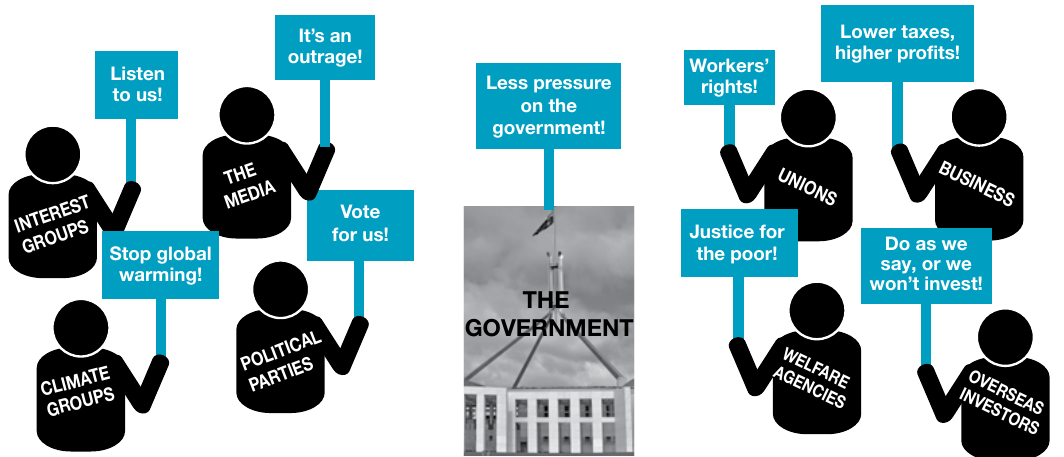
The diagram above illustrates how governments face pressure from multiple directions when making policy decisions. Each group attempts to influence government policy to advance their own interests, creating a challenging environment for policy-makers who must balance competing demands.
Parliament and political parties
The parliamentary process
In democratic Australia, economics and politics are closely intertwined. For most major policy changes to become law, they must follow a formal parliamentary process:
- Cabinet approval: Economic reforms must first be supported by Cabinet, the committee of senior government ministers who make key decisions
- Parliamentary authorisation: Major policies require passage through an Act of Parliament
- Dual approval: A proposed law (called a Bill) must be supported by majorities in both houses of parliament
Important
While some administrative changes can be made without parliamentary approval, significant measures such as the Budget, taxation reform, industrial relations changes, and privatisation of government businesses all require parliamentary support.
The House of Representatives
The House of Representatives is the Lower House of parliament with 151 seats. Governments are formed by the political party or coalition that wins a majority of seats in this house.
Governments typically face few difficulties passing legislation through the House of Representatives because they control the majority. However, minority governments (where no party has an outright majority) do occasionally occur.
Example
Example: Minority Government (2010-2013)
Between 2010 and 2013, Australia experienced its first minority national government in 70 years, when the Labor Party formed government with support from Independent and Green MPs. In such situations, policy details often require negotiation and debate before legislation can pass.
The 2019 election resulted in a very close result, with the Coalition Government achieving a majority of just two seats, demonstrating that parliamentary numbers can be tight even when a majority government is formed.
The Senate
The Senate is the Upper House with 76 seats. Unlike the House of Representatives, governments rarely control a majority in the Senate. Typically, governments fall a few seats short of the Senate majority needed to pass legislation.
To secure passage of laws through the Senate, governments must negotiate with:
- Opposition senators
- Minor parties (such as the Greens)
- Independent senators
Note
For example, after the 2019 election, the Coalition Government needed to obtain support from either Labor (which has 26 senators) or at least four senators from the Greens, minor parties, or independents to pass legislation.
The Senate acts as a "house of review" that can slow down or modify government legislation. Most Australian voters appear to support this role, as evidenced by their voting patterns. While this slows the legislative process, it also ensures more detailed scrutiny of government policies and may prevent extreme policies from either major party.
The last time a government enjoyed a Senate majority was after the 2004 election, when the Howard Government had a one-vote majority. This allowed it to pass previously rejected legislation including the full sale of Telstra and reduced media ownership controls.
Political party decision-making
Since political parties form governments, they play a crucial role in economic policy-making. In Australia, federal and state governments are usually formed by:
- A single party (such as the Australian Labor Party), or
- A coalition of the Liberal Party and National Party (often called "the Coalition Parties")
Internal party processes:
Technically, political parties develop policy through:
- Local party branches
- State and federal party conferences
- Member participation
Note
In reality, however, most policy decisions are made by elected political representatives. Party leaders and senior ministers hold the greatest decision-making power.
Party discipline:
Although Australian parliamentarians technically have the freedom to vote differently from their party, in practice party members almost always vote along party lines. This strong party discipline means that party support is crucial for any policy.
Leadership dynamics:
The Prime Minister or Premier is ultimately responsible for economic policy decisions, though the extent to which they involve other ministers varies. Recent decades have seen decision-making become more centralised in the Prime Minister's Office or Premier's Office, with power concentrated among a small group of senior ministers and public servants.
Important
However, party leaders depend on support from other party members to maintain leadership. Since 2010, government MPs have removed their party leader (the Prime Minister) on four occasions: in 2010 (Rudd), 2013 (Gillard), 2015 (Abbott), and 2018 (Turnbull). This demonstrates that while leaders have significant power, they must maintain the confidence of their parliamentary colleagues.
Electoral considerations
Governments must retain popular support to be re-elected, which constantly influences policy decisions. This requires political leaders to:
- Explain economic policies clearly to voters
- Convince the public that their strategies are effective
- Manage unpopular aspects of necessary reforms
This process is challenging because economic reform often creates both winners and losers. Some groups benefit from policy changes while others face costs, making it difficult to maintain broad public support.
Business
Business influence on policy
Business groups wield significant influence over government policy decisions for several reasons:
- Economic importance: In a market economy, successful and growing businesses are crucial for national prosperity
- Public voice: Businesses can participate actively in public policy debates
- Financial power: Businesses provide substantial donations to political party campaigns
Important
Political parties receive limited public funding for elections and now depend heavily on business donations to fund their campaigns. This financial relationship gives businesses considerable leverage over policy decisions.
Business lobbying extends across a wide range of issues including taxation, regulation, privatisation, outsourcing of government services, and government spending programs. Political parties are sometimes accused of altering policies in response to business donations.
Recent years have seen several NSW parliament members resign after receiving illegal campaign donations from businesses, particularly property developers who benefit directly from government approvals for construction projects. This highlights the problematic nature of business-political relationships.
Peak business organizations
Australia has three main peak business groups that represent different sectors:
Business Council of Australia (BCA):
- Represents chief executives of approximately 100 of Australia's largest companies
- Focuses on major economic policy issues affecting big business
Australian Industry Group (AIG):
- Represents businesses from diverse industry sectors
- Includes manufacturing and information technology companies
- Focuses on industry-specific policy concerns
Australian Chamber of Commerce and Industry (ACCI):
- Represents chambers of commerce across Australia
- Includes many smaller businesses
- Advocates for broad business interests
Sector-specific business groups
Some business organizations represent particular industry sectors:
- Minerals Council of Australia (mining industry)
- Australian Bankers' Association (banking sector)
- Housing Industry Association (construction industry)
These groups advocate for policies that benefit their specific industries.
Lobbyists
Professional lobbyists represent individual companies and advocate for the interests of specific firms. They work on issues such as:
- Taxation policy
- Industry regulation
- Privatisation opportunities
- Government service outsourcing
- Government spending programs
Note
Many lobbyists are former Members of Parliament or former ministerial staff who understand the policy-making process and how to influence it effectively. This "revolving door" between politics and lobbying has raised concerns about transparency.
Lobbying regulation:
Concerns about lack of transparency in lobbying prompted the Government to establish:
- A Lobbying Code of Conduct (2008)
- An official Register of Lobbyists (2008)
These measures aim to increase accountability in the lobbying process, though debates about lobbying influence continue.
Unions
Union role and influence
Unions are among Australia's largest membership organizations, representing workers' interests. However, union influence has declined significantly as membership has fallen from a peak of 55% of the workforce in the 1970s to around 14% today.
Despite lower membership, unions remain active participants in policy debates. They:
- Represent members' interests in individual workplaces
- Participate in government consultations on policy issues
- Issue reports and contribute to public debates
- Focus particularly on industrial relations and labour market policies
Example
Example: Health Services Union Advocacy
The Health Services Union (HSU) regularly participates in public debates on health policy and the role of health workers, demonstrating how unions leverage their expertise to influence policy beyond just workplace negotiations.
Peak union organization
The Australian Council of Trade Unions (ACTU) is the peak body of the Australian union movement. It:
- Coordinates campaigns across the union movement
- Advocates for policy positions nationally
- Represents the collective voice of unions
Important regional groups also exist, such as Unions NSW, which operates at the state level.
Political relationships
Unions have closer relationships with Labor governments than Coalition governments:
- Provide major donations to Labor Party campaigns
- Have greater input into Labor government policies
- Focus on policies affecting lower-income workers
Unions concentrate particularly on:
- Labour market policies
- Specific industry policies
- Measures affecting people on lower incomes
- Workplace rights and conditions
Note
The declining union membership has reduced their overall political influence, but they remain significant participants in policy debates, especially under Labor governments.
Climate and environmental groups
Environmental advocacy organizations
Australia has several major interest groups dedicated to climate action and environmental protection:
- Australian Conservation Foundation (the peak environmental group)
- Friends of the Earth
- Greenpeace
- Wilderness Society
- World Wildlife Fund
These organizations engage in multiple activities:
- Conducting research on environmental issues
- Providing educational information to the public
- Lobbying governments and companies
- Advocating on local, national and global environmental issues
Methods and influence
Environmental groups employ various tactics to influence policy:
High-profile protests: Groups like Greenpeace are known for dramatic protest actions such as blockading forestry workers or nuclear warships. While these protests attract media attention, environmental groups use many other methods to influence policy.
Policy engagement: Environmental organizations participate in:
- Government inquiries and consultations
- Policy development processes
- Public education campaigns
- Research and evidence provision
Growing impact:
The environmental movement has successfully made the environment a priority issue for economic policy-makers. This is evident in several ways:
- Political parties now compete to demonstrate environmental commitment
- Industries such as mining face much tougher environmental standards than in the past
- Substantial government spending on environmental initiatives
- Environmental considerations integrated into economic decision-making
Political representation
The Australian Greens party places especially high priority on environmental concerns. As the third largest party in Australia, the Greens have enjoyed significant Senate influence in recent years, allowing them to shape environmental policy through their voting power on legislation.
Welfare agencies
Representation of disadvantaged groups
Welfare organizations advocate for the most vulnerable members of society:
- Aged people
- People with disabilities
- Carers
- Unemployed people
- People on low incomes
Note
These groups often lack the resources or ability to advocate for themselves, making welfare organizations crucial voices in policy debates.
Peak welfare organization
The Australian Council of Social Services (ACOSS) operates as the peak welfare lobby group, coordinating advocacy across the welfare sector and representing broad welfare concerns to government.
Types of welfare groups
Other welfare organizations include:
- Community legal centres (providing legal assistance)
- Charitable organizations (delivering services and advocating for change)
- Specific advocacy groups (focusing on particular disadvantaged groups)
Influence methods
Welfare groups participate in policy-making through:
Formal channels:
- Participation in government inquiries
- Submissions to policy reviews
- Direct lobbying of government ministers
- Expert advice and research
Public engagement:
- Using media to publicize issues
- Public campaigns to raise awareness
- Building public pressure on government
- Highlighting disadvantage and injustice
Note
While welfare groups generally have fewer financial resources than business organizations, they can be effective by:
- Providing expert knowledge
- Highlighting moral and social justice concerns
- Building public sympathy for disadvantaged groups
- Demonstrating the social impacts of policy decisions
The media
Dual role of media
Although the media's primary role is reporting news, it also significantly influences government policies. The media landscape is evolving with the rise of social media and new digital platforms, changing how media influence operates.
Multiple levels of influence
Media influence on policy operates at various levels:
Agenda-setting: The media determines which issues receive public attention. By choosing what to cover and how extensively, media outlets shape what the public and politicians consider important.
Framing: The media influences how issues are presented and understood. The same issue can be framed differently depending on editorial choices, affecting public perception.
Anticipatory influence: Political leaders anticipate media reactions when developing policies. If leaders expect heavy criticism, they may:
- Modify their proposals
- Change their plans entirely
- Adjust how they communicate policies
Conversely, leaders may pursue policies primarily because they will generate positive media coverage, even if the policies have limited actual benefit.
Opinion and reporting
The distinction between factual reporting and opinion is often blurred in media coverage. Some popular media personalities are considered highly influential in shaping:
- What voters think about issues
- How voters cast their ballots
Example
Example: Sydney Media Personalities
Sydney has notable radio personalities such as Alan Jones and Ray Hadley who:
- Express strong opinions on political issues
- Sometimes appear at political rallies
- Are regarded as important influences on Coalition government policies
Media bias debates
Debate about media bias is a longstanding feature of Australian politics. In 2018, these debates intensified after Prime Minister Malcolm Turnbull was removed as Liberal Party leader following sustained criticism from:
- Radio personalities Jones and Hadley
- Parts of Rupert Murdoch's media organization, News Corporation
Note
Varying coverage: Even day-to-day economic news tends to differ between media outlets, reflecting different editorial perspectives and priorities. What one outlet presents as positive economic news might be framed negatively by another.
Changing media landscape
Traditional media influence is being reshaped by:
- Social media platforms
- Online news sources
- Direct communication between politicians and voters
- Citizen journalism and commentary
These changes are altering how media influences policy, though traditional media outlets retain significant power.
Interest groups
Nature of interest groups
Interest groups form when people with shared concerns, interests, or expertise organize to work toward common goals. These groups vary widely in their focus, size, and methods.
Types of interest groups
Local focus groups: Interest groups sometimes concentrate on local issues:
- Resisting development proposals
- Raising community concerns
- Addressing local environmental issues
Example
Example: Hydraulic Fracking Opposition
Hydraulic fracking of underground gas reserves has become increasingly controversial in rural Australia, leading to formation of numerous local opposition groups.
Single-issue groups: Some groups organize around one specific issue:
- Australian Republican Movement (constitutional change)
- Campaign groups for specific policy changes
Sector representatives: Many interest groups represent particular sectors or demographics:
- National Farmers' Federation (agricultural sector)
- National Union of Students (student interests)
- National Roads and Motorists' Association (motorist concerns)
Public interest groups: Some organizations represent broader public interests:
- Choice (formerly Australian Consumers' Association) - consumer rights and product testing
- GetUp! - online political advocacy on progressive causes
Influence methods
Interest groups employ various strategies to influence policy:
- Direct lobbying of government officials
- Public campaigns and protests
- Research and evidence provision
- Media engagement
- Coalition-building with like-minded groups
- Legal challenges to government decisions
Note
The effectiveness of interest groups varies depending on:
- Their resources and organization
- Public sympathy for their cause
- Their expertise and credibility
- Their ability to mobilize supporters
- Their strategic approach to advocacy
International influences
Financial markets
Since the early 1980s, international financial markets have emerged as a significant constraint on economic policy. Particularly important is the foreign exchange market, where currencies are traded globally.
Policy constraints:
Governments exercise caution when making decisions that might displease international financial markets. If markets lose confidence in government economic management, potential consequences include:
- Falls in the exchange rate
- Higher interest rates on government borrowing
- Negative media coverage
- Capital flight from the country
Important
Continuous scrutiny:
Economic policy faces constant evaluation by financial markets. This scrutiny has influenced government behavior, leading to:
- Lower budget deficits
- Stronger commitment to microeconomic reform
- Market-friendly policy approaches
- Greater fiscal discipline
Global financial crisis example
Financial markets can force governments to change policies dramatically.
Example
Example: Global Financial Crisis (2008)
During the 2008 global financial crisis:
- International credit markets nearly collapsed after a major investment bank bankruptcy
- Governments worldwide feared severe economic collapse
- Governments announced investments of trillions of dollars in:
- Buying bank shares
- Guaranteeing bank deposits
- Purchasing securities
This extreme example demonstrates how financial market problems can dictate government policy responses. While such dramatic interventions are rare, they illustrate the power of financial markets over policy.
Recent years:
Financial market influence has been less visible recently because government policies (especially in Australia) have generally aligned with market preferences. However, this doesn't mean the influence has disappeared—it simply reflects successful government anticipation of market reactions.
Global economic integration
As Australia has become more integrated with the global economy, national government power has been constrained in several ways:
Trade agreements:
As a World Trade Organisation (WTO) member, Australia faces restrictions:
- Cannot provide direct subsidies to exporters
- Can only offer general industry assistance
- Must avoid export-specific support programs
- Must comply with international trade rules
Important
These commitments limit the policy tools available to government.
International policy trends
Australian governments are influenced by policy approaches in other developed nations, particularly those in the Organisation for Economic Cooperation and Development (OECD). Most industrialized nations face similar challenges:
- Globalization pressures
- Aging populations
- Growing demands on government services
- Pressures to reduce taxation
Sharing these common challenges, governments often adopt similar policy responses, learning from each other's experiences.
Organizations influencing policy
International organizations that influence Australian policy include:
- World Trade Organisation (WTO) - trade rules
- International Monetary Fund (IMF) - economic policy advice
- World Bank - development policy
- Organisation for Economic Cooperation and Development (OECD) - policy research and recommendations
These organizations conduct research, publish policy recommendations, and create frameworks that shape national policy debates.
Note
Note: The impact of international factors on the Australian economy is examined in much greater detail in the HSC Year 12 Economics course topics: The Global Economy and Australia's Place in the Global Economy.
Remember!
Summary
Key Points to Remember:
-
Parliamentary process matters: Major policy changes require passage through both the House of Representatives and Senate, with governments rarely controlling the Senate majority
-
Multiple influences compete: Government policy-making involves balancing competing pressures from business, unions, welfare groups, environmental organizations, the media, and international factors
-
Business has significant power: Through lobbying, donations, and peak organizations, business groups exert considerable influence over economic policy
-
Financial markets constrain choices: International financial markets limit government policy options, as governments must maintain market confidence to avoid negative economic consequences
-
Media shapes debate: The media influences policy both by determining which issues receive attention and by how it frames those issues, forcing governments to anticipate media reactions