Market Instability: The Business Cycle (HSC SSCE Economics): Revision Notes
📚Revision Notes
Market Instability: The Business Cycle
Understanding market instability
Market instability represents a unique type of market failure that affects the entire economy, rather than just individual markets. This broad-scale failure occurs through the business cycle, which creates significant economic challenges when markets operate without government intervention.
Note
Unlike other market failures that affect specific markets or industries, market instability impacts the entire economy simultaneously, making it a systemic issue that requires coordinated government response.
What is the business cycle?
The business cycle refers to fluctuations in the level of economic growth due to either domestic or international factors. It describes how economic growth rates in a market economy tend to alternate between two distinct phases:
- Boom periods: phases of high economic growth
- Bust periods (recessions): phases of harsh economic downturn
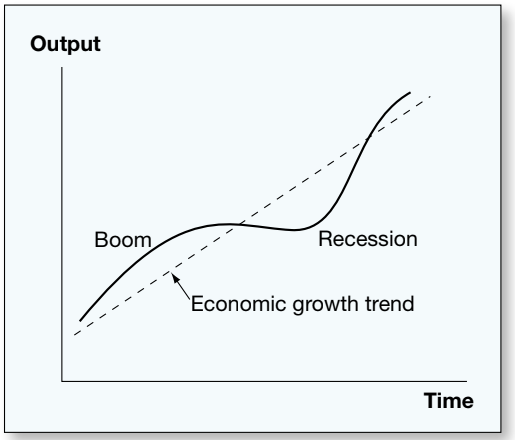
The diagram above shows how actual economic output (solid line) moves above and below the long-term growth trend (dashed line). During booms, the economy grows faster than the trend, whilst during recessions, growth falls below the trend or turns negative.
Economic problems caused by the business cycle
Without government intervention, free-market economies experience severe fluctuations in economic activity, making it difficult to achieve sustainable economic growth. Each phase of the business cycle creates distinct problems.
Important
The business cycle creates a paradox: both periods of strong growth (booms) and periods of decline (recessions) generate significant economic problems that harm overall welfare and stability.
Problems during boom periods
When the economy experiences a boom, excess demand for goods and services drives up prices, causing inflation. High inflation creates several harmful effects:
- Distorts business decision-making as firms struggle to plan with uncertain future prices
- Reduces consumers' purchasing power as wages fail to keep pace with rising prices
- Forces interest rates to increase to control inflation
- Can trigger a recession by slowing economic activity too quickly
Note
The Inflation Chain Reaction
Inflation doesn't occur in isolation. When prices rise, it sets off a chain of economic responses: businesses face uncertainty, consumers lose purchasing power, central banks raise interest rates, and the economy may slow down too rapidly—potentially causing the very recession that policymakers try to avoid.
Problems during recession periods
A recession is a severe downturn in the level of economic activity. Recessions create serious economic and social problems:
- Rising unemployment as firms reduce their workforce
- Business failures as demand falls and revenue declines
- Reduced living standards and increased financial hardship
- Social costs including increased poverty and inequality
Important
The Human Cost of Recessions
While economic statistics measure output and employment, recessions create profound social consequences: families struggle with job loss, poverty rates increase, inequality widens, and communities face long-lasting economic hardship that can persist even after the recession ends.
Government intervention through economic stabilisation
To achieve strong and stable economic growth whilst minimising the harmful effects of inflation and unemployment, governments intervene through economic stabilisation policies. These policies are also known as macroeconomic policies and include:
- Fiscal policy: government decisions about spending and taxation
- Monetary policy: decisions about interest rates and money supply
The primary aim of these policies is to help the economy maintain a sustainable rate of economic growth by smoothing out the extremes of the business cycle.
Note
Economic stabilisation doesn't mean eliminating all fluctuations in the economy. Instead, it aims to moderate the extremes—preventing booms from becoming too intense (and inflationary) and stopping recessions from becoming too severe (and causing mass unemployment).
How macroeconomic policy counterbalances the cycle
Macroeconomic policy works by applying the opposite force to whatever direction the economy is moving. This is called countercyclical policy.
During excessive growth periods
When the economy grows too fast and inflation becomes a risk, the government aims to reduce economic activity through:
- Decreased government spending
- Increased taxation
- Higher interest rates
By slowing down a fast growth rate, the government helps the economy sustain growth for a longer period without overheating.
Example
Worked Example: Countercyclical Policy During a Boom
Scenario: The economy is growing at 6% annually, well above the sustainable rate of 3%. Inflation is rising to 5%, and there are signs of overheating.
Government Response:
- Fiscal Policy: Reduce government spending on new projects by $10 billion and increase income tax rates by 2%
- Monetary Policy: Raise interest rates from 2% to 3.5%
Expected Outcome: Economic growth slows to a more sustainable 3-4%, inflation moderates to 2-3%, and the economy avoids the boom-bust cycle that would have resulted from continued overheating.
During recession periods
When the economy enters recession, the government tries to stimulate growth through:
- Increased government spending
- Tax cuts
- Lower interest rates
These measures boost demand and help the economy recover from the downturn.
Example
Worked Example: Countercyclical Policy During a Recession
Scenario: The economy has contracted by 2% in the past year. Unemployment has risen from 5% to 9%, and businesses are cutting back on investment.
Government Response:
- Fiscal Policy: Increase government infrastructure spending by $15 billion and reduce income tax rates by 3%
- Monetary Policy: Lower interest rates from 4% to 0.5%
Expected Outcome: Increased government spending and lower taxes boost consumer and business demand. Lower interest rates encourage borrowing and investment. The economy begins to recover, and unemployment gradually falls.
Through this countercyclical approach, the government attempts to smooth fluctuations in the business cycle and promote long-term sustainable growth. Macroeconomic policy measures therefore impact the economy as a whole.
Microeconomic reform policies
Whilst macroeconomic policies target the entire economy, governments also use microeconomic reform policies. These are designed to:
- Improve work practices in individual firms and industries
- Increase productivity levels
- Enable structural adjustment of specific sectors
Note
The Key Distinction: Macro vs. Micro
- Macroeconomic policies influence the entire economy through aggregate demand management
- Microeconomic policies target specific firms, industries, or sectors to improve efficiency and productivity
Think of macroeconomic policy as adjusting the overall economic thermostat, while microeconomic policy fine-tunes individual components of the economic system.
The key distinction is that microeconomic policies target individual firms and industries, whilst macroeconomic policies influence the entire economy.
Summary
Key Points to Remember:
- The business cycle causes economic growth to fluctuate between boom and recession, creating instability in market economies
- Booms lead to inflation, which distorts decision-making and can trigger recessions; recessions cause unemployment and business failures
- Governments use macroeconomic policies (fiscal and monetary policy) to counterbalance the business cycle through countercyclical intervention
- During booms, governments reduce spending, raise taxes and increase interest rates to slow growth; during recessions, they do the opposite
- The goal of economic stabilisation policy is to achieve sustainable long-term growth by smoothing out extreme fluctuations in the business cycle