Stabilisation and Sustainable Growth (HSC SSCE Economics): Revision Notes
📚Revision Notes
Stabilisation and Sustainable Growth
The challenge of economic fluctuations
A significant problem facing market economies is the inherent instability in economic growth rates. Rather than growing steadily, economies typically experience cycles of expansion and contraction—often described as boom and bust periods. During boom phases, economic activity surges, whilst bust periods bring declining output and rising unemployment.
Government intervention plays a crucial role in addressing this volatility. Through stabilisation policies, governments can moderate these economic swings, creating more predictable growth patterns. Over the long term, effective stabilisation leads to higher average growth rates and improved living standards for the population.
Note
The business cycle refers to these recurring patterns of economic expansion and contraction. Understanding these cycles is fundamental to comprehending why governments intervene in the economy and how stabilisation policies work.
The difference between an unmanaged economy and one with active stabilisation is illustrated below:
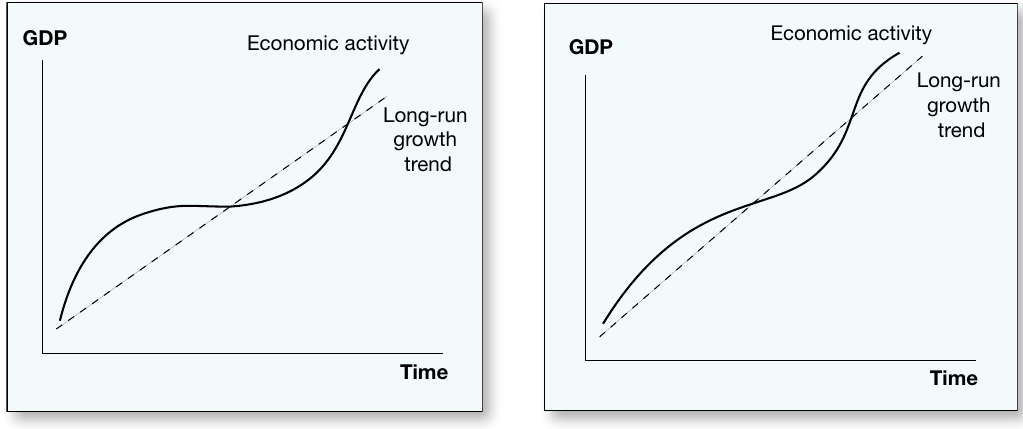
The diagrams show how stabilisation policies reduce the severity of economic fluctuations. Without intervention (left), the economy experiences sharp swings above and below the long-run growth trend. With stabilisation policies (right), these fluctuations are dampened, keeping economic activity closer to the sustainable growth path.
Important
The key insight from these diagrams is that stabilisation policies don't eliminate economic cycles entirely—they reduce the amplitude of the fluctuations. This means fewer extreme booms and busts, leading to more stable economic conditions and better long-term outcomes.
Macroeconomic policies
To smooth out business cycle fluctuations, governments employ macroeconomic policies—interventions specifically designed to manage aggregate economic activity.
There are two principal types of macroeconomic policy in Australia:
Monetary policy operates as the primary stabilisation tool. It works by influencing interest rates, which in turn affect spending and investment decisions throughout the economy. Higher interest rates typically restrain excessive growth, whilst lower rates stimulate economic activity when growth is sluggish.
Fiscal policy also plays an important role through the government's spending, taxation, and borrowing decisions. The combined effect of these fiscal variables directly impacts overall economic activity. Fiscal policy is particularly significant during economic downturns and is examined in greater detail in subsequent chapters.
Note
Think of monetary policy as the fine-tuning mechanism (quick to adjust, works through interest rates) and fiscal policy as the broader structural tool (involves government budgets and spending programs). Both work together to achieve economic stability.
Monetary policy
What is monetary policy?
Monetary policy encompasses actions taken by the Reserve Bank of Australia (RBA), acting on behalf of the government, to control interest rates and the money supply. By adjusting these variables, the RBA influences critical economic outcomes including:
- Overall level of economic activity (GDP growth)
- Inflation rates
- Unemployment levels
How monetary policy works
The RBA's primary tool is domestic market operations (DMOs). This involves buying and selling government securities in financial markets to influence the cash rate—the interest rate in the overnight money market. Changes to the cash rate flow through to other interest rates across the economy, affecting borrowing costs for households and businesses.
Note
Understanding DMOs:
When the RBA buys government securities, it injects money into the financial system, putting downward pressure on interest rates. When it sells securities, it withdraws money from the system, pushing interest rates higher. This is how the RBA controls the cash rate and influences broader interest rates across the economy.
Tight monetary policy
When the economy is growing too rapidly and inflationary pressures are building, the RBA may implement contractionary (tight) monetary policy by raising interest rates.
Mechanism:
- Higher interest rates increase the cost of borrowing
- This reduces demand for credit and loans
- Consumer spending falls (particularly on big-ticket items like houses and cars)
- Business investment declines as projects become less profitable
Economic effects:
- Lower aggregate demand reduces pressure on prices, helping to control inflation
- Economic activity slows
- However, cyclical unemployment typically rises as businesses cut back production and employment
Example
Worked Example: Tight Monetary Policy in Action
Scenario: The economy is experiencing rapid growth with inflation at 4.5% (above the RBA's 2-3% target band). The unemployment rate is 3.5% (very low).
Step 1: The RBA raises the cash rate from 3.0% to 3.5%
Step 2: Commercial banks increase their lending rates
- Mortgage rates rise from 5.5% to 6.0%
- Business loan rates increase accordingly
Step 3: Economic effects unfold
- Households with mortgages face higher repayments, reducing disposable income
- Fewer people can afford to buy homes, reducing housing demand
- Businesses postpone expansion plans due to higher borrowing costs
- Consumer spending on credit-financed goods (cars, appliances) falls
Step 4: Outcomes (after 6-18 months)
- Inflation gradually falls back toward the 2-3% target
- GDP growth slows from 4% to 2.5%
- Unemployment rises slightly to 4.2% as some businesses reduce staffing
Loose monetary policy
When economic growth is weak and unemployment is rising, the RBA may adopt expansionary (loose) monetary policy by reducing interest rates.
Mechanism:
- Lower interest rates decrease the cost of borrowing
- This stimulates demand for credit
- Consumer spending increases, particularly on items purchased with credit
- Business investment rises as more projects become financially viable
Economic effects:
- Higher aggregate demand stimulates economic activity
- Cyclical unemployment falls as businesses expand and hire more workers
- However, there is a risk that inflation may increase if the economy overheats
Example
Worked Example: Loose Monetary Policy in Action
Scenario: The economy is experiencing weak growth at 1.5%, with unemployment at 6.2% (high) and inflation at 1.8% (below target).
Step 1: The RBA cuts the cash rate from 2.5% to 2.0%
Step 2: Commercial banks reduce their lending rates
- Mortgage rates fall from 4.5% to 4.0%
- Business loan rates decrease accordingly
Step 3: Economic effects unfold
- Existing mortgage holders have lower repayments, increasing disposable income
- More people can afford to enter the housing market
- Businesses find it cheaper to borrow for expansion and investment
- Consumer spending on credit-financed goods increases
Step 4: Outcomes (after 6-18 months)
- GDP growth accelerates from 1.5% to 2.8%
- Unemployment falls to 5.5% as businesses hire more workers
- Inflation gradually rises toward 2.0% (closer to target)
Time lags in monetary policy
Monetary policy does not produce instant results. The full impact of an interest rate change typically takes between six and eighteen months to work through the economy. This time lag occurs because:
- Households and businesses take time to adjust their spending and investment plans
- Existing loan contracts continue at previous interest rates until they are refinanced
- Psychological effects and changed expectations take time to influence behaviour
Important
Why Time Lags Matter:
The 6-18 month delay means the RBA must be forward-looking in its decision-making. Interest rate changes made today will have their full effect well into the future. This requires the RBA to:
- Forecast economic conditions 12-18 months ahead
- Act on expected future conditions, not just current data
- Avoid overreacting to short-term economic fluctuations
This forward-looking approach is why the RBA carefully monitors leading indicators and economic forecasts when setting monetary policy.
Fiscal policy
Fiscal policy—the government's decisions about spending, taxation, and borrowing—provides another important tool for managing economic activity. It is particularly effective during significant economic downturns when monetary policy alone may be insufficient.
The role and mechanisms of fiscal policy in influencing the economy are examined comprehensively in later chapters of this course.
Exam guidance
Note
Exam Success Tips:
When answering questions about stabilisation policy:
Explain questions require you to show the causal chain:
- Interest rate change → borrowing costs change → spending/investment changes → aggregate demand changes → economic effects (growth, unemployment, inflation)
Analyse questions need you to:
- Break down the impacts on different economic variables
- Consider both intended and unintended consequences
- Discuss the relationships between variables
Evaluate questions demand assessment of:
- Effectiveness of the policy
- Consideration of time lags and their implications
- Potential limitations or side effects
- Whether the policy is appropriate for current economic conditions
Common exam scenarios involve being given economic data (growth rate, inflation rate, unemployment rate, current cash rate) and recommending appropriate monetary policy action with justification.
Remember!
Summary
Key Points to Remember:
- Market economies naturally experience boom-bust cycles that create economic instability
- Stabilisation policies aim to smooth these fluctuations, achieving higher average growth and better living standards
- Macroeconomic policies include both monetary policy (primary tool) and fiscal policy
- Monetary policy is conducted by the RBA through domestic market operations affecting interest rates
- Tight monetary policy (higher rates) slows the economy, reducing inflation but increasing unemployment
- Loose monetary policy (lower rates) stimulates the economy, reducing unemployment but risking higher inflation
- Monetary policy effects take 6-18 months to fully impact the economy, requiring forward-looking decision-making
- The RBA must balance competing objectives: controlling inflation while maintaining employment and economic growth